

The Japan sequel to the China act
Starbucks is reportedly weighing a stake sale in its Japanese business, with the unit valued at ¥400–500 billion ($2.6–3.2 billion), according to people familiar with the matter. That follows barely six months after the company sold a controlling stake in its China business to Boyu Capital for $4 billion, shifting China operations to a licensing model.
The press narrative is that China was a retreat from a market where Starbucks couldn't compete. But China was never about competitiveness - it was about balance sheet engineering. And Japan is the logical next chapter in the same play.
China was financial engineering, not a strategic retreat
Here's what actually happened in China. Starbucks brought in Boyu Capital, handed over 60% of operations, and converted China from a company-operated business into a licensed one. Boyu takes on all the capital expenditure, labor costs, and real estate risk of growing from 8,000 stores to 20,000. Starbucks collects royalties and product margin fees.
The financial mechanics are elegant if your job is to manage quarterly headlines. China company-operated revenue is projected to decline 55% year-over-year. But the cost structure collapses with it. Starbucks shifts from absorbing every yuan of operating expense to collecting 40% product margin plus royalty fees on top. The company adds $3.1 billion in cash to its balance sheet.
It is not as good as it looks. The margin improvement is real - but only because the revenue line is shrinking by more than half. You're not getting a more profitable China. You're getting a much smaller one that's easier to make look efficient on a per-dollar basis.
Starbucks' fiscal first quarter 2026 - the first full quarter of this transition - already shows the pattern. GAAP earnings per share fell 62%. The company is booking the windfall, restructuring the income statement, and asking investors to focus on the margin percentage rather than the revenue cliff.
Why Japan is next
Japan is different from China, and that is precisely why it's the natural target for the same playbook. In 2014, Starbucks paid $509 million to buy out its Japanese joint venture partner Sazaby League and take full ownership. Today, Japan has approximately 1,600+ stores and is the #1 coffee chain in the country, having overtaken the long-reigning local leader Doutor.
But Japan is a mature, low-growth market. The Japanese coffee market is saturated, competitive with domestic chains like Doutor and Tully's, and the demographic headwinds are structural. Starbucks Japan is profitable - it delivered $308.5 million in operating income on $6.9 billion in revenue for fiscal 2025, an operating margin of roughly 45%. But the upside ceiling is low.
For Starbucks corporate, Japan represents $500+ million invested capital in a market that will grow slowly, if at all. A stake sale converts that ill-held ownership into a cash event and a licensing stream. The buyer absorbs the cost of opening new stores, renovating existing ones, and fighting the local price war. Starbucks takes a royalty check instead.
The cross-currents are clear: Japan's margins are high but growth is anemic; selling preserves the royalty stream but surrenders the operational upside that full ownership provides.
The pattern: TCO of ownership is too high
Any astute investor would have noticed this pattern forming. Starbucks' operating margin contracted from 11.6% to 9.9% in the fiscal second quarter 2026. RBC Capital Markets downgraded the stock to "sector perform" citing structural cost pressures. The company's answer to margin erosion isn't to fix the underlying economics of running 37,000+ stores globally. It's to stop running the stores and start collecting fees.
This is the total cost of ownership problem that every consumer franchise eventually faces. The per-store economics of company-operated locations - labor, real estate, training, supply chain, compliance - are getting more expensive. Licensing offloads that TCO to a partner who wants it badly enough to pay for it.
But there's a hidden cost to this strategy. Every market you license out is a market where you lose operational control. You stop learning from frontline execution. You stop adapting products to local taste in real time. You become a brand management company rather than a retail operator. Over time, the brand equity that justifies the royalty fee itself erodes because the customer experience becomes someone else's problem.
What the stock is telling us
Starbucks shares are up roughly 16% in 2026 and trading around $137, well above analyst consensus targets averaging $97. The market is rewarding the "margin improvement" thesis without asking whether margin improvement through revenue reduction is a sustainable strategy or a one-time accounting event.
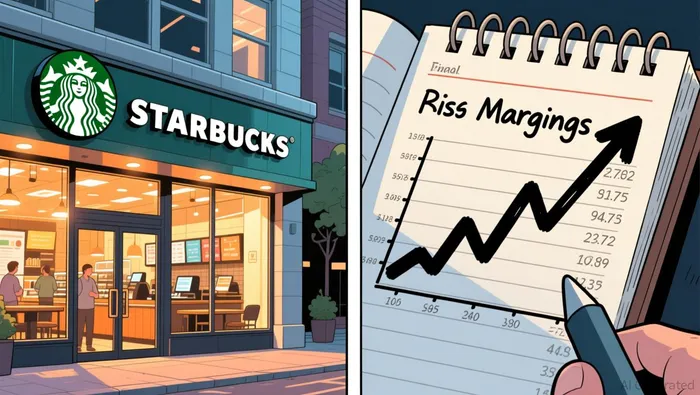
The $3.1 billion from China will buy back shares and fund dividends, supporting the near-term stock. A Japan stake sale would add another $2.6–3.2 billion to the war chest. Combined, these divestments generate over $6 billion in capital recycling. But the revenue being shed is permanent.
The question isn't whether the Japan deal will be announced. The question is whether you can still call this a coffee company when half its international business is a royalty collection business.
The investor implication
The thesis change is subtle but material. Starbucks is transitioning from a company that earns money by operating stores to a company that earns money by licensing its brand to operators who take the risk. That changes the growth profile, the risk profile, and ultimately the valuation multiple the market should apply.
If Japan follows the China path, investors should expect: lower top-line growth, higher reported margins, more cash on the balance sheet, and less visibility into the operational health of two of Starbucks' three largest international markets. The stock's 16% YTD rally is pricing in the margin story. It is not pricing in the revenue story, which is the one that actually determines long-term cash flow.
The cross-currents are margin expansion through licensing, revenue contraction through divestment, and capital recycling through buybacks. Directionally, the move is defensive management treating a structural operating problem with a financial one. It works for a quarter. Whether it works for a decade is a different question entirely.
You decide which was marketing fluff and which one was analysis.