

The "Tank Day" tumbler promotion is the headline. The incumbent collapse is the story.
On May 18, 2026 - the anniversary of the Gwangju Uprising, when military tanks brutally suppressed pro-democracy demonstrators in South Korea - Starbucks Korea launched a tumbler promotion called "Tank Day." The marketing copy included the phrase "Slam on the desk".
The company pulled the promotion within hours. CEO Sohn Jeong-hyun was fired the same day. By May 26, Shinsegae Group chairman Chung Yong-jin was holding a press conference, bowing to cameras, personally apologizing for a campaign that should never have survived one internal review. The Interior Ministry canceled Starbucks vouchers for government employees. Civil servant unions organized boycotts. President Lee Jae Myung publicly condemned the company.
This is the kind of blunder that only happens when a business stops paying attention to the market it's supposed to own.
The PR failure is the symptom, not the diagnosis
The obvious read of this story is: a marketing team made a cultural misstep, a CEO got the axe, the chairman apologized, and eventually the storm passes. That's the version every press release will work toward.
It is not as good as it looks - for Starbucks, or for anyone assuming this is a one-off error.
Starbucks Korea operates 1,893 stores. It planned to open at least 100 more in 2026. It is the dominant foreign coffee brand in a country where coffee culture expanded explosively over the past decade. By all measures, it should be deeply embedded in local consumer sentiment. Instead, a tumbler ad with two careless phrases triggered a national boycott that reached the presidential level. That is not an execution error. That is brand blindness - the kind that happens when management believes its own moat is wider than it actually is.
The competitive math the boycott is exposing
Here's what nobody is connecting: the boycott didn't create Starbucks Korea's vulnerability. It revealed one that was already there.
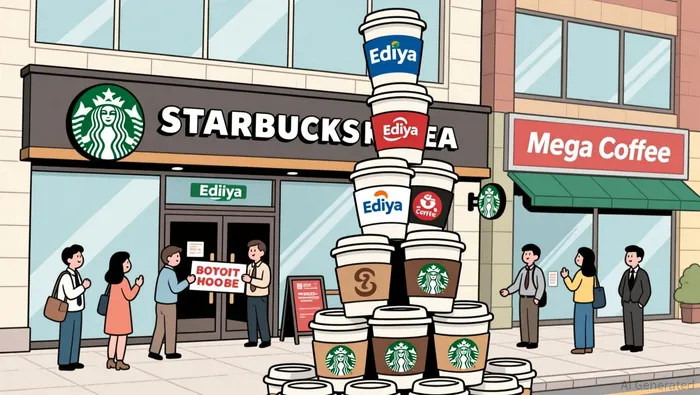
Domestic competitor Ediya Coffee operates approximately 3,800 stores. Mega Coffee has expanded to over 3,000. And the per-cup economics are brutal: Starbucks charges roughly ₩4,500 per cup while Mega Coffee charges ₩1,500. That's a three-to-one price gap in a category where the product differentiation is already thin.
Starbucks Korea has been running on brand equity built during a period when domestic competitors were still scaling up. Once Ediya and Mega Coffee hit critical mass in store count, the game changed. Starbucks was already losing share on price before "Tank Day" happened. The boycott didn't create the competitive gap. It just accelerated the migration to alternatives.
When a new entrant gains share, the first question is always: did the challenger out-execute, or did the incumbent collapse on its own? In this case, the incumbent did both things wrong - it failed to defend its price premium and gave its cheapest competitors a cultural reason for customers to switch.
The prepaid card time bomb
Then comes the financial layer, and this is where the crisis stops being about optics.
Starbucks Korea held ₩427.6 billion in customer prepaid card balances at the end of 2025 - roughly $276 million. Over six years, the company earned ₩40.8 billion in interest and investment returns on money it didn't own. This is a classic float model: customers load money in advance, Starbucks earns interest on the balance, and the company effectively gets an interest-free line of credit from its own customers.
Now those same customers are demanding their money back.
The refund rules are structured to discourage exits: customers must spend at least 60% of their remaining balance before they can request a refund. The Korea Consumer Federation has publicly challenged these rules, and the company faces a court review of its refund policy. If the court rules the 60% threshold invalid, Starbucks Korea could face a wave of full-balance refund claims on hundreds of billions of won.
The float model that was quietly subsidizing Starbucks Korea's economics is now the mechanism that could amplify the financial damage. The boycott didn't just reduce foot traffic. It threatened to reverse the cash flow structure that made the business model work.
What the apology cycle tells you
Chung Yong-jin's May 26 press conference was the latest in a sequence of damage-control moves: the CEO firing, the pulled promotion, the postponed marketing events, the chairman's personal apology. Each one is designed to signal accountability. Each one also signals how deep the failure went - no single person's resignation was enough to stop the fallout, which means the problem was institutional, not individual.
Starbucks Korea postponed additional marketing events it had planned. The Interior Ministry, which had been issuing Starbucks vouchers as employee benefits, announced a complete halt. Government agencies and companies followed suit, dropping Starbucks coupons from their benefit programs.
That last detail matters more than the headlines suggest. Corporate and government benefit programs are not discretionary small-change - they are recurring, volume-driven revenue channels. When the Interior Ministry and civil servant unions pull out, Starbucks Korea is losing guaranteed foot traffic from a segment it couldn't easily replace.
The cross-currents
The question for anyone watching SBUX isn't whether Starbucks Korea will recover. It will. The brand is too large globally for one regional PR disaster to be terminal. The question is what this event reveals about the trajectory.
The cross-currents are:
- Brand erosion - The "Tank Day" blunder is evidence of a local management team that lost its read on the market it serves. That doesn't fix itself with a new CEO and an apology. It fixes itself with sustained competence, and there's no evidence yet that the incoming leadership has restored that capability.
- Competitive migration - Ediya and Mega Coffee are sitting at roughly double and triple the price advantage with store counts that are approaching or exceeding Starbucks Korea's. The boycott gives customers permission to switch to alternatives they were already evaluating on price. Some of that migration will be permanent.
- Prepaid liability - ₩427.6 billion in customer balances, a ₩40.8 billion interest windfall over six years, a refund policy under legal challenge. If the refund rules are struck down, the financial hit could be material for the Korea operation. Even if not, the prepaid model's value as a customer lock-in mechanism is now poisoned.
- Global insulation - Starbucks Korea is a franchise operated through Shinsegae. The global parent benefits from royalties and format licensing but is partially insulated from the direct financial damage. SBUX stock has fallen roughly 18% year-to-date, driven by broader challenges including U.S. store traffic weakness and activist pressure from Elliott Management and Starboard Value. The Korea fallout is a margin note, not a margin call, for the global business.
Directionally, the Korea story is a warning sign about incumbent decay disguised as a PR scandal. When you combine cultural blindness, price vulnerability to local competitors, and a prepaid model that's now under legal and consumer attack, you have an operation that's losing on multiple fronts simultaneously. The boycott was the catalyst, but the conditions were already present.
You decide which was marketing fluff and which one was analysis.