

Stellantis signed a $1.17 billion deal with Chinese state-owned Dongfeng Motor today to produce Peugeot and Jeep vehicles at a Wuhan plant starting in 2027. The market will hear this as a China turnaround. I hear it as a company that has nowhere else to go.
My rating on Stellantis (NYSE: STLA) is Hold. The Dongfeng deal is not a reason to buy. It is a reason to watch. The valuation, however, is cheap enough that if management can deliver even modestly on this partnership thesis, the stock has asymmetric upside from here.
The deal mechanics
Stellantis is investing €130 million of its own capital into the arrangement. Dongfeng will manufacture two new Peugeot-branded energy vehicles and two Jeep-branded off-road energy vehicles at its Wuhan facility. The Peugeot models target the Chinese domestic market. The Jeep models are intended for global markets.
That split matters. Stellantis is not just trying to regain Chinese sales. It is trying to use Dongfeng's low-cost Chinese manufacturing to produce vehicles that sell in Europe and elsewhere - where Stellantis still makes its money. CEO Antonio Filosa confirmed this broader thinking on May 12, saying partnerships would be central to the company's future strategy. Separate reports indicate the companies are also in talks about giving Dongfeng access to underused Stellantis factories in Europe.
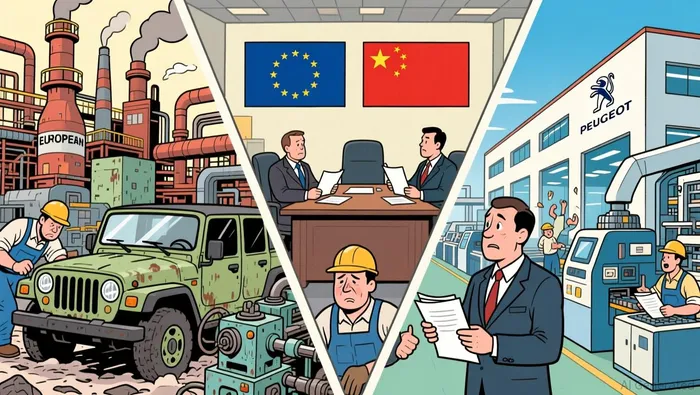
This is a pivot away from the old model. Stellantis tried to compete directly in China for years. It failed. The company's China sales have been declining, market share has collapsed, and the local brands have won the EV transition. The Dongfeng deal is an admission that the only viable path now is through a partner that already controls Chinese manufacturing and distribution.
The operating backdrop
The timing of the deal has to be read against what the business actually looks like right now. Stellantis returned to profitability in Q1 2026, posting €377 million in profit on €38.1 billion in revenue - a 2.5% adjusted operating income margin. That is better than the €22.3 billion net loss from full-year 2025, which was driven by €25.4 billion in one-time restructuring charges.
But adjusted margins of 2.5% are thin for an automotive operator of Stellantis's scale. FY2025 net revenues fell 2% to €153.5 billion, hurt by weaker net prices and exchange rates. Industrial free cash flow - the cash the core business generates after capital expenditures, before financing decisions - was still negative €1.9 billion in Q1. That is an improvement of €1.1 billion year-over-year, but the business is not yet printing positive cash from operations.
Management has reaffirmed 2026 guidance calling for progressive improvement in revenues, margins, and industrial free cash flow. That is the right direction. It is not yet proof.
Why the valuation is the bridge
This is where the stock quality separates from the business quality. STLA closed last week at approximately $7.84. The market capitalization sits around $22.5 billion. The price-to-book ratio is 0.33x, meaning the market values Stellantis at roughly one-third of its net asset value. That is deep-value territory for any manufacturer, let alone one with global brand portfolios, European and North American factory footprints, and a North American truck business that remains one of the most profitable in the industry.
The 59% dividend cut in 2025 - from $1.65 per share to €0.68 - shows the balance sheet pain management demanded. But at a $22.5 billion market cap, Stellantis trades below what its European and North American manufacturing alone should be worth, even before crediting anything for the China partnership. If the Dongfeng deal works and the Jeep off-road EVs gain traction in global markets, that is upside on top of a base that is already valued as if the company were in distress.
The risks that could break the thesis
Three things could go wrong.
First, execution risk is enormous. This is a partnership with a Chinese state-owned enterprise. These deals move slowly, governance can be opaque, and brand dilution is a real threat. If Jeep-branded EVs built in Wuhan fail to meet quality expectations, they damage the brand Stellantis depends on in North America. If the Peugeot models can't find buyers in China against BYD, NIO, and the domestic EV pack, the €130 million investment vanishes.
Second, the timeline is too long for near-term relief. Production doesn't start until 2027. That is 18 months away. Stellantis's Q2 earnings report should arrive in August, and by then the Dongfeng deal will be a line-item commitment, not a revenue contributor. The stock could sit at current levels - or slide further - through mid-2027 while the market waits for actual units to ship.
Third, the European side of the partnership is unresolved. The reports about Dongfeng using underused European Stellantis factories are still in talks. If those talks collapse or reveal that Stellantis has more idle capacity than the market realizes, it confirms the margin pressure problem is worse than management admits.
The catalyst clock
The next three inflection points are: (1) Stellantis's Q2 2026 earnings, expected in August, which will show whether the Q1 profit recovery is sustainable or a one-time bounce; (2) any official announcement on the European factory partnership, which could come in the second half of 2026; and (3) the first vehicle design reveals from the Dongfeng joint venture, which should arrive sometime in 2026 as 2027 production approaches.
Investor takeaway
I'm maintaining a Hold on STLA. The Dongfeng deal is a credible strategic move - it is better than throwing more capital at a failing direct China operation - but it is too early, too partnership-dependent, and too far from revenue impact to trigger a rating upgrade. The stock is not a Buy today.
The counterpoint, and the reason I'm not assigning a negative rating either, is the valuation. At 0.33x book value with a $22.5 billion market cap, the stock has already priced in a worst-case scenario where Stellantis fragments, the China deal fails, and Europe stays weak. If management delivers even a moderate recovery path - positive industrial FCF by year-end 2026, sustained low-to-mid-single-digit margins, and Dongfeng