

Durability, not just approval, is the key IMAAVY proof point
The most important message from the latest IMAAVY data is duration of benefit. J&J now reports beyond two years of open-label extension follow-up, and the approval package already highlighted 20 months of lasting disease control in the pivotal setting. For investors, that matters more than the approval stamp itself. Approval grants access; durability determines whether the therapy can become a meaningful maintenance option.
Why that matters for adoption
IMAAVY also showed 4.7-point mean reduction in MG-ADL versus 3.3 for placebo (P=0.002) in the approved labeling. That supports the case for clinical benefit, while the longer-term data suggest the therapy may sustain control well enough to influence prescribing over time.
The remaining debate is realistic. Long-term signals from an open-label extension are useful, but they are less rigorous than randomized comparative data, and real-world uptake can still be slowed by pricing, reimbursement, or dosing logistics. The next step is to see whether trial durability translates into sustained market use.
IMAAVY's mechanism supports a broader autoimmune platform story
The question is no longer only whether IMAAVY works in gMG. It is whether J&J is building a reusable approach for IgG-mediated autoimmune disease.
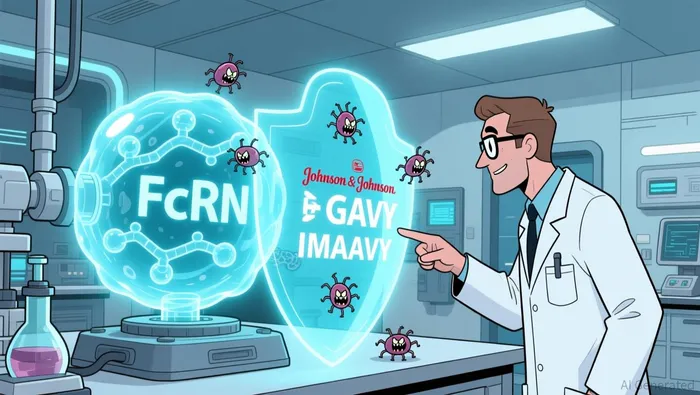
FcRn blockade is the common thread
In gMG, the disease driver is pathogenic IgG autoantibody activity, and IMAAVY is designed to reduce serum levels of total IgG and pathogenic IgG autoantibodies by blocking the FcRn recycling pathway. That mechanism offers a more targeted approach than broad immunosuppression and helps explain why the same therapy could, in principle, have relevance beyond a single indication.
J&J has also reported 72 weeks of sustained reduction in immunoglobulin G and sustained disease control in pediatric patients, with no new safety concerns. That does not prove a broad platform success on its own, but it does support the idea that the mechanism has staying power.
wAIHA is the clearest near-term catalyst
The most immediate test of the platform story is the Priority Review for wAIHA. In warm autoimmune hemolytic anemia, pathogenic IgG autoantibodies drive red-cell destruction, and J&J says IMAAVY targets that underlying cause while preserving important immune functions. If the sBLA is approved, J&J would have evidence that IMAAVY can move beyond a single neuro indication and speak to a wider class of IgG-mediated diseases.
Best-in-class is still unproven
Bulls can point to the upcoming EPIC study, which will directly compare IMAAVY with efgartigimod in adult gMG and includes a treatment-switch arm. J&J has also shared an indirect comparison suggesting consistent and sustained disease control versus other approved FcRn blockers at multiple timepoints.
But bears are right on the key point: none of that proves best-in-class yet. Indirect comparisons are not head-to-head proof, and EPIC still has to be done. The investable setup is straightforward: wAIHA approval plus supportive EPIC data would strengthen the platform narrative; without them, IMAAVY remains a promising single-drug launch rather than a proven broader franchise.
What the market likely needs next
The science is not the main bottleneck anymore. J&J has durability data and an approved indication in gMG. What the stock likely needs now is evidence that IMAAVY can change prescribing behavior quickly enough to matter commercially.
The main watchpoints
- wAIHA approval timing and commercial relevance: The approximately six-month Priority Review is the near-term catalyst. The bigger question is whether the label and early data are strong enough to shift patients away from older immunosuppressive approaches.
- gMG durability into real-world use: J&J has already shown beyond two years of open-label extension follow-up and says IMAAVY is the only FcRn blocker with sustained disease control in anti-AChR and anti-MuSK antibody positive adults and pediatric patients aged 12 and older. That is encouraging, but investors still need evidence that trial durability becomes long-term prescribing habit.
- A meaningful comparator win: EPIC is the first head-to-head study comparing FcRn blockers and includes a treatment-switch arm. That design could help clarify whether IMAAVY is merely active or actually preferable when physicians are choosing between options.
What would weaken the thesis
The bullish case becomes less compelling if wAIHA approval is delayed or less clinically compelling than Priority Review suggests, if long-term safety or tolerability becomes a barrier in practice, or if EPIC fails to show a clear advantage over efgartigimod. Those would not invalidate IMAAVY, but they would likely slow the broader platform narrative.