

U.S. stocks opened higher Friday morning as investors welcomed signs of progress in U.S.-Iran negotiations while continuing to pile into artificial-intelligence-linked technology names that have fueled much of this year’s rally.
Just after the opening bell, the Dow Jones Industrial Average rose 126.71 points, or 0.25%, to 50,795.7. The S&P 500 gained 16.74 points, or 0.22%, to 7,580.37, while the Nasdaq Composite advanced 64.12 points, or 0.24%, to 26,981.6. Crude oil fell $1.73, or 1.95%, to $87.17 a barrel, while the CBOE Volatility Index, or VIX, edged down 0.13% to 15.72.
The primary catalyst behind the early advance was renewed optimism surrounding diplomatic efforts between Washington and Tehran. According to reporting from Reuters and other outlets, U.S. and Iranian negotiators have reached a tentative framework to extend a ceasefire, though final approval from President Donald Trump remains pending. Investors interpreted the developments as reducing the risk of further disruptions in the Strait of Hormuz, helping push oil prices sharply lower after recent geopolitical-driven gains.
Technology and AI-related shares also remained a major source of market leadership. Investor enthusiasm accelerated after Anthropic unveiled Claude Opus 4.8 an upgraded version of its flagship AI model, alongside reports that the company raised fresh capital at a valuation approaching $965 billion. The announcement reinforced Wall Street’s belief that enterprise AI spending remains in the early stages of a multi-year expansion cycle.
Meanwhile, Dell continued to benefit from the AI infrastructure trade after reporting another major earnings beat tied to surging demand for AI servers.
Dell disclosed billions of dollars in AI-related orders and continued strength in its data-center business, further supporting the semiconductor, networking and infrastructure segments that have powered much of the market’s advance.
Investors also weighed comments from Apollo Global Management Chief Economist Torsten Slok, who argued there remains “zero evidence” of AI-driven job losses.
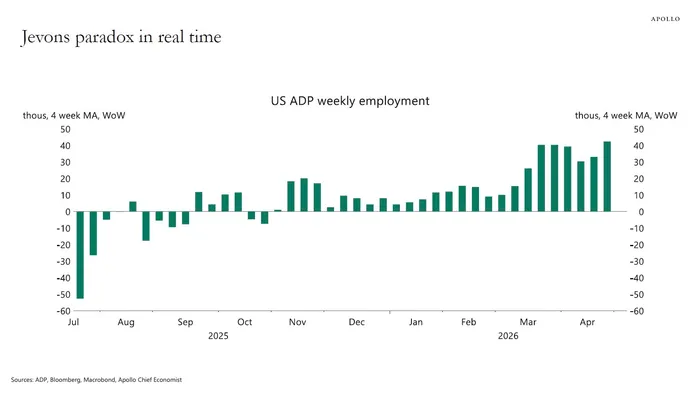
Instead, Slok said companies are hiring AI implementation specialists while data-center construction is boosting demand for semiconductors, equipment, energy and skilled labor. He suggested that AI spending is simultaneously supporting employment and contributing to inflationary pressures, raising the possibility that May nonfarm payrolls could exceed the consensus forecast of 95,000.