

The market is reading this Supreme Court ruling as a small rate tailwind for trucking stocks. It's not. It's a structural rewrite of who gets to play in the freight brokerage game - and the math now favors the companies that own their own trucks and employ their own drivers.
Last week, the Supreme Court unanimously ruled in Montgomery v. Caribe Transport II that freight brokers can be sued under state negligent-hiring tort claims when they select unsafe carriers. The brokers' defense was straightforward: the federal government already vets carriers through the Department of Transportation, so brokers should be shielded from liability. The Court rejected it 9-0. Federal safety oversight does not eliminate a broker's independent duty to vet the carriers they hire.
That is the legal headline. The investing implication is the part the tape hasn't fully processed.
The old story
For years, the freight brokerage model was treated as the elegant play: asset-light, high-margin, scale-driven. Brokers like C.H. Robinson (which was a named defendant in the Caribe case) matched shippers with owner-operators and small fleets, charging a spread, and carrying thin capital risk. Their argument was that cheap capacity - even from carriers with spotty safety records who cycled through DOT numbers to hide past violations - was a feature, not a bug. Lower cost meant more bookings meant more scale.
That model assumed brokers wouldn't be on the hook when the cheap carrier caused a crash. The Supreme Court has now ended that assumption.
The insurance gap is real
Here is the detail that matters. Freight brokers have no federal insurance requirement for this type of liability. The carriers they hire are federally required to carry at least $750,000 in commercial insurance for general freight, but brokers themselves carry no equivalent floor. Now that state courts can hold brokers liable for negligent carrier selection, that insurance gap becomes a genuine P&L question. Brokers will face higher insurance premiums, higher legal costs, and the operational overhead of actually vetting carriers beyond a DOT certification check.
Increased costs may push smaller or undercapitalized brokers out entirely. That's not theoretical - it's the immediate arithmetic of the ruling.
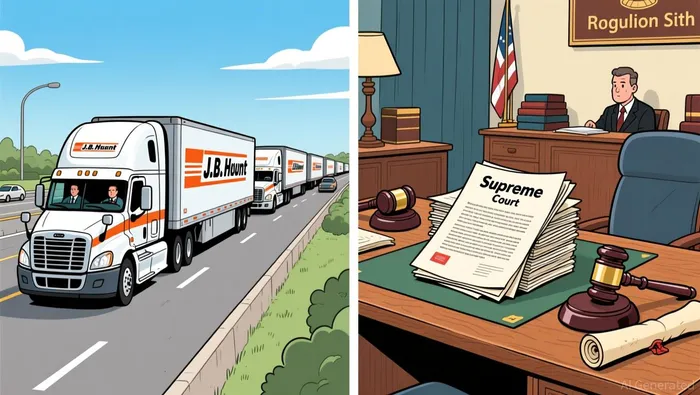
Why this shifts advantage to asset-based carriers
This is where J.B. Hunt, Knight-Swift, and Schneider change from being one of many trucking options to being the safer book.
Bernstein analysts estimated that the market's initial stock move implies roughly 3% higher contract trucking rates. That's the surface read. The deeper read is that brokers will now "book away" from the least compliant, lowest-cost capacity - because every load assigned to an unvetted owner-operator carries litigation risk. That doesn't just push rates up. It pushes volume up for the asset-based carriers whose drivers are employed, properly seated, and compliant by design.
Higher pricing plus stronger volume share. That is the inflection, not just a rate bump.
The numbers already point in the right direction
J.B. Hunt reported Q1 2026 earnings of $1.49 per share - up 27% from $1.17 a year ago - beating estimates on revenue of $3.1 billion, up 5% year over year. The company already operates the largest intermodal network in North America alongside its own truckload fleet. It owns the assets, employs the drivers, and doesn't need third-party brokers to access capacity. The earnings acceleration preceded the ruling.
The other names are less clean. Schneider National reported Q1 operating income down 21% year over year, at just $33.4 million. Its trailing twelve-month free cash flow sits around $54 million - thin for a company with a $5.4 billion market cap. Knight-Swift trades at roughly 33 times forward earnings, which means the market has already priced in quite a bit of optimism. A Supreme Court ruling doesn't fix thin cash flow or rich multiples on its own.
This is the kind of setup where you separate the names that are already earning their rerating from the ones still proving they can execute. J.B. Hunt is in the first group.
What would prove the thesis wrong
The ruling doesn't take effect overnight. Brokers have insurance markets to negotiate, legal frameworks to adapt, and existing carrier relationships to renegotiate. If brokers find a way to pass all compliance costs onto shippers without actually reducing their use of non-compliant owner-operators, the structural shift narrows to a pure rate story. If freight volumes stay soft and shippers don't reward safer capacity with more bookings, the volume thesis breaks alongside the pricing one.
The tripwire is simple: if asset-based carriers don't show accelerating revenue and margin over the next two quarters - the Q2 and Q3 2026 earnings reports - then the ruling was just a headline, not an inflection.
So what should you do
If you own J.B. Hunt, the ruling adds structural cover to a thesis that was already improving on its own terms. Hold through the noise. The 27% earnings jump in Q1 was the real signal; the Supreme Court just made the competitive moat harder to ignore.
If you're watching Schneider or Knight-Swift, wait for the proof. The ruling helps the category, but it doesn't fix weak cash generation or stretched valuation. Let the numbers catch up before adding exposure.
This isn't about excitement. It's about a shift in risk allocation that changes which business model wins when brokers can no longer treat liability as someone else's problem. The market is still pricing a 3% rate story. The setup is a lot bigger than that.
I can be wrong again. But if brokers start booking away from the cheapest carriers and toward the compliant ones, the asset-based names earn the rerating - and the earnings reports from this fall will tell us which way the capacity actually flows.