

The $25 trillion question isn't whether Tesla can make money today-it's whether Optimus represents the next infrastructure layer for the global economy. That's the thesis worth analyzing, because on the S-curve of technological adoption, Tesla is positioning itself at the inflection point before exponential growth begins.
Elon Musk has repeatedly framed Optimus as Tesla's most significant long-term value driver, with the potential to propel the company's market cap to $25 trillion. That's not a product play-that's an infrastructure play. The framing matters: Tesla isn't building a robot; it's building the physical workforce of the future.
At the World Economic Forum earlier this month, Musk doubled down on this vision, predicting robots will eventually outnumber humans and that AI will surpass human intelligence by year's end. More importantly for investors, he outlined a concrete timeline: Optimus will perform simple tasks in factories by the end of this year and more complex industrial work within 12 months. The company also plans to begin selling androids to the general public by the end of 2027.
That price point-$20,000 to $30,000-is the key to the S-curve thesis. At that cost, Optimus moves from industrial niche to mass-market infrastructure. But here's where the investment logic gets interesting: the market isn't buying the 2026 timeline. Prediction market Kalshi assigns only a 21% chance of being available for sale in 2026.
This is the inflection phase vs. exponential adoption phase distinction that matters. The inflection phase is where the technology proves itself in controlled environments-Tesla's current factory deployments. The exponential phase is where adoption accelerates as price points drop and use cases expand. Tesla is firmly in the inflection phase today. The 21% probability reflects market skepticism about crossing into exponential adoption within the next two years.
The competitive landscape reinforces the timeline uncertainty. Hyundai-owned Boston Dynamics has already begun pilot deployments of its electric Atlas bot, and Hyundai has confirmed its entire 2026 production run is fully committed. A Tesla delay would give Hyundai a massive window to capture the enterprise market first.
Yet the $25 trillion thesis doesn't require Tesla to win tomorrow. It requires Tesla to survive the inflection phase and be positioned when the S-curve turns upward. The question for investors isn't whether Optimus will work-it's whether Tesla can navigate the gap between today's factory prototypes and tomorrow's mass-market infrastructure without burning through its capital runway. That's the real risk, and that's the real opportunity.
The Infrastructure Constraint: Why Energy Is the Real Bottleneck
The real bottleneck isn't chips-it's electrons.
Elon Musk's most underappreciated insight isn't about robotics or AI at all. It's this: electricity and grid infrastructure are the true limiting factors on exponential technological growth, not compute power. "Training and running advanced AI systems turns them into power-hungry monsters," Musk explained in a recent interview. "Grid capacity, transformers, and transmission infrastructure, not chips, are the limiting factors."
This is first-principles thinking at work. Everyone's focused on semiconductor supply chains, but Musk sees the constraint further up the stack. The implication is profound: any company controlling the energy stack-from generation through storage to execution-holds the real leverage. Tesla isn't just making robots; it's building the complete infrastructure layer that powers the next era. That's the moat. That's also the risk, because scaling energy infrastructure is hard, capital-intensive work that most competitors can't replicate.
The opportunity is massive. Solar represents the foundation of future abundance-Musk frames it as fundamentally superior to all other energy sources. Tesla's Megapack storage system becomes critical infrastructure to manage that capacity. This positions Tesla uniquely across the entire energy-to-robotics value chain, giving it structural advantages if the S-curve accelerates.
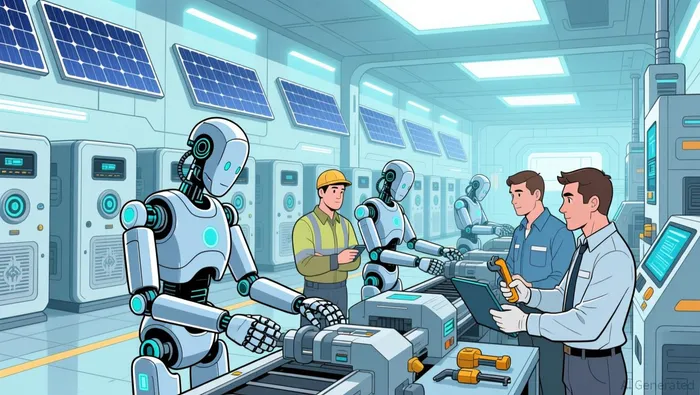
But the timeline is tight. With AGI potentially emerging by 2026 and AI surpassing human intelligence by 2030, the window for building this infrastructure is narrow. The grid constraints are already forcing AI companies to build their own power plants. Tesla's vertical integration across energy generation, storage, and robotic execution could be the differentiator-but only if it can scale fast enough to meet the demand that's coming.
For investors, this reframes the entire thesis. The $25 trillion robotics opportunity is real, but it's gated by energy infrastructure. Tesla's position as an integrated energy player isn't ancillary-it's central to whether the S-curve ever reaches exponential adoption. The company that solves the power problem wins the era.
The Competitive Landscape: Chinese Dominance and the Crowded Field
Even if Tesla hits every technical milestone, the competitive threat is already massive-and already here.
While Musk talks about 2027, Chinese manufacturers are already shipping at scale. In 2025, China accounted for more than four out of five humanoid robots sold-that's 80%+ market share. Global shipments reached 16,000 devices, mainly for data collection, research, logistics, and manufacturing. This isn't prototype territory. This is real volume, real deployments, real market penetration.
Unitree Robotics delivered over 5,500 units to clients in 2025 alone, ramping production ahead of its stock market debut. Its annual production exceeded 6,000 units. AgiBot sold over 5,000 units and earned $142 million. These companies are not waiting for the S-curve to turn-they are already riding the early adoption phase.
Then there's Hyundai. Boston Dynamics' electric Atlas bot has begun pilot deployments, and Hyundai has confirmed its entire 2026 production run is fully committed. A Tesla delay gives Hyundai a massive window to capture the enterprise market first.
So where does Tesla fit? The answer isn't pure robotics capability. It's ecosystem integration. Tesla's advantage isn't building a better arm or leg-it's controlling the entire stack from energy generation (solar) through storage (Megapack) to AI training (Blackwell chips) to robotic execution. Chinese competitors may lead on unit volume today, but they don't have the integrated infrastructure layer. That's Tesla's differentiation play.
For investors, this means the competitive risk is real but nuanced. Tesla doesn't need to beat Unitree on volume in 2026. It needs to survive the inflection phase and be positioned when the S-curve accelerates-leveraging its energy moat to capture the infrastructure layer of the robotics economy. The race isn't over. It's just getting started.
Valuation & Scenarios: What Moves the Stock
The valuation puzzle is stark: Tesla trades at a PE of 417.98 and EV/EBITDA of 138.57-multiples that would be absurd for any traditional automaker-yet the stock is down 6.11% year-to-date and sits well below its 52-week high of $498.83. This disconnect is the key to understanding what the market is actually pricing.
At $422 per share with a 31% rolling annual return, Tesla has outpaced the market significantly over the past year. But the YTD weakness suggests investors are growing impatient with the robotics timeline. The prediction market odds-just 21% chance of humanoid robots in 2026-are being baked into the stock.
Here's how the scenarios break down:
Bull Case: The S-Curve Inflection Triggers Re-Rating
If Tesla hits its 2026-2027 production milestones for Optimus-demonstrating reliable factory deployment and moving toward the $20,000-$30,000 price point-the stock could re-rate sharply. The market would begin pricing in the infrastructure layer thesis: energy generation (solar), storage (Megapack), and robotic execution as a unified stack. Combined with progress on FSD and energy business scaling, a move back toward the 52-week high is plausible. The bull case requires Tesla to prove it can cross from inflection phase to exponential adoption within the next 12-18 months.
Base Case: Gradual Pricing of the Robotics Option
More likely, Tesla slowly prices in robotics progress as it becomes undeniable. The stock trades sideways or drifts higher as energy business delivers volume and Optimus moves from factory prototypes to limited commercial deployment. The PE compresses as earnings grow from automotive and energy, even if robotics revenue remains minimal. This is the "wait and see" path-no dramatic re-rating, but no collapse either. The 31% rolling return suggests the market already sees something valuable here, even if it's uncertain when.
Bear Case: Elon Time and Competitive Encroachment
The bear case is straightforward: Musk misses more deadlines, Chinese competitors (Unitree, AgiBot) capture enterprise deployments, and Hyundai's Boston Dynamics locks up the industrial market. If the 2026 production run remains committed to Hyundai while Tesla stumbles, the window for Tesla narrows. Combined with automotive demand weakness, the stock could test lower supports. The extreme multiples become unsustainable if robotics revenue stays years away and energy business fails to scale fast enough to offset car sales volatility.
The critical catalyst isn't a single product launch-it's whether Tesla can demonstrate it's crossing the chasm from inflection to exponential adoption. That's what will move the stock from here.