

Do you know what the Tesla FSD headline doesn't tell you? That the word "Supervised" is right there in the product name.
Tesla announced on May 21 that its Full Self-Driving - Supervised - is now available in China as part of a wider global push. The press is calling it a milestone. The stock trades at a $1.5 trillion valuation and a P/E ratio above 370. And the company has never paid a single dividend in its 18-year history.
I don't think investors are being paid to believe this news changes the fundamental risk/reward equation for Tesla. The better question is whether you own a company that actually returns cash today - or one that asks you to hope something works perfectly tomorrow, while paying you nothing in the meantime.
The Word That Changes Everything Is "Supervised"
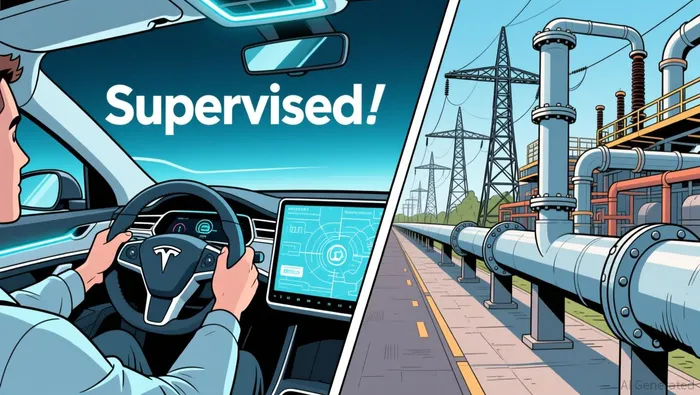
Tesla's own branding calls it "FSD Supervised." That is not marketing for a driverless car. That is a Level 2 driver-assistance system - meaning you are still legally and practically responsible for driving. The system helps. You still drive.
This matters because the market narrative around Tesla has been priced for perfection. Musk has promised China FSD approval multiple times - early 2026, then February 2026, then Q1 2026 - and each time the timeline slipped. Chinese state media explicitly pushed back on his February claim, calling it "not true." The company built an AI training center in China in February 2026 as it waited. Now, nearly two years after Musk first hinted at full approval, the product is "Supervised."
The gap between the promise - autonomous driving, robotaxis, a self-driving revenue machine - and the reality - a driver-assistance feature that requires your eyes on the road - is where the valuation risk lives.
A $1.5 Trillion Company Trading at 370x Earnings
Here is the arithmetic that the headline asks you to ignore. Tesla's stock trades at a P/E ratio between 317 and 380, depending on which data provider you check as of May 20, 2026. The S&P 500 average is roughly 20 to 25 times earnings. Tesla trades at roughly 15 times the broader market.
What does that mean for the investor? It means Tesla's stock price already assumes years of flawless execution on FSD, robotaxis, energy storage growth, and AI monetization. If any one of those assumptions runs into delays, regulatory friction, or competitive disruption, the multiple compresses. Fast.
And then there is the earnings side. Tesla's Q1 2026 results showed revenue growth of just 2.25% year-over-year, while earnings per share declined 42.63%. The core automotive business is slowing. The AI story is the only thing propping up the multiple. That is a single-point-of-failure valuation.
Zero Dividend, Zero Income, Zero Cash Return
Tesla's investor FAQ is explicit: "We have never declared or paid cash dividends on our common stock. We currently do not anticipate paying any cash dividends in the foreseeable future."
For the income investor, that is the whole argument. You can believe in the Tesla story forever - and you can receive $0 of income while you wait. In a world where inflation is structurally higher than the old 2% regime, that $0 matters more than it did ten years ago.
I believe inflation is likely to remain more persistent than the market wants to admit. Structural drivers - deglobalization, demographics, energy transition, fiscal dominance - all pressure prices upward. When inflation runs at 3% to 4%, a zero-dividend stock eats your purchasing power every year until the price appreciation keeps up. And at a 370x P/E, price appreciation needs the story to keep getting better. Forever.
The Real Economy Is Still There
This is where the TOLL thesis - the one I've written about for years - matters more than a Tesla headline. Energy companies that own pipelines. Industrials with oligopolistic positioning. Defense contractors building the hardware that keeps nations secure. Logistics operators moving freight across continents.
These are companies that provide what the economy cannot function without. They can raise prices without losing customers - that is pricing power, and it is the ultimate moat. They have balance sheets with investment-grade credit. They pay dividends that grow faster than inflation. And they trade at multiples that don't require perfection.
The FANG story - including Tesla's - is about hoping something works. The TOLL story is about owning businesses that already work, that already return cash, and that can raise prices when inflation pressures them. From an income and risk/reward point of view, the choice is clearer than the headlines suggest.
This Is Not a Prediction Against Tesla
I don't need FSD to fail for this framework to hold. I don't need Tesla to collapse. The argument is about what the market is paying you to wait.
At a $1.5 trillion market cap and 370x earnings, you are buying the best-case scenario at the best-case price. The compounding math doesn't work when you're earning $0 of income and your upside depends on a technology that requires "Supervised" and may still require it for years.
I don't think the question is whether Tesla's FSD is a technological achievement. The question is whether you are being fairly compensated for the risk you're taking and the income you're giving up. I believe most investors are not.
The alternative - concentrated positions in companies with pricing power, balance-sheet strength, and growing dividends - doesn't generate headlines. But it generates income. And income that grows faster than inflation, paid to you quarterly, is what protects your purchasing power when the old regime is gone for good.