

Rating: Downgrade to Wait. Don't chase the solar factory narrative at these multiples.
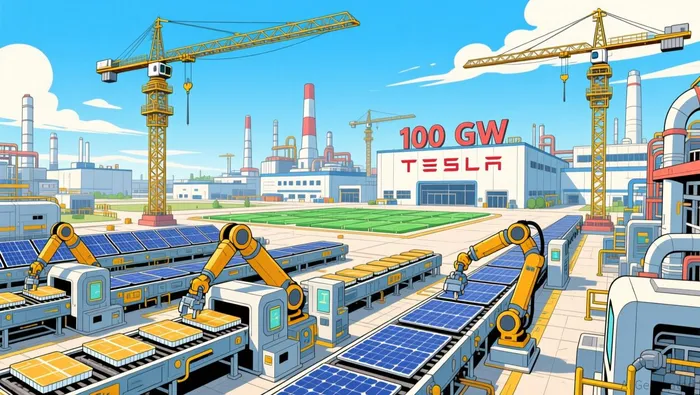
What more does the market need to justify a $1.6 trillion Tesla? A massive new solar panel factory in Texas, targeting 100 gigawatts of annual manufacturing capacity. Well, guess what - the factory is real. Tesla has begun full-scale construction in Brookshire, a Houston suburb, and it will house a vertically integrated solar operation: ingot growth, wafer slicing, cell production. Not just assembly.
That sounds like a growth catalyst. But the question isn't whether Tesla can eventually build panels at scale. The question is whether today's valuation has already priced in a world where it succeeds flawlessly - while the company's energy revenue declined 12% year-over-year in Q1 2026.
I've been puzzled by how quickly the market flipped from Tesla-as-a-struggling-EV-story to Tesla-as-a-solar-empire because a factory broke ground. The numbers haven't earned that pivot.
The factory is big. The execution risk is bigger.
Here's the scale: Tesla's existing Buffalo, New York solar facility produces around 300 megawatts per year. The Brookshire plant targets 100 gigawatts - that's roughly 330 times the Buffalo output. To reach that ambition, Tesla is reportedly spending $2.9 billion on manufacturing equipment, sourced from Chinese suppliers including Suzhou-based vendors. Yes, the company that Musk has publicly attacked for Chinese EV competition is buying Chinese solar manufacturing equipment. That irony won't matter to the balance sheet if tariffs shift, but it shows how dependent this plan is on a global supply chain that could fracture.
The 100 GW target has also been Musk's aspirational number for years. He floated it before. He hasn't hit it. Setting a target and hitting a target are different things, and vertical integration in solar - from raw ingots to finished panels - is enormously difficult for a company whose core expertise is cars and batteries, not photovoltaic manufacturing.
Energy revenue is declining. The stock is priced for the opposite.
Tesla's energy division generated $2.41 billion in Q1 2026, down 12% from the same quarter a year earlier. Energy storage deployments fell 15%. These are not the numbers of a division that's about to rescue a stalling EV business.
Now, here's the nuance that matters: energy margins are genuinely strong. The segment hit a record 29.8% gross margin in Q4 2025 and stayed above 26% for the full year. Energy contributed roughly 23% of Tesla's total profit in 2025 while accounting for just 13% of revenue. That profit leverage is real.
But strong margins on declining revenue are a different story than strong margins on accelerating revenue. The market can't keep rewarding margin quality when the topline is shrinking. And that's exactly the disconnect - TSLA's forward P/E trades near 200x earnings. For comparison, the S&P 500 trades near 20x. That means the market is pricing in roughly 10 years of exceptional growth that hasn't shown up in the last quarter's results.
At a $1.6 trillion market cap, Tesla needs the solar factory to deliver on schedule, the energy business to reverse its revenue decline, EV deliveries to stabilize, and somehow all of this to happen without margin compression in a year Tesla itself has flagged. The burden of proof isn't on the bears anymore. It's on the bulls to explain why a stock priced for perfection deserves a single miss.
The GARP test: does the valuation connect to the growth?
GARP investing - growth at a reasonable price - exists because markets routinely detach valuation from reality in both directions. Sometimes a stock is dirt cheap despite growth that justifies the price. Sometimes it's the opposite: the growth is real but the price has run so far ahead that the risk/reward flips.
This is the latter case.
Tesla's energy business IS growing structurally. Megapack demand is strong, utility-scale storage deployments hit records in Q4 2025, and the grid electrification tailwind is secular and real. But "the tailwind is secular" doesn't justify a forward P/E that's 10x the broad market when last quarter's energy revenue actually fell. A GARP investor waits for the multiple to compress toward growth, not for the growth to somehow justify the multiple in perpetuity.
So what's the investor action?
If you own TSLA and your thesis includes the energy business as a growing profit center, the Q1 decline warrants attention but doesn't necessarily break the long-term case - energy margins are still best-in-class, and the Brookshire factory represents real optionality if it delivers. But buying here? Or adding? At 200x forward earnings, the setup doesn't offer the asymmetric risk/reward that a contrarian entry requires.
I'd reassess if energy revenue reaccelerates into double-digit growth for two consecutive quarters while the multiple compresses below 150x. That's where the GARP entry zone begins. Until then, the solar factory story is a headline, not a buying signal.
Don't chase a narrative that the numbers haven't earned yet. The opportunity will be better - and the entry safer - when the market forces the multiple closer to reality.