

The Behavioral Narrative Is Wrong
The market's explanation for Tesla's recent stock decline is tidy but wrong. Tesla shares have fallen sharply ahead of the SpaceX IPO on June 12, and the consensus narrative - pushed by analysts and commentators alike - is that investors are selling Tesla to free up capital for a day-one pop in the next Musk IPO. The implication is a behavioral story about attention competition between two vehicles. That framing is a distraction from what is actually happening: Tesla is undergoing a structural breakdown in capital discipline.
Capex Trajectory: The Real Story
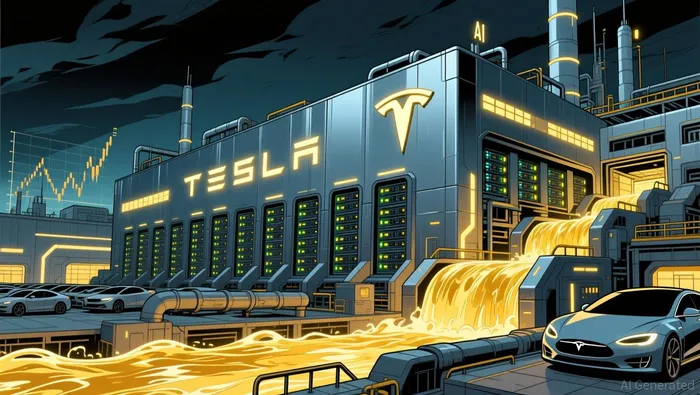
The structural driver is the capital expenditure trajectory, not investor behavior. Tesla spent approximately $9 billion on capex across all of 2025. In its Q1 2026 earnings report in April, the company guided for over $25 billion in full-year 2026 capex - nearly triple the prior year's spend, and up from the $20 billion it had forecast as recently as January. Tesla also stated it expects negative free cash flow for the remainder of 2026.
That is not a normal spending increase for a company whose core automotive business is maturing. A near-tripling of capex in a single year signals a fundamental shift in capital allocation. Companies do not triple their capital spending trajectory without a corresponding shift in what they are trying to build. For Tesla, the target is clear: AI infrastructure, Optimus robot development, and the Cybercab robotaxi platform. These are long-horizon bets with no established revenue model and no clear timeline for payback.
The market is pricing in the gap between the magnitude of this spend and the uncertainty of its outcome. That is a supply-side structural judgment, not a behavioral one. When a company shifts from generating positive free cash flow to guiding for negative free cash flow, the constraint migrates from margin to cash burn. Investors are not selling Tesla to buy SpaceX. They are questioning whether Tesla's capital discipline has survived its pivot from automotive manufacturer to AI infrastructure builder.
The Two-Market Split
This capex trajectory also forces a structural split in how Tesla should be evaluated. The company now effectively operates two distinct businesses with fundamentally different capital dynamics.
The car business, which includes vehicles and energy storage, is the mature segment. Revenue rose 16% year-over-year to $22.4 billion in Q1 2026. Energy storage deployments are accelerating, with Wall Street estimating the energy division will generate roughly $18.3 billion in 2026 revenue, up from $12.8 billion in 2025. The car business did not fall apart. It is generating revenue growth. But it is no longer the margin engine it once was.
The second business - AI infrastructure, robotics, and autonomous driving - is the cash consumer. It has no established revenue line, no recurring cash flow, and no near-term path to profitability. The $25 billion capex guidance is overwhelmingly directed at this segment. The two-market split matters because it determines which part of Tesla is being valued at the multiple implied by the stock price and which part is subsidizing the other.
Profit Compression Is Secondary
Tesla's net income dropped 46% year-over-year, and the decline extended into consecutive quarters of revenue and profit contraction through Q1 2026. These are the numbers most headline-focused analysis latches onto. They are real, and they are worth noting, but they are not the primary driver of the stock's trajectory.
Profit compression in a company guiding for $25 billion in capex is a downstream consequence of the capital allocation decision, not an independent shock. When capex nearly triples, depreciation and amortization expense rises accordingly in subsequent quarters, and the free cash flow impact is immediate. The earnings decline validates the capex concern but does not replace it. The market is not reacting to weak profits in isolation. It is reacting to the realization that the spending required to sustain Musk's AI and robotics ambitions will keep margins under structural pressure for years, not quarters.
Why the SpaceX Narrative Is a Red Herring
SpaceX is planning to debut on the Nasdaq under the ticker SPCX on June 12, priced at $135 per share and targeting $75 billion to $80 billion in proceeds. If fully priced, it could approach a $1.7 trillion valuation, making it the largest IPO in history. The scale of the event creates the behavioral narrative: investors must choose between Musk's two crowning ventures.
But the SpaceX IPO is functionally irrelevant to Tesla's capital trajectory. The two companies are financially separate. SpaceX's public debut does not redirect Tesla's capital. It does not change Tesla's $25 billion spending plan. It does not alter Tesla's free cash flow outlook. The only mechanism by which the SpaceX IPO could pressure Tesla is through investor attention - the idea that capital flees Tesla because SPCX offers more excitement. That mechanism is real but secondary. It amplifies a move that is already happening on structural grounds.
The Historical Trackback
Tesla has made capital commitments before that outpaced the underlying business. In 2020, the company guided for aggressive Gigafactory expansion while unit delivery growth was still proving itself. In 2022-2023, capex remained elevated through the demand normalization phase, and Tesla was forced to cut prices to clear inventory while still spending on production capacity. The pattern is familiar: Musk announces a capital target, the market prices in the upside, and then the revenue required to justify the spend takes longer to materialize.
The difference this time is the scale. A $25 billion capex program for a company with roughly $95 billion in annual revenue (based on 2025 figures) represents a capex-to-revenue ratio approaching 26%. That is not an automotive number. It is closer to a high-growth technology infrastructure builder, and Tesla does not yet generate the software margins that would justify the classification.
Investor Takeaway
The key issue is not whether the SpaceX IPO will distract investors from Tesla. The more important question is whether Tesla can justify a $25 billion capital expenditure program against an AI and robotics revenue stream that does not yet exist. If Tesla maintains the discipline to scale capex in phases - matching spend to demonstrated milestones in AI training capacity and robot deployment - the negative free cash flow is a tolerable bridge. If the spending accelerates without corresponding revenue recognition, the constraint migrates from valuation to liquidity, and the market's reaction will intensify well beyond what a SpaceX distraction narrative can explain.
The stock has already begun pricing that risk. The question is whether the trajectory holds or whether the capex discipline breaks further.