

USAT is a US-facing rail, not a USDT replacement
This is not a replacement story. It is a compliance-split strategy.
USAT was built to clear US gates that could block USDT, not to displace it. It launched on January 27, 2026 as the first stablecoin Tether tied to a federally chartered US bank and the first product built specifically for the GENIUS Act framework. Crucially, it is a separate token from USDT, with separate reserves, issuance, and redemption rails, and it is issued by Anchorage Digital Bank rather than Tether Operations. USDT continues to operate globally and still had roughly $189 billion in circulation as of early 2026. In other words, Tether did not dismantle its offshore engine; it added a US-licensed front end.
Why the split matters strategically
The bullish read is straightforward: Tether now has a vehicle for US institutions and regulated DeFi through Anchorage, while leaving its larger offshore flow machine intact. In policy terms, that makes USAT a hedge against a tougher US stance on stablecoins. If Washington tightens rules, Tether already has a compliant product inside the system instead of outside it anchoring issuance inside the US banking system.
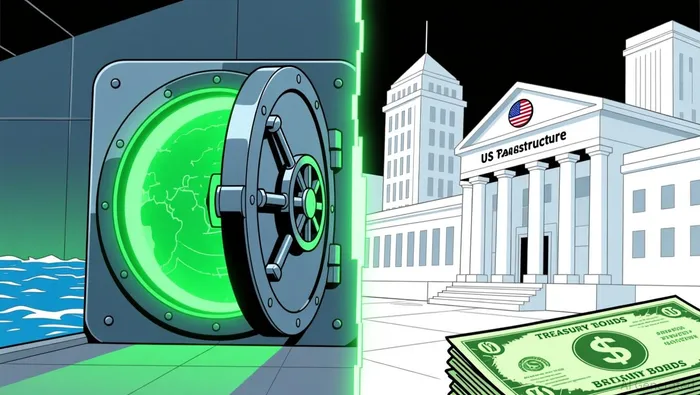
The bearish read is that a thin compliant coin changes little if the core business remains offshore. That is partly true. But the more important point is asymmetry: investors are not watching for a fragile migration of USDT. They are watching whether Tether can route fresh US demand through USAT while the flagship token continues to dominate global liquidity.
Reserve quality matters more than early supply
The first number to watch is not supply growth. It is reserve quality. USAT's first attestation showed $17.6 million in assets against 17,501,391 USAT outstanding. Deloitte confirmed reserves were in excess of the stablecoin's circulating supply. The assets consisted of U.S. dollar cash and reverse repurchase agreements collateralized by U.S. Treasury securities, held in segregated fiduciary trust accounts. That is a conservative, low-yield pool by design.
Why ring-fencing the US float matters
USAT is a separate token from USDT, with separate reserves, issuance, and redemption rails, and it is issued by Anchorage Digital Bank rather than Tether Operations. That structure matters because Tether can now park compliant US demand in a cleaner bucket without touching the larger offshore book. In plain terms, ring-fencing compliant US float into USAT lets Tether keep lower-yield US compliance float separate from USDT's broader offshore reserve pool.
That is the core investment implication. Tether may accept lower yield on the US sleeve in exchange for political cover, banking access through a federally supervised issuer, and a stronger competitive pitch against USDC. If that trade-off works, the broader franchise becomes more durable without changing the balance-sheet math of the flagship token.
The debate is whether that structure becomes economically meaningful or stays mostly symbolic. Some investors like that USAT is being marketed as a compliant alternative with a regulatory edge versus USDC. Others see it less as a branding challenge than as a regulated domestic rail for institutions that still want Tether's distribution. Bulls think the first bucket can become a real flow channel. Bears think compliant design means little unless institutions keep choosing it over established regulated dollars.
Watch four things now: - Whether flows build enough to make ring-fencing a real durability advantage. - Whether institutions and platforms keep adopting the token beyond launch. - Whether reserve composition stays high-quality as supply changes. - Whether the product remains a useful shield even if it stays small.
What changes for investors if USAT actually scales
The key question is no longer whether USAT is compliant. It is whether compliance can become a real flow story.
For investors, the first change is that Tether is no longer just a crypto-dollar franchise. It is starting to look like a marginal buyer of US short-term debt. Tether has signaled it could become one of the top 10 buyers of U.S. Treasury bills this year if demand for its dollar-backed tokens keeps expanding. If that happens, stablecoin growth would have a clearer link to Treasury demand and reserve-yield durability.
The second change is what the market should monitor next. Early proof is still small, but that is normal for a new rail. What matters now is whether the initial base keeps building from institutions and platforms, not whether the coin suddenly matches the flagship's scale. The basic setup is simple: more USAT supply should mean more Treasury purchases, and more Treasury demand would make the model more than a branding exercise.
So the near-term takeaway is blunt: watch the monetization path, not the narrative. If flows stay thin, this remains a useful shield with limited market impact. If flows accelerate, investors are watching a new institutional dollar rail that could change how the market values Tether's moat.
Watchlist: - Sustained growth beyond the early base tied to demand for its dollar-backed tokens - Evidence of institutional adoption through available platform and enterprise channels - Treasury-buyer claims turning into real volume, not just guidance
Invalidation is straightforward: if USAT fails to convert its regulatory edge into durable platform and institutional uptake, its market relevance stays small.