

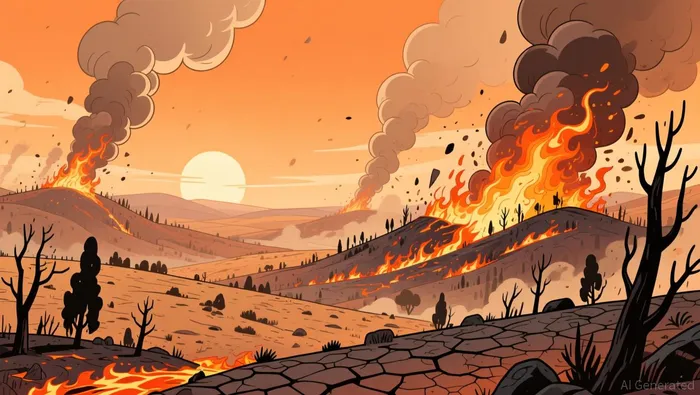
The Thompson Fire exploded into life this week in Butte County, sending roughly 28,000 residents scrambling to flee their homes after the Thompson Fire broke out this week. That's tens of thousands of people uprooted in a matter of days, a number that keeps climbing as the blaze feeds on dangerously hot, dry conditions.
Governor Gavin Newsom responded by declaring a state of emergency in Butte County to provide resources, a move designed to unlock additional firefighting assets and support for the affected area. The urgency is understandable-temperatures are expected to hit 118°F (47°C) in some spots early next week, with the National Weather Service warning of extreme heat stress risk across the state.
The threat is so severe that the city of Oroville, near where the fire started, has cancelled its July 4 fireworks celebration entirely and officials warned residents not to use fireworks. Butte County Sheriff Kory Honea put it bluntly: "Don't be an idiot, cause a fire and create more problems for us." He noted the area has already seen four fires in the past couple weeks within the last couple weeks.
This is the immediate picture: a fast-moving wildfire, a massive evacuation order, and weather that's doing everything it can to make things worse. The crisis is unfolding now, and the danger is far from over.
Weather Conditions Driving Fire Behavior
The meteorological setup for this fire season is about as unfavorable as you can get, and the numbers tell a clear story. The National Weather Service is predicting temperatures could reach 118F (47C) in some areas early next week-dangerously hot conditions that turn everything dry and flammable into kindling.
Butte County Sheriff Kory Honea saw the pattern forming early. The area had already seen four fires within the last couple weeks, and his assessment was straightforward: "This is a bad fire season." That's not alarmism-it's a law enforcement officer who's seen what these conditions do, saying the setup is unusually dangerous.
The reason becomes obvious when you look at what happened this spring. Across California, spring 2025 was warmer and drier than normal. In Southern California, precipitation since October was about 70% of average, while Northern California experienced below-normal rainfall along with a notable heat wave at the end of May. When you don't get enough rain and you get extra heat, the ground stays dry longer and fires spread easier.
The snowpack story is especially telling. In the north Sierra, snowpack declined rapidly-from 75–80% of normal on May 1 to just 20–30% by month's end. That's a massive loss of the state's natural water reservoir. Snowpack doesn't just feed rivers; it keeps the landscape humid and fuels moist as it melts slowly through spring. When it disappears that fast, everything below it dries out faster too.
Put it all together: you've got below-normal rain going into the season, above-normal temperatures accelerating drying, and a snowpack that melted out early and left a lot less moisture behind. That's the recipe for a fire season that starts early and stays intense. The weather mechanisms are all pointing in the same direction-toward more fire, faster spread, and harder containment.
Statewide Fire Context and Season Outlook
The Thompson Fire is not an isolated event-it's exactly the kind of early, aggressive fire activity that forecasters have been warning about all season. As of May 18, California has already recorded 1,436 fires burning 32,054 acres, with 7 structures destroyed and no fatalities. That's a lot of fires for this time of year, and the pattern matches the outlook predictions to a tee.
The 2025 fire season outlook predicted an early and active season with elevated risk continuing into September with elevated risk continuing into September. That prediction is playing out in real time. The conditions that drove that forecast-below-normal rainfall, above-normal temperatures, and a snowpack that melted out early-are still in place. What was supposed to be a gradual transition into fire season has accelerated faster than usual.
One developing concern that doesn't get enough attention is the weakening coastal marine layers, especially in Southern California coastal marine layers are showing signs of weakening. Those marine layers normally provide a moderating effect, bringing moisture inland and keeping fires in check during the early season. When they weaken, coastal zones that typically have some relief become vulnerable. That's a key reason why fires are spreading into areas that historically have been safer.
The models are clear on the timeline: above-normal fire potential from May through July in Northern California above normal from May through July. That's the core fire season window, and it's where the risk is highest right now. The key wildcard remains lightning in July. If dry thunderstorms develop, they could spark multiple fires simultaneously across remote terrain, stretching firefighting resources thin just when conditions are most favorable for rapid fire growth.
The bottom line: this is shaping up to be a season that starts early, intensifies quickly, and may not let up until well into fall. The statistics so far are modest compared to catastrophic years, but the trajectory is what matters. When you have the weather setup, the dry fuels, and the early fire activity all pointing in the same direction, common sense says to expect more.
What to Watch Next
The Thompson Fire is still growing, and the weather machine isn't done with California yet. Here's what residents and readers should actually be watching for in the coming days and weeks.
Wind events are the immediate trigger to worry about. When you've got dry fuels and extreme heat, all it takes is a gusty wind event to turn a contained fire into a runaway. This is especially true in Southern California, where the Springs Fire recently burned roughly 16 square kilometres in Riverside County. That fire is now mostly contained, but it's a reminder of how quickly conditions can shift. Watch for red flag warnings-those indicate the combination of hot, dry, and windy weather that fires need to spread rapidly.
Evacuation orders and road closures will change fast. The Thompson Fire is still active, and with temperatures expected to hit 118F (47C) in some areas, fire behavior can accelerate overnight. Residents in affected areas should have multiple evacuation routes mapped out and keep their vehicles fueled. Don't wait for a formal order if you see smoke or feel the heat intensifying.
The fire season doesn't end until October. That's the typical runway, and this year's conditions suggest elevated risk will persist through the summer months. The snowpack melted out early, the ground stayed dry, and the heat is just getting started. What was supposed to be a gradual transition into fire season has accelerated faster than usual-and it may not slow down until we get meaningful rain, which isn't in the forecast.
The practical takeaway: stay informed, have a plan, and don't get complacent just because it's still early in the calendar year. The fire season clock is ticking, and the next wind event could be the one that changes everything.