

There is a war on, and the market is telling two different stories about it. One story, written in oil options and Treasury bid‑ask spreads, says this is a serious liquidity crisis. The other, written in equity indices, says everything is basically fine. The odd thing is not that different assets react differently to geopolitical risk. The odd thing is that the plumbing and the surface are moving in opposite directions.
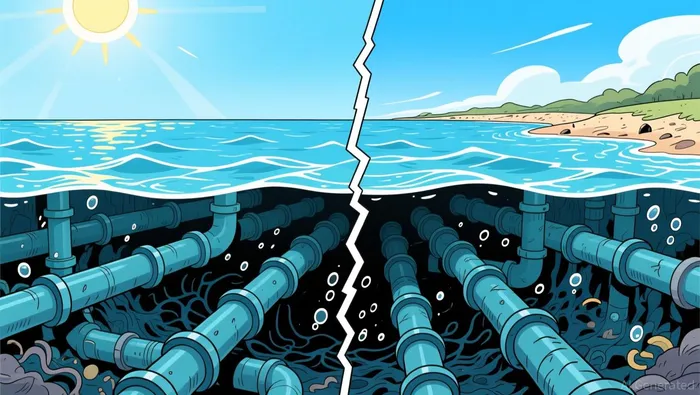
Start with the plumbing. When the U.S. and Israel struck Iranian nuclear facilities last month, market makers did what market makers do in a crisis: they pulled back. The difference between the price at which dealers would buy two‑year U.S. Treasuries and the price at which they would sell them widened roughly 27% in March compared with February. That is a big move for the most liquid government bond market in the world. One European rates trader described liquidity in short‑term interest‑rate futures as "severely diminished," operating at 10% of usual levels. The message from the plumbing is clear: trading has become harder, costlier, and riskier.
Meanwhile, oil markets are pricing something closer to apocalypse. Brent crude futures spiked from around $70 before the conflict to above $110 a barrel, briefly touching $119.58 in early March. But the real story is in the options. Using options‑implied probability distributions, the market sees a plausible path to Brent at $230 per barrel by late 2026-a two‑standard‑deviation outcome, but one that traders are willing to pay for. That is not a normal geopolitical‑risk premium; that is a bet on a supply catastrophe.
And then there are stocks. The S&P 500 fell nearly 10% in the days after the strikes began. Then it recovered all of that loss in just 11 trading sessions and went on to hit record highs. This fits a historical pattern: markets often spike on geopolitical news and then normalize within weeks, even when the fighting continues. During a 12‑day war between Israel and Iran in June 2025, for example, the S&P 500 dropped 1.13% on the first day of trading and then rose 5.70% over the next 30 trading days. The market has learned that these events are usually short‑lived, at least in terms of market impact.
So you have a market that is simultaneously saying "this is a liquidity crisis" (plumbing), "this could be an oil‑supply catastrophe" (options), and "this is basically a blip" (equities). That is not necessarily a contradiction. Different assets price different risks. Oil options are pricing the physical possibility that the Strait of Hormuz stays closed; equities are pricing the expectation that corporate earnings will be fine; Treasury spreads are pricing the cost of providing liquidity when everyone wants to trade at once.
But the plumbing stress is interesting because it affects everything. When market makers widen spreads and pull back from making markets, they are not just reacting to oil or stocks or bonds. They are reacting to the whole environment of uncertainty. And they are charging a premium for it-a 27% wider spread is a 27% higher transaction cost for anyone who needs to trade Treasuries. That premium shows up in the plumbing long before it shows up in the headline indices.
There is a familiar financial machine at work here. In every crisis, there is a gap between the story the market tells about itself (often through indices and popular narratives) and the story the market tells through its actual mechanics (spreads, liquidity, options pricing). The Iran conflict is just a particularly stark example. The oil‑options market is pricing a tail risk that most investors would call absurd; the equity market is pricing a return to normal that seems almost too quick; and the plumbing is pricing the cost of bridging that gap.
What makes this time a little different is the speed. The 11‑day equity recovery is the fastest on record for a drawdown of that size. Part of that is structural-markets have more liquidity, more algorithmic trading, more ways to bounce back quickly. Part of that is behavioral-investors have been trained by recent history to buy the dip on geopolitical news. And part of it is that the market has gotten very good at separating the political story ("war") from the economic story ("probably not a recession").
The risk, of course, is that the plumbing is right and the surface is wrong. If liquidity stays strained and trading stays expensive, eventually that stress will bleed into the indices. Or if the oil‑options market turns out to be pricing something real-a prolonged closure of the Strait of Hormuz, say-then the equity bounce will look premature. For now, the market is running two parallel narratives: one for people who watch the headlines, and one for people who watch the spreads.