

Tim Cook will step down as CEO on September 1, 2026. John Ternus — currently Senior Vice President of Hardware Engineering — will assume the CEO role.
As Tim Cook prepares to hand the reins to John Ternus, let's take a step back and assess the full record — what he built, where he stumbled, and what his legacy really means for Apple going forward.
Part I: Achievements — What Cook Got Right
Shareholder Returns: Far Outpacing the Market
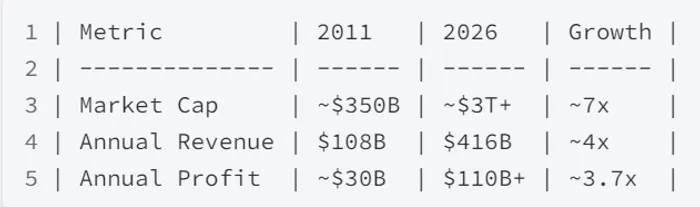
The most undeniable number of the Cook era. When Cook took the helm in August 2011, Apple had a market cap of ~$350 billion. By 2026, Apple's market cap exceeded $3 trillion — a compound annual growth rate of ~18.4%, far exceeding the S&P 500 over the same period, delivering exceptional wealth creation for shareholders.
Services Business: From Zero to Empire
One of Cook's most strategic legacies. By 2025, Apple's services revenue exceeded $109 billion annually — becoming Apple's second-largest revenue pillar with margins far exceeding hardware. Apple Music, Apple TV+, App Store, AppleCare, and Apple Pay form a powerful services flywheel: more iPhones sold → more services revenue → higher user stickiness → steeper switching costs.
Perhaps an even consequential bet: China.
This was a market Steve Jobs virtually ignored. Cook visited China nearly every year — three times in 2018 alone — building relationships with regulators and consumers at the highest levels.
In 2013, China was included in the iPhone first-launch list for the first time. By 2014, the iPhone 6 made Greater China Apple's best-selling iPhone market globally. The momentum was extraordinary: by June 2015, China accounted for 27% of Apple's total revenue — surpassing Europe for the first time.
When Cook took over, China represented just 2% of Apple's total revenue. Over his tenure, China revenue grew by over 600%. Apple expanded from 4 retail stores to 42 in mainland China. And among Apple's top 200 suppliers, 86 are now based in mainland China, Hong Kong, or Taiwan — a testament to how deeply Apple embedded itself in the world's factory and its largest consumer market.
Beyond the iPhone: Wearables
Under Cook's leadership, Apple's product portfolio expanded well beyond the iPhone. The two most significant achievements: the Apple Watch and AirPods, both of which Cook shepherded from concept to launch — defining the smartwatch and wireless earbuds categories and establishing Apple as the dominant force in smart wearables.
The scale of that dominance is staggering. According to data from Strategy Analytics, based on industry reports and Apple's filings, Apple Watch shipments reached 30.7 million units last year — surpassing the entire Swiss watch industry's 21.1 million units over the same period. Apple had effectively disrupted one of the oldest and most prestigious industries in the world.
New Product Categories

Apple Silicon: A Defining Bet
In 2020, Apple cut ties with Intel and launched the M1 chip — a bold, high-risk decision that revitalized the Mac business. Apple Silicon's performance-per-watt leadership ran so deep that even data centers adopted Apple chips. This was genuine moat-deepening.
Supply Chain Crisis Management
During the 2022 Zhengzhou Foxconn lockdown, production hit zero — costing Apple over $1 billion per week. It was the most severe test of Cook's supply chain management, and proof of his crisis response capabilities under extreme pressure.
Part II: Crisis Management
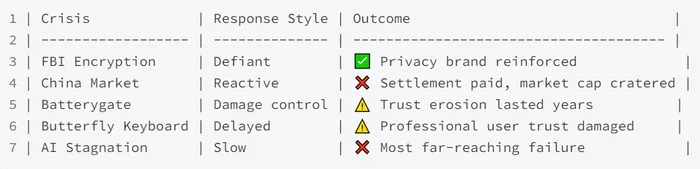
🔐 FBI Encryption Standoff (2016) — Most Defiant
FBI demanded Apple unlock the San Bernardino shooter's iPhone. Cook wrote an open letter refusing, calling it a request to build "a master key capable of opening hundreds of millions of locks." Apple took the fight to Congress rather than compromise. Apple never gave in. Privacy became Apple's sharpest brand differentiator.
📉 China Market Crisis (2018–2019) — Most Reactive
In January 2019, Apple issued its first revenue guidance cut since the iPhone's launch, causing a 10% stock drop and $74 billion in market cap wiped out in a single day. Cook had previously stated "China demand is strong," leading investors to allege misrepresentation. Apple settled for $113 million.
🔋 Batterygate (2017) — Most Trust-Damaging
Apple was exposed for intentionally slowing older iPhones via iOS updates to prevent battery-related shutdowns. Cook appeared on ABC News to apologize personally. Battery replacement fees dropped from $79 to $29. France fined Apple €25 million; US states imposed additional penalties totaling $113 million.
⌨️ Butterfly Keyboard (2016–2019) — Most Prolonged
MacBook's butterfly keyboard mechanism failed repeatedly due to dust intrusion. Apple dismissed complaints and redesigned the mechanism four times without solving the problem. Eventually abandoned the design entirely in 2019, offering free repairs to affected users. Professional users' trust in Apple's "obsessive perfection" reputation was damaged.
🤖 AI Stagnation (2011–2026) — Most Far-Reaching Strategic Failure
• 2011: Siri launched with iPhone 4S — the industry's first major smartphone voice assistant
• 2018: Cook recruited AI chief John Giannandrea from Google with high expectations
• 2018–2022: Giannandrea reportedly lacked urgency; progress stalled
• November 2022: ChatGPT launched; Apple's position went from "one generation behind" to "three to four generations behind"
• June 2024: Apple Intelligence launched in haste; user reception was poor, multiple promised features delayed or missing
• 2025: Giannandrea departed quietly; Apple Intelligence mocked as "Apple Ignorance" online
Part III: The Great Supply Chain Migration
Cook's Own Words: "What we learned some time ago was that having everything in one location had too much risk with it, and so we have over time opened up new sources of supply."
Production Shift Data
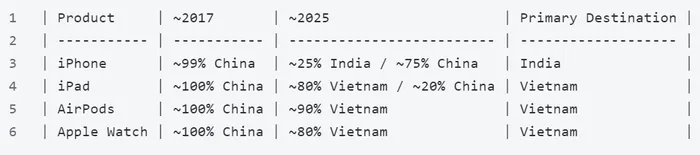
Key milestone: In Q2 2025 earnings, Cook announced the majority of US-bound iPhones would be India-origin, and nearly all US-bound iPads, Macs, Apple Watches, and AirPods would be Vietnam-origin.
Tariff cost absorbed: ~$900 million — Cook chose margin compression over price hikes to protect market share.
Structural limitations: Yield rates (China 95% vs. India 70–85%); Vietnam's supply chain integration remains below 30%; rare earth materials remain entirely dependent on China. India and Vietnam represent a "China Plus One" strategy, not a true exit from China.
Part IV: Overall Assessment
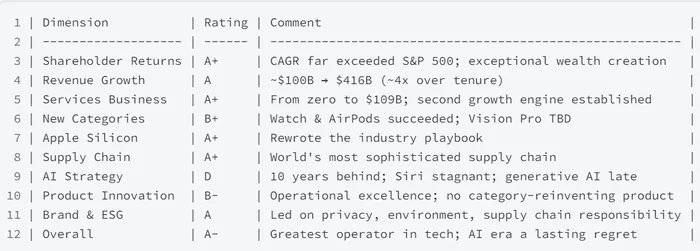
Pattern: Cook excels at post-crisis recovery and operations, but early warning and pre-crisis anticipation are his weaknesses — he often acts only after problems become severe.
Bottom Line: Tim Cook was one of the greatest operational executives in business history — transforming Jobs' "creative company" into the world's most sophisticated, cash-rich enterprise, with annualized returns that far outpaced the S&P 500. But an operations genius is not an innovation pioneer, and the AI gap will be John Ternus' greatest challenge.