

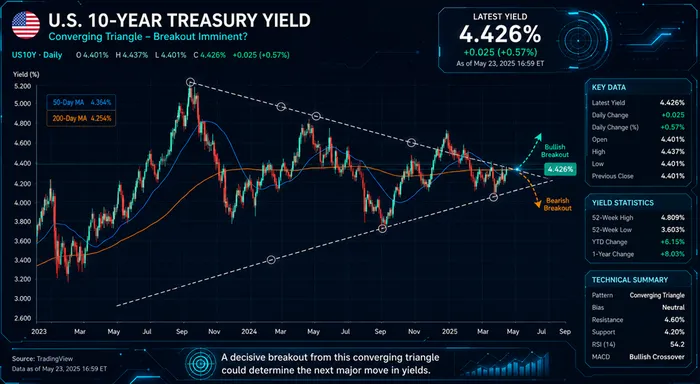
The 10-year US Treasury yield has broken above 4.4%, clearing a major technical triangle pattern that has been building for months. The 30-year yield has crossed 5%. These are not random numbers. They are thresholds that matter — and markets are not ready.
The Triangle Breakout Everyone Should Be Watching
When a large consolidation pattern breaks on the 10-year Treasury, it tends to move fast. The 10-year yield is now above 4.4%, and if it continues climbing toward 4.5%, the feedback loop into financial markets could accelerate quickly. This is not a gradual drift — technical breakouts in bond yields have a history of triggering sharp repricing across all asset classes.
ㅤ
The 30-Year Yield at 5%: We Are in Uncharted Territory
The 30-year Treasury yield breaking 5% is a different category of risk. This is a 30-year cycle level. If the 30-year yield clears 5.1%, it enters a range that has no modern precedent. Markets have no historical playbook for what comes next.
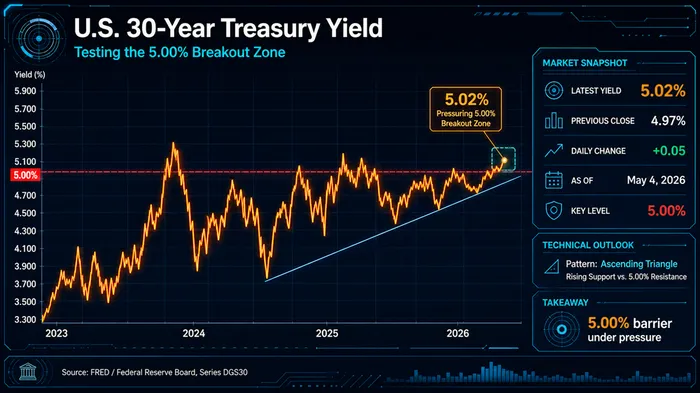
The last two times the 30-year approached 5% — October 2023 and May 2025 — stocks sold off. We are now at that level again, except the macro backdrop is more complicated.
The Red Lines: 10-Year at 4.5%, 30-Year at 5%
These are the lines that matter:
- 10-year at 4.5% — above this, borrowing costs across the economy reprice aggressively
- 30-year at 5% — above this, Treasuries become a genuine competitor to equities for long-term capital
At these levels, there are only two outcomes: either the government intervenes to bring yields back down, or yields continue rising — and eventually, stocks have no choice but to follow.
Stocks and Bonds Have Decoupled. That Never Lasts.
The 10-year Treasury yield and the S&P 500 are supposed to have a strong negative correlation. When yields rise sharply, stocks historically fall. Right now, that relationship has broken down. The gap between where yields are and where equities are priced is historically large.
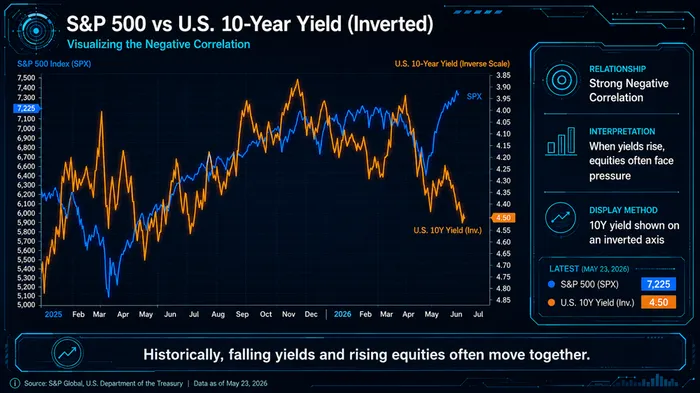
This divergence does not persist. Either yields come back down — which would require Fed intervention or a demand shock — or equities reprice to reflect the new rate reality. The longer the gap holds, the more violent the eventual convergence.
Bond Volatility Is Surging — And That Is a Stock Market Warning
Bond market volatility is rising. The last time we saw this kind of movement in Treasury volatility, it coincided with a major equity selloff. Rising rate volatility destabilizes risk asset pricing models, increases hedging costs, and forces institutional rebalancing.
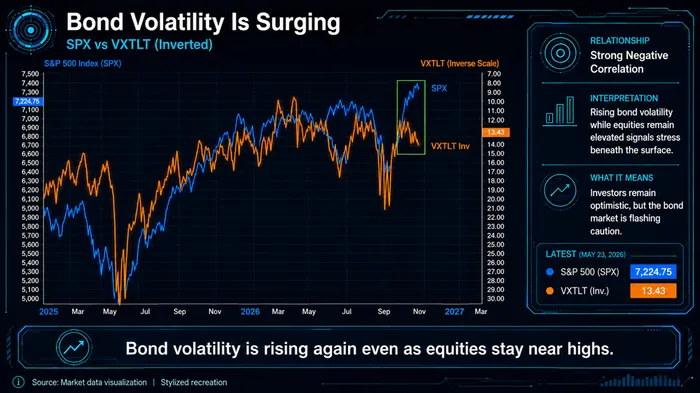
When the bond market becomes unstable, equities cannot stay calm indefinitely.
The Bottom Line
Rates are moving. Stocks have not responded. That gap is the trade.
If the 10-year holds above 4.5% and the 30-year stays above 5%, the pressure on equity valuations will become impossible to ignore. The scenario to watch: continued yield momentum forces a disorderly repricing in stocks — not a slow grind, but the kind of fast move that catches consensus positioning offside.
The bond market is telling you something. The stock market is not listening yet.