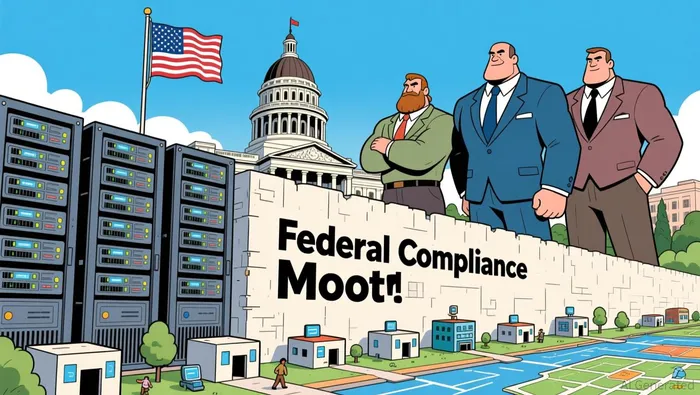
Trump is using the slow count of California's primary mail ballots to renew his election-fraud playbook. That's the surface story. The part investors should actually be watching is what sits underneath: a coordinated federal strategy to dismantle California's AI regulatory architecture - and in doing so, concentrate market power toward the incumbents who can afford federal compliance while pricing out everyone else.
The market is treating this as political noise. It's not. It's a market-structure shift.
The regulatory architecture, not the rhetoric
Two executive orders define the new framework. The first, signed in December 2025, directs federal agencies to challenge state AI regulations and threatens to withhold federal funding from states that enforce "onerous" AI laws. The order specifically names California's data transparency and reporting requirements for generative AI systems. The second, signed June 2, 2026, establishes a voluntary federal vetting process for frontier AI models - a framework that sounds light-touch but effectively makes federal compliance the path of least resistance for companies building at scale.
What this means for the competitive landscape is straightforward. The four companies that account for nearly 10% of California's total income tax revenue from stock compensation alone - Nvidia, Apple, Google, and Meta - can absorb federal compliance costs that would crush a smaller competitor. California was the last state with enough regulatory heft and enough startup density to create an alternative compliance path for smaller AI builders. That path is now being closed.
The market is missing the connection between these orders and the product architecture debate I've been tracking for months. If federal preemption kills state-level AI rules, the barrier to entry for new AI infrastructure companies rises sharply. The incumbents' moat widens not because their chips are better - though they are - but because the regulatory cost of competing with them just went from manageable to existential.
Incumbents already know how to use this
This isn't theoretical. In April 2026, Apple and Google crushed a California legislative measure that would have helped smaller rivals compete in the app ecosystem. The bill never made it out of committee. Tech giants have been running parallel strategies: welcoming federal preemption that kills state rules they can't manage, while quietly killing state rules that would actually help competitors.
The distinction matters. When Sam Altman argued that a patchwork of state regulations could slow AI development, he wasn't speaking as a neutral observer - he was speaking as the CEO of the company best positioned to win under uniform federal rules. His position was defensible. It was also self-interested in a way that the market hasn't priced in.
But here's the counter-signal
Tech's regulatory influence isn't one-way. On May 22, 2026, Trump called off plans to sign an AI executive order hours before it was scheduled, after last-minute phone calls with industry leaders and former AI czar David Sacks. The order had been moving forward for months. It died in the final hour because the tech lobby said it crossed a line.
This is what separates the companies that set the rules from the companies that react to them. The incumbents aren't immune to Washington - but they have a veto. Small-cap AI startups don't. That asymmetry is the investment story buried inside the election noise.
The geographic concentration question
There is a secondary layer here that deserves attention. Companies are leaving California - Tesla, Oracle, HP, and others have relocated headquarters, and the exodus accelerated in 2025-2026. But the companies that matter most to the AI thesis - Nvidia, Google, Apple, Meta, OpenAI - remain anchored in the Bay Area. Their talent networks, supply chain relationships, and developer ecosystems are too deep to move on a regulatory whim.
What I'm watching is whether the regulatory hostility becomes personal enough to change that calculus. If it does, the capital flight wouldn't just be about tax rates or office space. It would be a structural deconcentration of the AI industry away from its densest innovation cluster. That scenario would hurt incumbents as much as startups. For now, it remains a tail risk, not a base case.
Where capital goes
The debate isn't whether Trump's election attacks are baseless - they are. The debate is whether the regulatory architecture built under the same political energy concentrates or dilutes AI market power.
I believe it concentrates. The December 2025 preemption order and the June 2026 vetting framework together create an environment where compliance cost becomes a competitive moat. Nvidia, Google, Apple, and Meta don't just survive that transition - they extend their lead. Smaller AI infrastructure and application companies that were betting on state-level regulatory differentiation now face a federal monopoly they can't afford.
However, the May 2026 veto episode shows the limits. If federal overreach crosses the line from preemption to active constraint on AI development, the tech lobby will push back - and it will win. That means the bull case for incumbents depends on the administration staying within the preemption lane and not trying to regulate AI architecture itself.
The break condition is simple: if the federal government moves from preempting state rules to actively dictating technical requirements for AI models, the incumbents' compliance advantage becomes a liability. At that point, the return profile shifts, and I'd start looking at the smaller players who can operate outside the federal framework entirely.
Until then, the political noise about California elections is just cover. The real play is regulatory consolidation - and the companies positioned to win from it are the ones already trading at the top of the market. That doesn't make them a bad investment. It makes them an investment whose best returns may be front-loaded, not back-loaded. The question isn't whether they stay dominant. It's whether you're comfortable holding the winners of a regulatory game that may be nearing its peak advantage.