

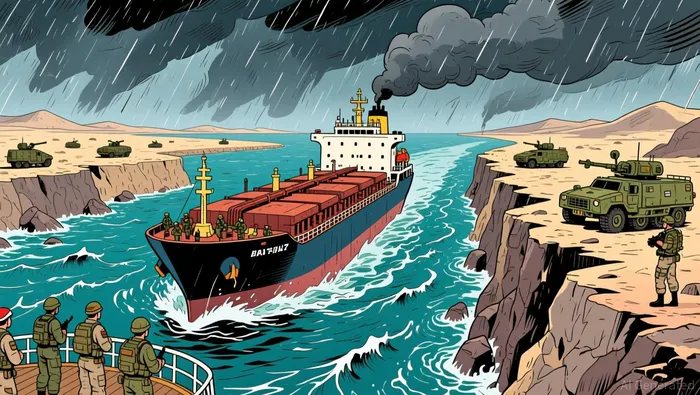
The immediate market impact was a sharp reset. On April 7, as the U.S. and Iran stood on the brink of a full-scale war, President Trump announced a two-week ceasefire agreement brokered by Pakistan, averted a looming U.S. strike threat. The deal was a direct response to Iran's defiant rejection of a previous U.S. plan and its continued blockade of the Strait of Hormuz. The core financial trigger was Iran's commitment to reopen the Strait of Hormuz for safe passage, a key oil chokepoint that had been closed, sending fuel prices soaring and threatening global inflation.
The market's reaction was a classic flow-driven de-escalation. The mere announcement of a deal that promised to unblock a critical shipping lane caused a brief drop in oil prices and a boost in global stocks. This was a direct liquidity relief: the perceived risk of a sudden, massive supply shock to crude oil evaporated, cooling the panic that had fueled the prior surge. The ceasefire provided a two-week breathing space to finalize a broader peace agreement, removing the immediate, catastrophic price-disrupting event from the calendar.
The setup was one of extreme tension. Just hours before the announcement, Iran had rejected the U.S. plan, and the U.S. military was preparing to deploy around 1,000 troops from the 82nd Airborne Division to the region. The market had priced in the high probability of a catastrophic escalation, with oil futures reflecting the cost of a potential war. The ceasefire deal, therefore, acted as a powerful negative shock to the risk premium, causing a rapid repricing of Middle East geopolitical risk downward.
The Strategic Pivot: From Direct Engagement to Regional Partnerships
The U.S. is executing a deliberate financial and operational retreat from the Middle East. The 2025 National Security Strategy explicitly aims to de-emphasize U.S. involvement in the region, shifting focus to great power competition. This is a direct policy pivot away from the decades-long pattern of nation-building and direct military engagement that cost over 6,000 U.S. lives and trillions in reconstruction. The strategic logic is clear: by reducing direct American exposure, the U.S. can redirect resources toward its primary geopolitical rival.
This de-escalation is being funded by regional partners. The new strategy calculates that Arab Gulf states will bear most of the burden for reconstructing Gaza and post-Assad Syria. This is a massive transfer of fiscal and political risk. The U.S. is effectively offloading the enormous costs of post-conflict stabilization onto allies who are already investing heavily in economic diversification. The financial implication is a significant reduction in U.S. fiscal outlays for Middle East reconstruction, but it also places immense pressure on Gulf economies to deliver.
Operationally, the U.S. is pushing key allies to take the lead. The strategy states that Israel will play a leading role in combating Iran and Iran-backed groups. This is a direct reduction in direct American military exposure. The U.S. is shifting from being the primary enforcer to a supporting partner, relying on regional capabilities. This changes the flow of military risk and operational command, with the U.S. minimizing its frontline footprint while still seeking to shape outcomes.
Market Flow Implications and Key Risks
The reopening of the Strait of Hormuz directly addresses a major supply constraint, providing immediate relief to global oil flows. Brent crude prices had surged nearly 40% since the blockade began, reflecting the market's pricing of a catastrophic supply shock. The ceasefire deal, by committing Iran to reopen the chokepoint, removes that immediate risk, which should translate into a sustained flow of crude and downward pressure on prices. This is a classic supply shock unwind, a positive liquidity event for global markets.
The primary risk is the ceasefire's tenuous nature. It is conditional on a longer-term agreement and does not cover ongoing conflicts like Israel's fight against Hezbollah in Lebanon. The deal's foundation is fragile, resting on a 14-day negotiation period to finalize a durable peace. Any breakdown in talks could trigger a rapid repricing of geopolitical risk, with oil prices likely to spike again as the supply threat returns. The market must watch for the deal's inherent instability.
The critical path forward is the 14-day negotiation window. The U.S. has stated Iran's 10-point proposal is a "workable starting point," but it includes major sticking points like Iran maintaining control of the Strait. The flow of diplomacy is now paramount. If talks lead to a concrete, verifiable agreement, the risk premium will remain low. If they stall or collapse, the cycle of threats and strikes is likely to resume, causing renewed market volatility and a sharp reversal in the recent flow relief.