

President Trump is arriving in Beijing without the victory he promised. When he delayed his trip by six weeks, he was betting on Iranian capitulation-expecting to land with shattered Iranian leadership having turned over its nuclear stockpile and reopened the Strait of Hormuz to send a clear message to President Xi. That narrative is gone.
Instead, Trump will step off the plane to questions about how he got bogged down by a far lesser power in a war he started. Iran's nuclear stockpile remains exactly where it was-still under the rubble of last June's American bombing raid with no obvious plan to pry it open again. The Strait of Hormuz, through which China gets more than 30 percent of its oil, stays closed with no obvious plan to pry it open again.
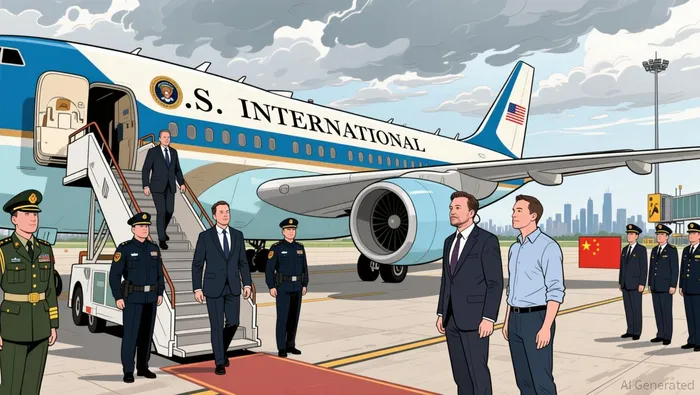
Chancellor Friedrich Merz put it bluntly two weeks ago: Trump looks "humiliated" by a smaller power, having entered the conflict "with no truly convincing strategy". That's the perception problem Beijing will exploit. This is the first U.S. presidential visit to China in nine years since Trump's 2017 trip, but Trump enters without the narrative of American dominance he anticipated.
The leverage dynamics have flipped. Trump wanted to arrive as the man who forced Iranian capitulation-demonstrating Chinese declarations of American decline were premature. Now he's arriving as the man who can't finish a war against a smaller power. For Xi, this changes everything. The Chinese leader can now position himself as the steady hand the world needs, while Trump's bargaining position weakens by the hour.
The summit's ambitions have already been scaled back as a result. The honor guards and business delegation-including Musk, Cook, and CEOs from Citi, BlackRock, and Boeing-remain to demonstrate economic engagement. But the strategic subtext is clear: this is no longer about Trump leveraging an Iran victory. It's about damage control.
The Tech Deal Gambit: Musk, Cook, and the Real Currency
With the Iran narrative in tatters, Trump is arriving with a different kind of ammunition-Silicon Valley's biggest names and the promise of AI cooperation. Elon Musk and Tim Cook are not ceremonial additions. They are the primary bargaining chips in a summit where traditional leverage has evaporated.
Trump expects headline-grabbing deals in AI and trade to compensate for Middle East weakness. He has said he expects China's leader, Xi Jinping, would "give me a big, fat hug when I get there"-a line that reveals both his optimism and his desperation for a visible win. The tech delegation, including CEOs from Citi, BlackRock, Blackstone, Boeing and Goldman Sachs, represents a calculated pivot: if military leverage fails, economic and technological interdependence becomes the story.
But the numbers tell a troubling story for Trump. China gets more than 30 percent of its oil through the Strait of Hormuz-and a bit less of its natural gas. That pipeline is now blocked, with no obvious plan to pry it open. The closure threatens China's energy security directly, giving Beijing leverage Trump cannot easily counter. When the U.S. sanctioned several Chinese firms accused of assisting Iranian oil shipments, China condemned the measures as "illegal unilateral sanctions" and invoked a rarely used blocking statute. Beijing has shown no willingness to pressure Tehran, instead hosting Iran's foreign minister and defending Iran's right to develop civilian nuclear energy.
This is where Pete Hegseth's presence becomes critical. His trip marks the first time a U.S. defense secretary has accompanied a president to China since Nixon in 1972. Beijing had already provided high-level assurances-explicitly ruling out the transfer of surface-to-air missiles to Iran-but Hegseth is there to lock in security arrangements before Iran escalates again. The message is clear: Trump needs to secure the strategic backdrop before the tech deals can even be discussed.
The tension is palpable. Trump wants to walk away with signed agreements and photoshopped handshakes. But Xi controls the pace, the agenda, and the oil flowing through the Strait. The tech deals may be Trump's best offering, but they arrive in a room where China holds the matches.
The Taiwan Question: What Trump Is Willing to Sacrifice
The most dangerous implicit trade on this trip isn't about AI chips or Boeing jets-it's America's commitment to Taiwan. Trump's insistence that his personal relationship with Xi will "prevent" a Chinese invasion reveals he's signaling flexibility on a issue that has long been the red line of US Asia policy.
"I have a very good relationship with President Xi. He knows I don't want that to happen," Trump told reporters before departing-the direct signal that he's softening the US commitment Taiwan has come to rely on. This isn't just diplomatic posturing. Trump also said he would speak to Xi about US arms sales to Taiwan, a departure from the historic American position that it will not consult Beijing on its support for the island.
That's a fundamental shift. For decades, the US has deliberately avoided giving China any veto over its arms sales to Taiwan. By opening that discussion, Trump is effectively treating Taiwan as a bargaining chip rather than a strategic imperative.
The timing is catastrophic for this calculus. The Iran war has left Trump looking "bogged down by a far lesser power" having entered the conflict with no truly convincing strategy. China controls the leverage points that matter-oil flowing through the Strait of Hormuz, influence in Tehran, and the ability to punish American weakness at the exact flashpoint where China holds the advantage.
The fears are already explicit in London and Washington. Fears exist that Trump might be tempted to weaken US support for Taiwan in return for Xi's assistance on Iran or trade concessions. The US recently sanctioned several Chinese firms accused of assisting Iranian oil shipments, and China responded by invoking a rarely used blocking statute and condemning the measures as "illegal unilateral sanctions."
Xi has offered implicit criticism of the US approach throughout the crisis, saying safeguarding international rule of law "must not be selectively applied or disregarded." Meanwhile, Beijing has hosted Iran's foreign minister and defended Tehran's right to develop civilian nuclear energy.
This is the setup. Trump arrives needing a win. China controls the oil, holds leverage on Iran, and sits on the Taiwan question that matters most to Beijing's strategic ambitions. The personal relationship pitch-"he knows I don't want that to happen"-treats a sovereign democracy's security as negotiable. That creates long-term strategic risk far exceeding any short-term gain on Iran or trade.
The tech delegation may grab headlines. But the real test of this summit will be whether Trump walks away having strengthened America's position in the Western Pacific-or traded it away for a hug.
Catalysts and Scenarios: What Moves the Market
The visit runs from May 13 to 15, 2026, with key announcements expected on day one-May 14 Beijing time when Trump lands in Beijing. That's when markets will get their first real signal on whether this summit delivers a strategic win or a diplomatic setback.
The victory scenario is narrow but clear: a joint statement committing both powers to reopening the Strait of Hormuz. Without it, Trump returns looking like the man who couldn't finish a war against a smaller power having entered the conflict with no truly convincing strategy. That narrative would crush his political positioning and signal to markets that American leverage is evaporating.
A China-mediated ceasefire in Iran-or a breakthrough in nuclear negotiations with Tehran-would reframe the entire visit as a strategic success. It would show Xi choosing stability over confrontation, and give Trump a tangible win to showcase back home. But here's the problem: China has shown no willingness to pressure Tehran. Beijing has hosted Iran's foreign minister and defended Tehran's right to develop civilian nuclear energy while condemning US sanctions as "illegal unilateral measures".
The disaster scenario is equally clear: if Trump appears to trade Taiwan for Chinese help on Iran or trade, markets will price in higher regional conflict probability and potential ally defection. The signal would be catastrophic-America treating a sovereign democracy's security as negotiable. That undermines the entire alliance architecture in the Western Pacific.
The tech deals Musk and Cook are meant to deliver may grab headlines, but they arrive in a room where China controls the matches. The oil flowing through the Strait of Hormuz-more than 30 percent of China's oil and a bit less of its natural gas-remains blocked. That's the leverage point that matters, and Xi holds it.
Watch the joint statement. Watch for any mention of the Strait. Watch whether Trump mentions Taiwan during his meetings with Xi. Those three things will tell you whether this visit moves the market-or breaks it.