

The strategic deadlock surrounding the Strait of Hormuz has evolved into a high-stakes "messy middle" that defies traditional market pricing models. As of April 13, 2026, the global energy landscape is trapped between President Trump's optimistic rhetoric and the grim reality of a newly enforced U.S. Maritime Blockade. While the White House publicly signals that the transit route could reopen "fairly soon," the underlying mechanics of the conflict suggest a deliberate strategy of "controlled pressure" rather than a clean de-escalation. This tension is keeping the energy risk premium firmly embedded in global benchmarks, as evidenced by Brent Crude surging back toward the $104 range following the collapse of the Islamabad peace talks.
Domestic Pressure Mounts Amid Inflationary Fallout
The economic consequences of this prolonged "journey down to Iran" are no longer theoretical. The most recent data from the Bureau of Labor Statistics (BLS) indicates that March CPI hit 3.3%, a sharp acceleration that has rattled Wall Street's hopes for a stable interest rate environment. This inflationary spike is directly tied to the "gray zone" of the Hormuz blockade, where shipping is technically possible but functionally restricted by astronomical war-risk insurance premiums and aggressive U.S. naval interdictions. As JPMorgan CEO Jamie Dimon noted in his 2026 shareholder letter, the market is currently struggling to price an environment that is neither a full-scale war nor a return to the status quo, leading to "stickier" inflation that could force the Federal Reserve to remain hawkish through the November midterms.
Agriculture and Fertilizer Disruptions
Beyond the gas pump, a secondary and perhaps more dangerous crisis is brewing in the American Heartland. The American Farm Bureau Federation warns that the blockade has effectively throttled the transit of 49% of the world's urea and 30% of its ammonia supplies. This disruption to the fertilizer supply chain represents a systemic threat to the 2026 harvest, creating a direct feedback loop between Middle Eastern military operations and U.S. food security. Agriculture Secretary Brooke Rollins has already characterized this as an "emergency" for domestic farmers, as the rising cost of nitrogen-based inputs threatens to squeeze margins just as the planting season begins.
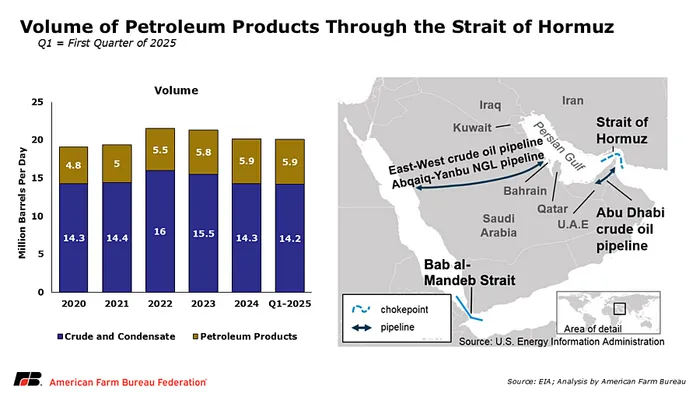
Despite the administration's claims that the "traffic snarl" will be resolved within weeks, industry insiders remain deeply skeptical. During a recent summit in Houston, Chevron CEO Mike Wirth argued that financial markets continue to underestimate the severity of the constraints on the physical flow of oil. The disconnect between Washington's optimistic messaging and the cautious behavior of VLCC (Very Large Crude Carrier) operators suggests that the energy risk premium is not a temporary blip but a structural feature of the 2026 economy.
A Long Stretch of Uncertainty
In summary, the United States is attempting to balance two contradictory goals: maintaining enough flow through Hormuz to prevent a global energy collapse while simultaneously tightening the noose on Iran's oil revenues. This policy of "maximal pressure with minimal shock" has left the market in a state of paralysis. Until a definitive resolution is reached regarding Iran's nuclear capabilities or a new logistical baseline is established for the Gulf, oil prices are likely to remain firm, inflation will remain harder to settle, and the political cost within the United States will continue to escalate as the November elections approach.