

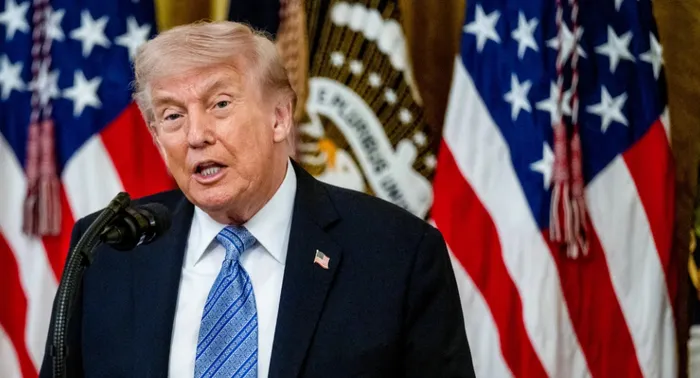
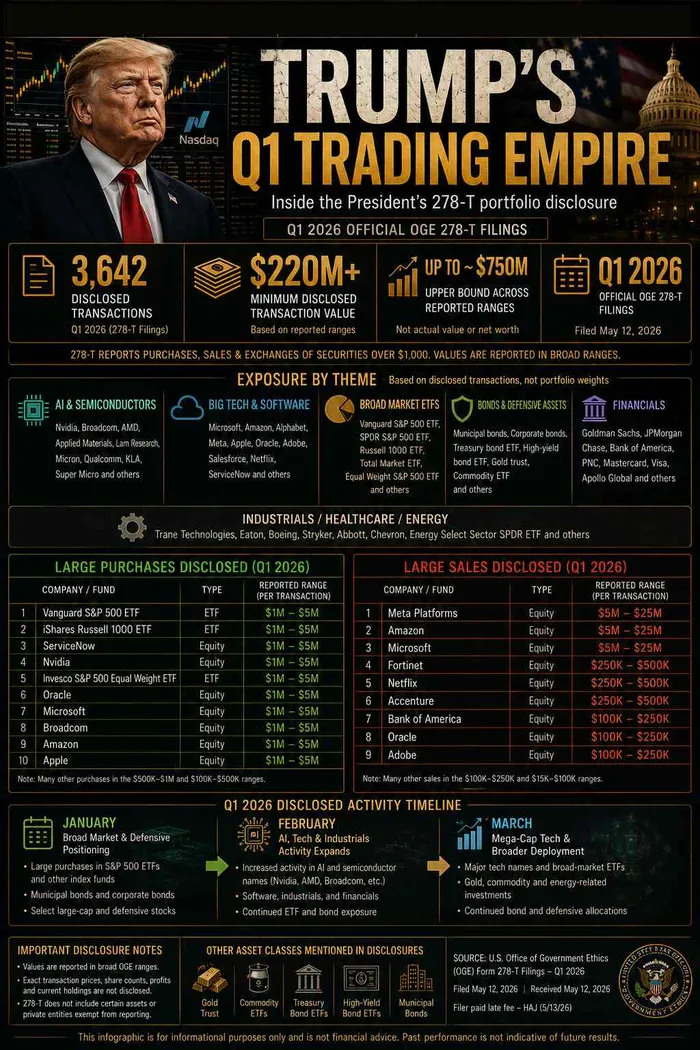
The recent release of two extensive Form 278-T periodic transaction reports by the U.S. Office of Government Ethics (OGE) has provided a rare window into the financial maneuverings of President Donald J. Trump. The filings, made public in early May 2026, document a staggering volume of securities trading during the first quarter of the year. With over 3,000 individual transactions and a cumulative value estimated between $220 million and $750 million, the disclosures underscore the unprecedented intersection of vast personal wealth, active equity trading, and executive branch policy. Most notably, strategic purchases in key aerospace and semiconductor stocks closely align with major geopolitical developments, reviving ongoing debates regarding executive ethics and conflict-of-interest norms.
Scope and Scale of the Q1 2026 Transactions
The sheer volume of the recently disclosed trading activity is highly unusual for a sitting chief executive. Across 113 pages, the filings detail a rapid restructuring of assets, including the purchase and sale of U.S. equities, exchange-traded funds (ETFs), and municipal bonds.
While federal ethics rules permit the reporting of transaction values in broad brackets rather than exact figures, the aggregate ranges paint a picture of immense liquidity movement. The portfolio exhibits massive outflows from legacy mega-cap tech stocks, offset by aggressive sector-specific acquisitions and broad-market indexing (such as the S&P 500 VOO and Vanguard Dividend Appreciation ETF VIG).
Strategic Positioning: The China Trip Correlation
From an analytical standpoint, the most scrutinized aspect of the disclosure is the timing of specific multi-million-dollar acquisitions in relation to the administration's foreign policy initiatives.
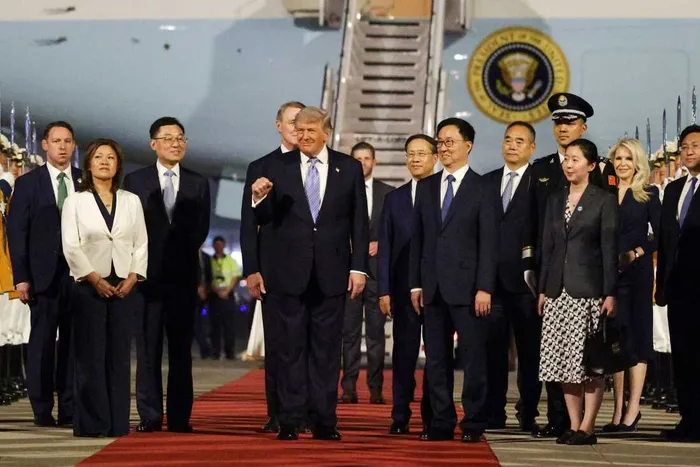
On February 10, 2026, purchases valued between $1 million and $5 million were executed for shares of Boeing (BA) and Nvidia (NVDA). These trades occurred against the backdrop of highly anticipated bilateral negotiations with China.
Boeing: As the administration finalized an aircraft procurement deal with Beijing—culminating in an announced order of 200 Boeing planes during the President's state visit—the timing of the equity purchase naturally raises questions regarding information asymmetry.
Nvidia: Similarly, Nvidia's stock has surged on expectations of renewed or expanded access to the Chinese market, a factor heavily dependent on the administration's semiconductor export control policies.
While the Trump Organization has previously stated that the President's investments are handled by independent managers utilizing "computer-based model portfolios" without direct familial input, the precise alignment of these trades with diplomatic deliverables highlights the vulnerabilities of current disclosure frameworks.
Major Divestments and Sector Rotation
In contrast to the targeted acquisitions, the filings reveal heavy selling pressure applied to specific technology giants. On the same day the Boeing and Nvidia purchases were made, large-scale sales—ranging from $5 million to $25 million each—were executed for shares of Microsoft (MSFT), Amazon.com (AMZN), and Meta Platforms (META).
This coordinated sell-off could indicate several underlying strategies:
- Algorithmic Rebalancing: If the trust is indeed managed by quantitative models, this may simply represent a routine rebalancing out of over-weighted tech mega-caps into industrials and semiconductors.
- Risk Mitigation: Liquidating high-beta tech holdings in favor of municipal bonds and diversified ETFs may represent a defensive posture against anticipated regulatory scrutiny or broader macroeconomic headwinds.
Ethical and Governance Implications
The May 2026 disclosures fundamentally test the boundaries of U.S. government ethics laws. By statute (18 U.S.C. § 208), the President and Vice President are exempt from strict conflict-of-interest rules that prohibit federal employees from participating in government matters in which they hold a financial stake. The underlying legislative logic assumes that the President's decisions impact the entire economy, making total divestment functionally impossible.
Historically, modern presidents have mitigated ethical concerns by liquidating individual equities and placing their wealth in blind trusts or broad, vanilla mutual funds. President Trump's reliance on a trust managed by his children and independent brokers, combined with active trading in single-name stocks, represents a stark departure from these traditional guardrails.
The OGE Form 278-T, while a vital tool for transparency, is structurally limited. It relies on 30- to 45-day reporting delays and broad valuation bands (e.g., "$1 million to $5 million"). Consequently, the public and regulatory bodies can only analyze these transactions retroactively, severely limiting real-time accountability.
Conclusion
President Trump's Q1 2026 transaction reports highlight a complex dynamic: the execution of a high-volume, nine-figure trading strategy concurrent with market-moving executive actions. While legally permissible under current presidential exemptions, the distinct correlation between targeted equity purchases (Boeing, Nvidia) and favorable diplomatic outcomes (China trade deals) illustrates the friction between private wealth and public duty. As the administration continues to negotiate major international economic policies, this portfolio will likely remain a focal point for governance watchdogs, market analysts, and political critics alike.