

The immediate shock arrived on Monday, May 11. President Trump's swift rejection of Iran's peace proposal as "TOTALLY UNACCEPTABLE" on Truth Social sent oil prices surging. This wasn't just a diplomatic stalemate; it was a visceral, authoritative rejection that triggered a classic fear response in markets. The psychological driver here is loss aversion: the potential costs of conflict escalation-paralyzed shipping lanes, soaring energy bills-outweighed any rational assessment of the proposal's merits. The recency bias amplified this, as a single, forceful statement from the most powerful leader in the room instantly reset the risk narrative.
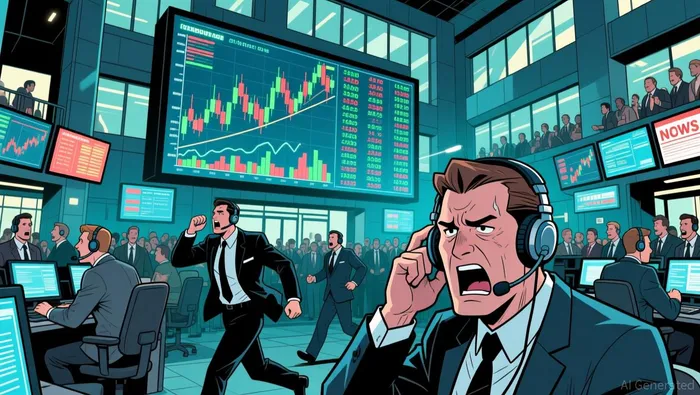
This breakdown exemplifies herd behavior. The rejection acted as a catalyst, triggering a flight to safe havens. Investors, seeing the geopolitical risk spike, rushed to assets perceived as less exposed to Middle East turmoil. The timing, however, introduces a layer of cognitive dissonance. This rejection occurs just days before a high-stakes state visit to China scheduled for May 14-15. Markets are now struggling to reconcile two powerful, conflicting signals: the immediate, visceral threat of war escalation versus the potential for diplomatic progress on another critical front. The result is a volatile tug-of-war, where the emotional punch of a single tweet can momentarily overpower a carefully planned summit agenda.
Earnings Season: The Behavioral Trap of HIMS and QUBT
The market's jitters are playing out starkly in two very different stocks, each illustrating a distinct behavioral trap. Hims & Hers Health (HIMS) shows how negative sentiment can amplify a stock's decline, while Quantum Computing (QUBT) reveals how investors gamble on binary futures, ignoring the present reality.
HIMS is a textbook case of overreaction and confirmation bias. The stock has fallen by more than 23% in 2026, making it a laggard in a weak sector. Yet, it has also seen wild swings, like a nearly 4% jump after an FDA announcement that was quickly erased by a nearly 5% drop as traders locked in profits. This volatility isn't driven by fundamentals alone. It's fueled by a powerful anchoring effect. The stock's forward P/E ratio sits at a steep 51.83, a valuation that sets a high bar. When the company reports its Q1 earnings on May 11, analysts expect a 90% year-over-year decline in earnings per share. For a stock anchored to that lofty growth narrative, even a modest miss could trigger a disproportionate sell-off, as investors' fear of loss outweighs the potential for recovery.
Contrast this with Quantum Computing (QUBT). The stock trades on pure hype and the promise of a technological revolution, embodying prospect theory. Investors are not valuing its current operations, which show a trailing EPS of -$0.11 and a 1-year target estimate of $17.83 against a current price around $9.60. Instead, they are gambling on a binary outcome: either the company becomes a dominant force in a new computing paradigm, or it fails entirely. This mindset ignores the company's significant operating losses and focuses on the potential for outsized gains from government contracts and partnerships. The stock's high beta of 3.70 reflects this speculative, high-risk appetite.
The bottom line is that both stocks are being driven by psychology, not pure math. HIMS suffers from the market's tendency to overreact to negative news and anchor expectations to past performance, even as the company navigates a strategic shift. QUBT, meanwhile, is a victim of the same irrational exuberance that often fuels tech bubbles, where investors are willing to pay for a dream rather than a dividend. In a volatile market, these behavioral biases create the very choppiness that defines the trading day.
Sector and Stock-Level Implications: Silver, AI Chips, and the Path Forward
The market's behavioral tug-of-war is now playing out in specific asset classes, where macro fears collide with micro-level realities. First Majestic Silver (AG) is caught in a classic recency bias trap. The stock has surged as silver prices surge, driven by the same geopolitical jitters that spiked oil. This creates a powerful, short-term momentum that can override fundamental risks. Yet, the company's own operational challenges are clear. First-quarter production of silver and gold fell year-over-year, and it faces a long-running tax conflict with the Mexican government that threatens its core mining operations. The behavioral flaw here is anchoring to the recent price pop, which may blind investors to these persistent, tangible headwinds. The stock's move is a herd reaction to a commodity surge, not a reassessment of the miner's specific vulnerabilities.
On the flip side, GSI Technology (GSIT) shows how herd behavior can fuel short-term momentum while masking deep financial strain. The company's SRAM business, critical for high-performance AI chips, saw revenue grow 22% in fiscal 2026. This demand-driven growth is real and creates a powerful narrative for investors. Yet, the financials reveal a different story. Despite the revenue climb, the company posted a fiscal 2026 operating loss of $17.5 million, more than doubling the prior year's loss. The herd is chasing the AI growth story, but the prospect theory of paying for a future winner ignores the present-day cash burn. This is a setup for volatility; a stumble in the AI demand narrative could quickly reverse the momentum.
The immediate path forward hinges on two clear catalysts that will test this fragile market narrative. First, the U.S.-China state visit scheduled for May 14-15 represents a major geopolitical reset. Markets are currently split between the fear of Middle East escalation and the hope for diplomatic progress in Asia. The summit's outcome will force a reconciliation of these conflicting signals, likely causing a sharp swing in risk appetite. Second, the May 11 earnings reports for HIMS and GSIT will provide concrete data points. For HIMS, the focus will be on whether the stock's 23% decline in 2026 can be arrested. For GSIT, investors will scrutinize if the 22% revenue growth can eventually offset its mounting losses. These events will act as reality checks, forcing investors to choose between the emotional pull of a narrative and the cold math of a balance sheet.