

The setup for this summit is a classic "sell the news" candidate. The market has already baked in the expectation of modest gains, leaving little room for a major positive surprise. Futures for the Dow, S&P 500, and Nasdaq 100 are trading flat, a clear signal of low conviction in a transformative outcome. This calm reflects a shared understanding that the meeting is unlikely to produce strategic breakthroughs.
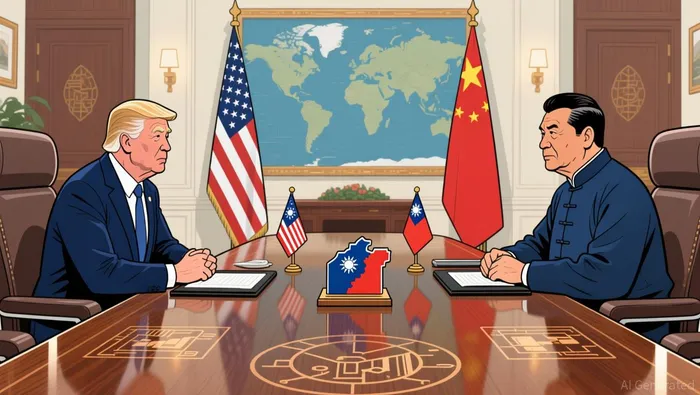
The likely focus will be on tactical issues. Both leaders are expected to grapple for specific concessions, with Xi seeking US easing on technology export controls, Taiwan, and tariffs, while Trump pushes for large Chinese purchases of US goods, expanded access to rare earths, and progress on fentanyl cooperation. The summit is also not expected to yield major investment announcements or meaningful Chinese support for US efforts on Iran. In other words, the agenda is defined by manageable, incremental asks, not grand bargains.
Against this backdrop, one specific watchpoint stands out as a potential "win" for Beijing: whether China secures a US commitment to restrict arms sales to Taiwan. This is a key demand for Beijing, and any perceived concession here would be a concrete outcome the market could react to. Yet, given the summit's expected tactical nature, even a positive development on this front may be seen as merely meeting a known expectation, not exceeding it. The flat futures market suggests investors are braced for this scenario, ready to sell any incremental good news that doesn't fundamentally reset the strategic trajectory.
The Taiwan and Trade Catalysts
The summit's high-impact catalysts are binary: they either deliver a concrete shift or confirm the status quo. The market is priced for the latter, leaving room for a surprise only if reality diverges sharply.
First, the Iran war backdrop. The conflict has become a major US political liability, with Republican resistance to the war growing in the Senate. The US hopes China will use its leverage to prod Iran to end the two-month-old war and reopen the critical Strait of Hormuz. Yet, as the evidence notes, China's leverage is limited; it has already positioned itself as having weighed in, and the PRC is confident enough to stand up to Trump on this issue. For markets, the key metric is whether China provides tangible, new diplomatic pressure. Any failure to do so would validate the "modest" expectation, but a significant, unexpected move by Beijing could be a major geopolitical relief for the US, potentially boosting risk assets.
The second, more direct catalyst is Taiwan. This is the specific watchpoint where reality could contradict the priced-in script. The market expects a "no" outcome on arms sales, but any explicit US concession would be a seismic geopolitical shift. President Trump authorized an $11 billion arms package for Taiwan last December but has not yet moved forward with delivery. The summit is the moment for that decision. A clear signal that the US is restricting sales would be a major win for Beijing, a concrete outcome that exceeds the low-expectation baseline. Conversely, a reaffirmation of the current policy would merely meet known demands. The expectation gap here is wide: the market is braced for no change, making a positive surprise for China a potential catalyst.
Separately, the business-friendly tone has spurred deals for companies like Boeing (BA) and Nvidia (NVDA). These are tangible economic wins that could support the "fairness and reciprocity" narrative Trump seeks. Yet they are distinct from the core political issues and are unlikely to move the needle on the Iran or Taiwan backdrops. They represent the summit's tactical, incremental side, not the strategic binary outcomes that will ultimately define its market impact.
Market Sentiment and Forward Scenarios
The market's current mood is one of cautious resilience, built on a foundation of strong corporate results but shadowed by geopolitical uncertainty. On one hand, the tech sector is providing a powerful floor. The recent rally that pushed the S&P 500 and Nasdaq to new highs was explicitly powered by confidence in the AI trade, with semiconductor stocks like Nvidia and Micron leading the charge. This earnings-driven momentum has created a "tech-driven long" market, where investor optimism is anchored in expected future profits rather than pure speculation. Yet, this positive sentiment exists alongside a persistent overhang. The market is braced for a summit that is expected to deliver only modest, tactical gains, leaving it vulnerable to any unexpected shift.
This sets up a clear "sell the news" dynamic. The fact that futures for the Dow, S&P 500, and Nasdaq 100 traded mostly flat ahead of the summit's conclusion is the market's clearest signal. It shows low conviction in a transformative outcome. In this setup, the most likely market reaction to a neutral or slightly positive conclusion would be a relief rally. After a period of high anticipation and flat prices, even a meeting of expectations could be enough to trigger a short-covering pop. The market is priced for disappointment, so a "no surprise" outcome might actually be a surprise in a positive sense.
Looking beyond the summit, the next major catalyst is the durability of any progress. Both sides have signaled a commitment to continued engagement, with the expectation that Chairman Xi will make a return visit to the United States in the fall. This upcoming visit will be the true test. It will determine whether the summit's initial goodwill translates into sustained diplomatic momentum or fades as the tactical issues of trade, technology, and Taiwan resurface. For now, the market is waiting to see if the summit's conclusion leads to a relief rally, or if the underlying geopolitical tensions quickly reassert themselves.