

TSMC's CEO says the world can't get enough AI chips. The headline version of that claim has been running for two years - first from Mark Liu in 2024, then from the current CEO C.C. Wei, who told investors in late 2025 that advanced-node capacity falls 'about three times short' of AI demand.
That sounds like a supply crisis. It's not. It's a deliberate bottleneck, and understanding why requires looking at something most headlines skip.
TSMC is not adding overall capacity. In 2025, total wafer output - measured in 12-inch equivalents - actually fell by roughly 10%, a decline of about 170,000 wafers per month. In 2026, the company is adding no net overall capacity either. Instead, it is converting older, cheaper production lines into advanced nodes. Total output goes down. Revenue goes up. That's the trade.
TSMC made $122 billion in 2025, up 36% from the year before. Advanced nodes - 7 nanometers and below, the category where AI chips live - accounted for 74% of wafer sales. First quarter 2026 revenue was $35.9 billion, beating guidance. The company is spending $52 to $56 billion on capital investments in 2026, a 32% jump from 2025, with about 70% going into advanced-node and packaging expansion.
The money isn't wasted. It's focused on one specific choke point that almost nobody outside the semiconductor industry thinks about.
The bottleneck isn't making the chip. It's packaging it. After the silicon die is etched and tested, AI chips need a special assembly step called CoWoS - chip-on-wafer-on-substrate - which stacks the processor next to massive amounts of high-bandwidth memory on a shared base. This is physically different from the wafer-fab work. It requires different equipment, different facilities, and it takes longer to scale. Nvidia alone has reserved more than 50% of TSMC's CoWoS capacity.
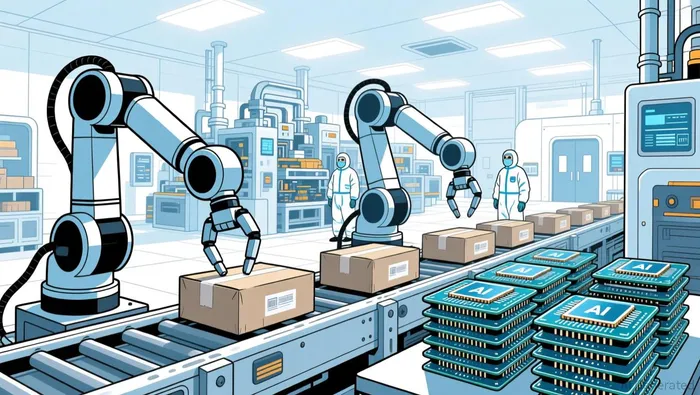
TSMC is expanding CoWoS from roughly 35,000 wafers per month in late 2024 toward a target of 170,000 by the end of 2027. That's real expansion. But the rest of the supply chain - total wafer starts, legacy node output - is flat or declining.
So when the CEO says supply won't meet demand for years, he's telling the truth about one narrow slice of the business. Advanced-node demand is roughly three times available capacity, as TSMC has put it. But total output is shrinking. The shortage is concentrated where the margins are highest.
There's nothing accidental about this. A company that controls the only advanced packaging step in the supply chain, with a single customer - Nvidia - responsible for roughly $33 billion in TSMC revenue this year, or about 22% of the total, doesn't rush to clear a bottleneck. It manages the pace. Let demand queue up. Keep utilization high. Let prices stay firm.
The way to read the CEO's warning is not as an alarm about a broken supply chain. It's a signal that TSMC intends to keep the squeeze on for as long as demand justifies it.
The real question isn't whether the shortage is real. It's what happens when it ends. Deloitte projects global chip sales will reach $975 billion in 2026, with generative AI chips approaching $500 billion - roughly half the industry. Nvidia's fiscal 2026 data center revenue was $194 billion, up 68%. The buildout is enormous. But every buildout has an inflection point where the last customer who wanted to spend stops spending.
TSMC's current margin is 66.2%, and the company is guiding to 65.5-67.5% in Q2. Those margins exist because capacity is constrained. If CoWoS catches up to demand - and TSMC's expansion plan suggests it will by 2027 - the margin compression starts there first. Then spreads to the wafer side.
I suspect the market has been so focused on the revenue growth story that it hasn't priced in how much of it depends on the bottleneck holding. The $52-56 billion capex cycle is the bridge between the current scarcity premium and the day the queues clear.
Test this by watching one number: CoWoS utilization. If Nvidia's share of that capacity stays above 50% into 2027, the squeeze is real and durable. If it drops, the 'shortage' was temporary by design, and the earnings model changes with it. The headline was right about the shortage. It was wrong about why it exists.