

The Goldman Sachs Upgrade Loop
Taiwan Semiconductor Manufacturing Co. (TSMC) stock is up in premarket trading again. Goldman Sachs is almost certainly involved - either a fresh upgrade, a profit forecast bump, or both. Goldman has done this repeatedly through 2026: January, April, and now again. The pattern is mechanical. The stock moves. The narrative writes itself.
But the question nobody in the sell-side ecosystem is asking is the one that actually matters.
The real story isn't why TSMC's stock is up today. The real story is whether the structural shift inside TSMC's operations - one that has already changed the competitive landscape - is durable, or whether the capital spending required to maintain it creates a hidden fragility. Most investors are trading headlines. Any astute engineer would be reading capacity utilization curves.
The Bottleneck Moved. That's the News.
Here is what actually changed inside TSMC's operations in the past six months - and it has nothing to do with Goldman Sachs' latest price target.
For all of 2024 and into early 2025, the bottleneck in TSMC's AI chip supply chain was CoWoS - the chiplet packaging technology that physically joins CPU dies, GPU dies, and HBM memory into the final product. The packaging line was sold out. Nvidia, AMD, and every other AI chip designer were stuck waiting for TSMC to wrap their chips. That constraint capped the entire AI silicon industry at roughly $1.3 trillion in potential revenue.
Then something shifted. SemiAnalysis, one of the few independent semiconductor research outfits worth reading, confirmed in March 2026 that the bottleneck has moved from CoWoS packaging to front-end wafer fabrication. TSMC successfully scaled CoWoS capacity - from approximately 35,000 wafers per month in late 2024 toward 130,000 wafers per month by end-2026 - and even began outsourcing portions of its CoWoS workload to OSAT partners.
The bottleneck moved upstream. That means TSMC just regained pricing power.
When packaging was the constraint, TSMC had to rush to clear the bottleneck. Now that front-end advanced-node capacity is the bottleneck, the dynamic flips. TSMC controls the scarce resource. It's the only foundry producing 3nm chips at scale and the only one with 2nm in mass production. Customers don't have alternatives.
This is why Q1 2026 delivered $35.9 billion in revenue with a 66.2% gross margin - both numbers beating the top end of management's own guidance. Q2 guidance of $39 billion to $40.2 billion implies 32% year-over-year growth. Full-year 2026 revenue is projected to grow more than 30%.
The sell-side narrative gets the direction right but misses the mechanism. TSMC isn't just riding AI demand. It's benefiting from a structural bottleneck migration that concentrates allocation power back where it already lived - at the front end, in TSMC's fabs, where no competitor can touch it.
The Capex Math Nobody Is Pricing In
But here's the part the upgrade reports skip.
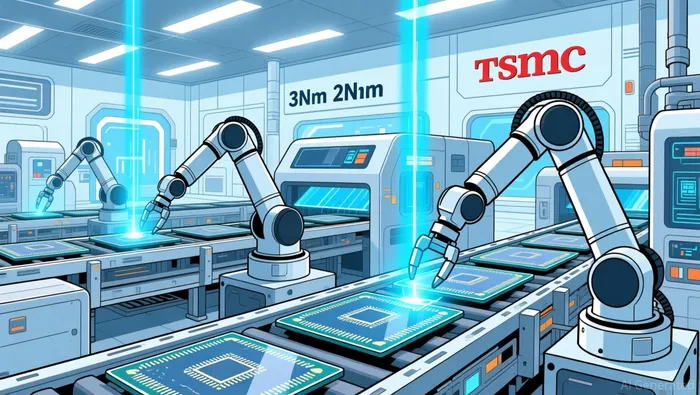
TSMC's capital expenditure guidance for 2026 sits at $52 billion to $56 billion in the baseline scenario. That's already up from $40.9 billion in 2025. But the upper bound could reach $110 billion if demand persists and TSMC decides to accelerate expansion further.
Capex at that scale isn't just a line item. It's a commitment to keep building the bottleneck - to keep front-end scarce enough to maintain pricing power, while simultaneously expanding enough to capture every dollar of AI demand. The $3.48 billion in equipment cost per 10,000 wafer starts per month for a 2nm GAA process means TSMC is spending billions just to add marginal capacity.
TSMC's moat is self-funding, but only if utilization stays near capacity.
The framework is simple: TSMC's gross margin of 66% funds capex of roughly 40-50% of revenue. That means TSMC is reinvesting more than half its gross profit back into capacity. If utilization drops, the math collapses. If utilization stays at current levels, the cycle sustains.
The Q2 guidance of 65.5% to 67.5% gross margin suggests management expects the cycle to hold. But here's what the numbers hide: that margin band already assumes continued AI demand growth, favorable advanced-node mix, and no geopolitical disruption. TSMC's own Q1 presentation warned that Middle East conflict could impact profitability through cost increases.
The Cross-Currents
The cross-currents are three: the bottleneck shift preserves TSMC's pricing advantage; the capex requirement is massive but sustainable only at high utilization; and the sell-side narrative keeps getting the conclusion right while missing the fragility in the mechanics.
Directionally, the thesis is intact. TSMC controls the scarce resource at the front end. Samsung remains a distant second in advanced nodes. Custom silicon players like Amazon and Google are adding volume but buying from TSMC, not replacing it. The 2nm ramp is real, not a keynote promise.
But the investor implication is narrower than the Goldman Sachs cheerleading suggests. TSMC's stock at roughly $412 reflects a company that can sustain its margins and growth - not one that is immune to a demand shock. The 30%+ revenue growth guidance embeds a specific assumption: that every hyperscaler and AI chip designer keeps spending at current trajectories. If that assumption breaks, the capex burden that looks like strength today becomes overcapacity risk tomorrow.
TSMC is the only game in town for advanced logic. That makes it indispensable - and makes the valuation entirely dependent on the demand cycle holding.
The stock can keep rising on analyst upgrades. But the real work is in the utilization curve, not the price target. If front-end utilization stays above 85%, the math works and the moat deepens. If it cracks below 75%, every dollar of that $56 billion in capex becomes a question about timing rather than strategy.
You decide which was marketing fluff and which one was analysis.