

The story here is two separate moves. First, Uber terminated a major acquisition. Second, it made a new investment. The market's muted reaction tells us which part was priced in and which was a surprise.
The acquisition itself was a clear bet. In May 2024, Uber announced it would buy Delivery Hero's Foodpanda business in Taiwan for $950 million. The goal was to expand Uber Eats by combining Foodpanda's strong local presence with Uber's platform. But Taiwan's antitrust regulator blocked the deal last year, citing competitive concerns. The combined market share would have been too dominant. So, the deal was dead. What was not dead was the financial penalty for walking away.
Under the original agreement, Uber is required to pay a termination fee estimated at about $250 million. This was a known cost. The market had already factored that fee into Delivery Hero's stock price, which is why the company's shares fell on the news. For Uber, the fee was a sunk cost. The stock's decline was more about the lost strategic opportunity than a surprise expense.
The new, forward-looking bet is the separate agreement. While the acquisition is off, Uber and Delivery Hero have a separate share purchase agreement under which Uber agreed to buy $300 million worth of newly issued shares of the German company. This is a clean break from the failed deal. It's a direct investment in Delivery Hero's future, not a merger. The market's calm response suggests this new purchase wasn't fully priced in. It's a fresh signal of partnership, not a surprise cost. The expectation gap has shifted from a regulatory risk to a new strategic alignment.
Expectation Gap: Why the Stock Reaction Was Mild
The market's measured response-Delivery Hero shares down 5.7% and Uber shares off 3.3%-tells a clear story. This wasn't a shock to the system. It was a confirmation of a known risk, followed by a modest, forward-looking adjustment.
The regulatory collapse was the main event, and it was widely anticipated. The deal's path was always narrow, facing a regulatory hurdle due to its anti-competitive nature. The Taiwan Fair Trade Commission's decision to block it last year was a high-probability outcome that had been priced into Delivery Hero's stock for months. When the news finally landed, it was a confirmation, not a surprise. The stock's decline reflects the loss of a strategic asset, but not a new, unexpected liability.
That brings us to the financial impact. The $250 million termination fee was a known cost from the start. It was a contractual penalty for walking away, not an unexpected write-off that would distort quarterly earnings. For Uber, this was a sunk cost. The market had already accounted for this fee as part of the deal's risk profile. The muted move in Uber's stock shows the fee didn't materially change the expectation for its near-term financials.
The real expectation gap here is smaller than it first appears. The market had priced in a high probability of regulatory failure and the associated fee. The actual outcome simply validated those priced-in risks. The only new element was the separate $300 million share purchase, which was a clean break from the failed deal and likely not fully reflected in the stock prices. In this setup, the stock moves were about the loss of a potential prize, not the discovery of a hidden cost.
The $300M Stake: A Strategic Alignment or a Distraction?
The $300 million share purchase is a clean break from the failed acquisition. It was not part of the terminated foodpanda deal and remains a separate transaction. This move is Uber's way of buying a piece of Delivery Hero's future, not a merger. But the timing suggests it's more than just a strategic alignment-it's a tactical play to manage fallout.
The deal was announced alongside a $1.25 billion package to boost liquidity for Delivery Hero, which is grappling with rising competition in Asia. This context is key. Delivery Hero is under internal pressure, with a major investor threatening to seek a leadership change and push for a strategic review. The $300 million purchase, at a 30% premium to the stock price, provides immediate cash to a company in a vulnerable position. For Uber, it's a low-cost entry into a market where it already has a strong platform, offering a potential path to profitability in Taiwan's competitive landscape.
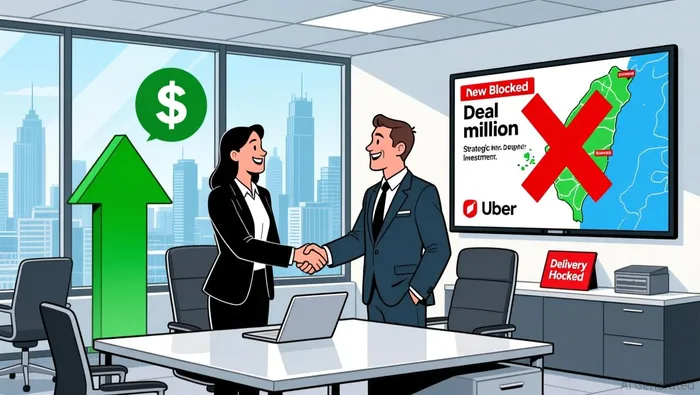
So, is this a genuine partnership or a distraction? The numbers point to a tactical move. The premium paid signals urgency, not patience. It comes as Delivery Hero faces a shareholder revolt and regulatory scrutiny over its market dominance. The investment helps Uber's bottom line by contributing to adjusted core profit, but it also ties Uber to a company in the midst of a strategic reset. The real expectation gap now is whether this stake will be a catalyst for Delivery Hero's turnaround or a costly distraction as it navigates internal and external pressures.
Catalysts and Risks: What to Watch for the $300M Stake
The $300 million stake is now a live investment. Its future value hinges on two primary catalysts and one clear risk, all of which will play out in the coming quarters.
The main catalyst is the strategic review at Delivery Hero itself. A major investor, Aspex Management, has threatened to seek a leadership change and speed up a strategic review. This pressure is the direct result of the company's struggles, including an EU fine of €329 million for a "no-poach" deal and ongoing battles with thin margins in Asia. The catalyst for Uber's stake is whether this internal push leads to concrete actions-like selling underperforming assets or sharpening its focus-that actually improve shareholder value. If Delivery Hero's turnaround succeeds, Uber's investment could be a winner. If not, the premium paid becomes harder to justify.
The key risk is that Uber's stake becomes a stranded asset. The investment was made at a 30% premium to the stock price during a period of significant internal and external pressure. If Delivery Hero's broader turnaround efforts fail, the stock could remain under pressure. The company is already facing rising competition in Asia and regulatory scrutiny over its market dominance. In that scenario, Uber's $300 million would be tied to a business that continues to struggle, offering little upside and potentially becoming a costly distraction.
Finally, monitor for any regulatory or competitive developments in Asia that could further pressure Delivery Hero's core business. The company has been trying to divest some of its assets in the region to improve profitability, but the path is fraught. The combined market share of Uber and Delivery Hero in Taiwan, if the acquisition had closed, would have been a regulatory risk. While that deal is off, the competitive intensity in Asia remains high, with platforms like Grab and DoorDash expanding aggressively. Any new regulatory action or a sharp escalation in discount wars could directly impact Delivery Hero's financials and, by extension, the value of Uber's stake. The expectation gap for this investment is now about execution: can Delivery Hero turn things around, or will Uber's bet get caught in the crossfire?