

The UK's decision to deploy its Carrier Strike Group to the North Atlantic and High North is not a temporary security measure-it is a structural response to shifting commodity trade risks. Operation Firecrest, led by HMS Prince of Wales, signals that the maritime corridors carrying oil, gas, and bulk commodities face a new era of persistent risk premium.
The driving force behind this reconfiguration is clear: Russian naval activity in the North Atlantic has surged 30% over the past two years, threatening UK waters with increasing frequency. For commodity traders, this is not merely a military statistic-it represents a material escalation in transit risk along critical supply routes. The Greenland-Iceland-UK gap, a traditional chokepoint for North Atlantic shipping, is becoming a zone of heightened strategic competition.
But the risk extends beyond surface vessels. Allied navies are increasingly focused on protecting critical undersea cables and pipelines that carry both communications and energy flows across the ocean floor. A disruption to these subsea assets would have immediate, severe implications for energy security across the Euro-Atlantic basin. The deployment explicitly aims to deter threats to this infrastructure, acknowledging that modern commodity trade depends as much on subsea integrity as it does on surface navigation.
Perhaps most consequential for long-term trade flows is the opening of the Arctic. Melting sea ice is creating new shipping routes through the High North, potentially shortening transit times between Asia, Europe, and North America. Yet these emerging lanes come with their own risk profile-limited infrastructure, harsh conditions, and now, increased hostile state activity. NATO's newly launched Arctic Sentry mission reflects the Alliance's recognition that the Arctic is no longer a peripheral region but a central arena for future trade security.
The UK's commitment to 2.6% of GDP defense spending from 2027 underscores the structural nature of this shift. This is not a short-term deployment but a sustained repositioning of maritime power to manage commodity flow risks over the coming decade. For energy and bulk commodity markets, the message is unambiguous: the North Atlantic trade corridor now carries a permanent risk premium, and the cost of securing these flows will rise accordingly.
Commodity Trade Implications: Routes, Insurance, and Price Effects
The security environment translating into concrete costs for commodity traders and shipping planners. The UK's enhanced naval presence in the North Atlantic and High North is a necessary response to rising threats, but it comes with material implications for trade flows.
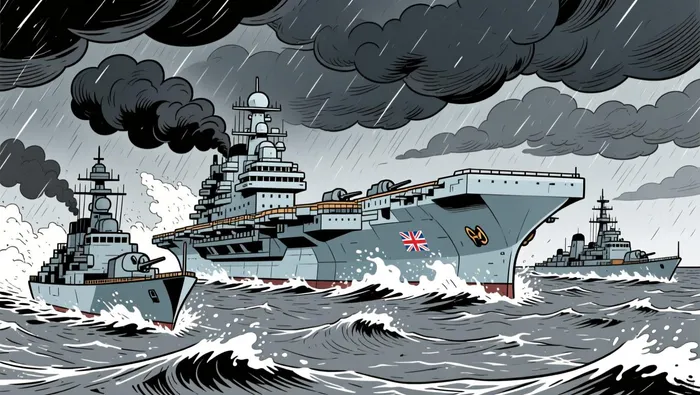
Russian naval activity has increased 30% over the past two years, forcing shipping planners to reconsider traditional routes. The Greenland-Iceland-UK gap, a critical chokepoint for North Atlantic shipping, now requires enhanced security precautions. While the Carrier Strike Group provides deterrence, its presence alone cannot eliminate transit risk-vessels may still opt for longer, safer corridors, adding days to transit times and increasing fuel costs. For bulk commodity traders moving oil and gas across the Atlantic, these extended routes represent a structural cost increase that will persist as long as the threat environment remains elevated.
Insurance premiums for North Atlantic and High North voyages are rising in tandem with the security deterioration. Underwriters are pricing in the heightened risk of naval confrontation and the potential for collateral damage to commercial vessels. This is particularly relevant for energy tankers and LNG carriers that form the backbone of Euro-Atlantic energy trade. The premium uplift is not a one-time charge but a recurring cost that compounds over the life of any trade route depending on these waters.
The UK's multi-theatre commitments create a concerning coverage gap. The Ministry of Defence has acknowledged that forces are simultaneously engaged in the Middle East, continuing support to Ukraine, and responding to increased activity in the High North. This stretching of capabilities means that no single theatre can guarantee full naval coverage at all times. For commodity traders, this introduces a layer of uncertainty-naval protection that appears assured in planning may be compromised if multiple crises erupt concurrently. The MoD's own admission of operating under increasing strain underscores that force availability is not guaranteed across all required regions simultaneously.
The most severe price shock would come from undersea infrastructure damage. The deployment explicitly aims to protect critical undersea cables and pipelines, acknowledging their vulnerability. A successful attack on these subsea assets-whether by hostile state actors or as collateral in a broader conflict-would disrupt energy flows instantly across the Euro-Atlantic basin. Gas markets, in particular, are sensitive to supply interruptions, and a disruption to undersea pipelines carrying natural gas could trigger sharp price spikes within days. The UK's focus on defending this infrastructure reflects a recognition that its loss would have immediate, severe implications for energy security.
The UK's concurrent security commitments-from the Strait of Hormuz to the High North-demonstrate the breadth of the challenge. While the UKMTO Centre provides essential security information for mariners, the sheer geographic spread of operations means that coverage cannot be absolute everywhere at once.
The bottom line for commodity traders: the North Atlantic now carries a permanent risk premium that will manifest in higher insurance costs, longer transit routes, and the ever-present risk of sudden disruption. This is not a temporary surcharge but a structural feature of the trade environment for the foreseeable future.
The Strategic Trade-Off: Deterrence vs. Supply Chain Reliability
The UK's enhanced naval presence in the North Atlantic delivers a clear deterrence signal-but it also exposes a fundamental tension between defensive ambition and operational capacity. For commodity supply chain planners, this tension translates into a critical question: how reliable is a security guarantee provided by forces that are already stretched thin?
The Ministry of Defence has acknowledged it is operating under increasing strain, with forces simultaneously engaged in the Middle East, supporting Ukraine, and responding to heightened High North activity. This is not a temporary scheduling conflict-it is a structural constraint. When the same naval assets are required across multiple theatres, the assurance provided to commodity traders becomes conditional on crisis concurrency. If multiple emergencies erupt simultaneously, as the MoD itself warns is a growing possibility, naval coverage in any single region-including the North Atlantic-becomes uncertain.
This structural strain extends to specific capability areas critical for North Atlantic operations. While the exact inventory levels are not detailed in available reporting, the MoD has confirmed ongoing capability gaps affecting key naval functions, with certain asset classes described as operating at fragile levels while awaiting replacements. For a Carrier Strike Group deployment like Operation Firecrest-led by HMS Prince of Wales and including HMS Dragon acting as the command ship-the availability of escort vessels, fleet support, and anti-submarine warfare assets becomes a critical planning variable. Any degradation in these supporting capabilities directly impacts the sustainability of forward deterrence.
Public skepticism reflects this operational reality. Social media commentary following recent naval operations reveals widespread doubt about the Royal Navy's ability to defend all approaches simultaneously. Comments ranging from "where's the Dragon" to "Even Spurs have got a better defence than the Royal Navy" may seem like casual criticism, but they signal a credibility gap that commodity traders will factor into their risk calculations. When the public questions whether the Navy can defend British shores, business planners will question whether naval protection can be relied upon for critical trade routes.
The strategic trade-off is clear: enhanced deterrence requires forward presence, but forward presence strains the very capabilities that provide it. The UK's response to rising threats-including a 30% increase in Russian naval vessels-demonstrates commitment, but the underlying force structure remains constrained. For commodity supply chains, this means the risk premium on North Atlantic flows will persist not because threats are absent, but because the security architecture itself carries inherent reliability constraints.
The bottom line for supply chain planners: the UK's deterrence posture is real, but so are its capacity limits. Reliability depends not just on the presence of warships, but on their availability when needed-and the MoD's own testimony suggests that availability cannot be guaranteed across all required regions simultaneously. This structural uncertainty is not a temporary disruption but a durable feature of the trade environment that must be priced into long-term planning.
Actionable Intelligence for Traders and Shipping Planners
The structural risk premium on North Atlantic commodity flows is not a theoretical concern-it is a present-day operational reality. For traders and shipping planners, the question is no longer whether to price in these risks, but how to do so effectively. The following actionable intelligence provides a framework for navigating the evolving security environment.
Monitor UKMTO security bulletins for real-time guidance. The UK Maritime Trade Operations Centre provides essential, verified security information for mariners navigating North Atlantic approaches to UK waters. With Russian naval activity up 30% over the past two years, the threat landscape shifts on timescales that matter for voyage planning. UKMTO bulletins will signal high-risk areas, recommended transit measures, and any changes to the security posture around critical chokepoints like the Greenland-Iceland-UK gap. Treat these bulletins as operational intelligence, not background noise.
Evaluate Arctic route alternatives with a long-term lens. Melting sea ice is opening new shipping lanes through the High North, potentially shortening transit times between Asia, Europe, and North America. The UK's deployment will operate under NATO's Arctic Sentry mission, which reflects Alliance recognition that the Arctic is becoming a central arena for trade security. However, these emerging routes come with their own risk profile-limited infrastructure, harsh conditions, and increased hostile state activity. Weigh the longer-term strategic advantages against current security uncertainties and elevated insurance costs. The Arctic route may offer efficiency gains, but it also introduces new variables into voyage planning that traders must understand before committing.
Hedge commodity purchases with explicit risk premiums. For oil and gas cargoes destined for European markets transiting the North Atlantic, the cost of security is now a material component of total landed cost. This is not a temporary surcharge but a structural feature of the trade environment. Price in higher insurance premiums, potential route extensions, and the risk of sudden disruption. The UK's commitment to defending critical undersea cables and pipelines acknowledges their vulnerability-a disruption to these subsea assets would trigger immediate price spikes across Euro-Atlantic energy markets. Hedging strategies should account for the possibility of sharp, sudden moves rather than gradual cost accumulation.
Track the 44-nation Hormuz security talks as a barometer. The UK hosted over 44 countries for a multinational planning conference on the Strait of Hormuz in late April, demonstrating the breadth of UK security commitments. The outcome of these talks-and the broader NATO deterrence posturing-will signal whether the risk environment is escalating or stabilizing. If multinational cooperation yields concrete security arrangements, traders may see gradual risk reduction. If talks fail or the security situation deteriorates, the pressure on North Atlantic flows will intensify. The MoD's acknowledgment that forces are simultaneously engaged in the Middle East, continuing support to Ukraine, and responding to increased activity in the High North means that no single theatre can be guaranteed full coverage at all times. Watch for signs of force concentration or drawdown as indicators of where risk is mounting.
The bottom line for traders and planners: the North Atlantic risk premium is structural, not temporary. It will manifest in higher insurance costs, longer transit routes, and the ever-present possibility of sudden disruption. Those who price these factors into their planning today will be better positioned when the security environment evolves tomorrow.