

The company's capital base is being reshaped. On April 23, 2026, US1 Critical Minerals announced a trading halt to allow disclosure of a capital raise. The purpose was clear: to fund the development of its Horse Heaven Project. The scale of the effort was a successful A$20 million institutionally-led Placement, secured with firm commitments from institutional and sophisticated investors. The placement was cornerstoned by Tribeca Investment Partners and L1 Capital Global Opportunities Master Fund, providing a significant vote of confidence.
This move has immediate financial consequences. The raise diluted major shareholder Matthew John Boysen, who ceased to be a substantial holder as of December 2025. This change was driven by the share placement itself, not a sale of his existing stake, signaling an expanded capital base. While this provides crucial funding for the project, it also subtly reshapes the shareholder register and influence dynamics among major investors. The proceeds are earmarked to accelerate development through further exploration drilling, tungsten and antimony metallurgical test work, and permitting across the Horse Heaven Project.
Project Development Timeline and Capital Deployment
The capital raise is now being directed toward a clear, multi-pronged development plan. The A$20 million in proceeds will fund three critical tracks: further exploration drilling, metallurgical test work for both tungsten and antimony, and permitting activities across the multi-commodity Horse Heaven Project. This deployment is designed to advance the project through key technical and regulatory milestones in the coming months.
A major catalyst for this timeline is the FAST-41 status granted by the White House for the Antimony Ridge project. This designation positions the asset as a strategically important U.S. critical minerals project and is expected to accelerate permitting timelines. The company has already begun leveraging this status, with an application for up to 250 drill holes and large-scale bulk sampling in the works. This regulatory tailwind is crucial for compressing the development schedule.
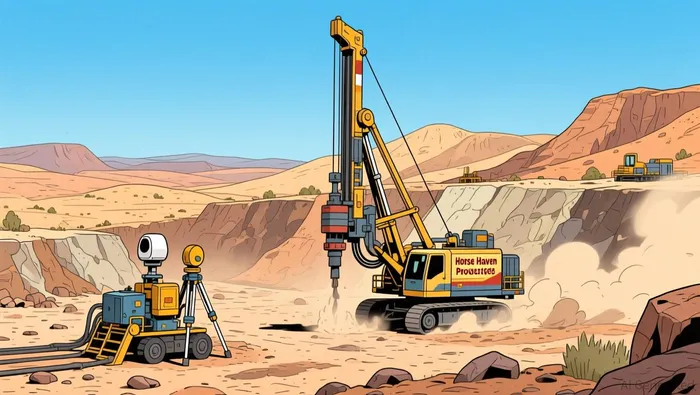
The immediate operational focus is on drilling. A Phase 2 drilling campaign is scheduled to commence in May 2026 at the Golden Gate target, involving up to 45 holes over approximately 13,700 metres. This program aims to define the scale of gold mineralisation and support the progression toward a maiden Mineral Resource Estimate, targeted for early next year. The campaign will also target associated tungsten mineralisation, reinforcing the project's multi-commodity potential.
Metallurgical work is progressing in parallel. The company has already achieved high-purity antimony production with 99.38 wt% antimony trioxide, demonstrating downstream processing capability. Further optimisation is underway, with both pyrometallurgical and hydrometallurgical test work in progress, and final results expected soon. This work is vital for de-risking the processing economics of the project.
Contextually, the company's financial position reflects its status as a small-cap exploration entity. With a market cap of approximately A$8.95 million and a stock price around A$0.022, the recent capital raise represents a significant scaling of its balance sheet. This provides the necessary runway to fund these near-term catalysts-drilling, metallurgy, and permitting-while the company also prepares for its imminent NASDAQ listing. The listing is expected to materially expand U.S. investor access and improve market liquidity, trading alongside other critical mineral miners.
Commodity Balance and Strategic Positioning
US1 Critical Minerals is positioning itself squarely within the structural supply-demand deficits that are reshaping global commodity markets. The company's strategic focus is on uranium and rare earth elements, two commodities central to the clean energy transition. Its portfolio spans 6 exploration licenses covering 1,811 km² in known exploration hotspots, aiming to advance projects that could contribute to a more secure supply chain.
The commodity fundamentals here are compelling. The global uranium market is already in deficit, with mine supply falling short of reactor demand. Projections indicate this gap will widen significantly as nuclear power demand doubles by 2040, a trend supported by a landmark ministerial declaration putting nuclear energy at the heart of climate action. This structural shortage is driving aggressive policy responses. As noted in a recent analysis, Western governments are deploying price floors and structured offtake frameworks to ensure non-China production remains investable. The U.S. alone has committed over $30 billion in support for secure supply chains, creating a powerful tailwind for projects like US1's.
For a junior explorer, this alignment with policy-driven demand is the core thesis. The company is not just chasing a commodity cycle; it is betting on a long-term realignment of supply chains. The recent capital raise and FAST-41 status for its Antimony Ridge project are steps to convert this strategic positioning into tangible progress. Yet the primary risk remains execution. The raised capital must be deployed effectively to advance exploration, metallurgy, and permitting. For a small-cap entity, this is a high-risk path. Success hinges on converting the company's geographic footprint and policy tailwinds into defined resources and a viable project plan. The commodity balance is favorable, but the company must navigate the long, capital-intensive journey from exploration to production.
Catalysts and What to Watch
The path from capital raise to shareholder value hinges on a series of near-term milestones. The most immediate catalyst is the company's NASDAQ listing, expected to materially expand U.S. investor access and improve market liquidity. This event is not just a formality; it is a strategic move to trade alongside established critical mineral miners and broaden the investor base that can support the company's growth.
Investors should watch for progress on the capital deployment plan. The Phase 2 drilling campaign scheduled to commence in May 2026 at the Golden Gate target is a key indicator of execution. Results from this program, which aims to define gold and associated tungsten mineralisation, will be critical for advancing the project toward a maiden Mineral Resource Estimate. Similarly, the application for up to 250 drill holes and large-scale bulk sampling leveraging the FAST-41 status is a major permitting milestone to monitor. Success here would demonstrate the regulatory tailwind is translating into concrete project advancement.
Metallurgical progress is another watch item. The company has already achieved high-purity antimony production, and final results from both pyrometallurgical and hydrometallurgical test work are expected in the coming weeks. These results are vital for de-risking the project's processing economics and will be a signal of technical progress.
Beyond company-specific events, the broader critical minerals market context is a key backdrop. The 2026 Critical Minerals Ministerial confirmed a hardened policy stance, with the U.S. alone committing over $30 billion in support for secure supply chains. This creates a favorable environment for projects like US1's. Price signals for core commodities-uranium, copper, and rare earths-are also material. The structural deficits driving these prices are the fundamental thesis, and sustained strength in these markets will validate the long-term investment case. For now, the focus is on whether the company can effectively use its capital to navigate the development timeline and capitalize on this supportive policy and market backdrop.