

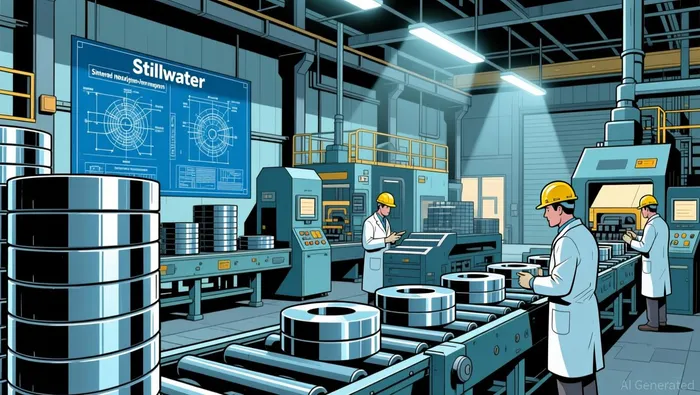
The successful commissioning of Phase 1a in March marks a critical operational achievement for USA Rare Earth. It validates the company's complex manufacturing process and, most importantly, enables it to begin fulfilling customer orders for sintered neodymium-iron-boron (NdFeB) magnets in the second quarter of 2026. This is the first tangible output from the new facility in Stillwater, Oklahoma, a foundational step toward reshoring a key part of the rare earth magnet supply chain.
The scale of this initial output, however, is what creates the immediate valuation disconnect. Phase 1a is expected to ramp to a run rate capacity of 600 mtpa by the end of Q4 2026. Combined with the next production line, Phase 1b, the company anticipates a total active capacity of 1,200 mtpa in Q1 2027. While this represents a significant expansion from the initial phase, it is still a tiny fraction of the global market. The estimated 2026 demand for sintered NdFeB magnets alone is believed to exceed 200,000 mtpa.
Viewed another way, the planned total capacity of 1,200 metric tons per annum (mtpa) amounts to less than 1% of the entire global market. This stark contrast between a company's operational milestone and its ultimate market share underscores the early-stage nature of the project. The production start is a necessary and positive step, but it does not yet meaningfully alter the supply-demand balance for these critical materials. The valuation gap, therefore, persists: the stock may price in a future where the company captures a major share, while the current physical output remains a rounding error in the global equation.
Financial Reality vs. Commodity Value
The company's financial position presents a stark contrast to the high-stakes narrative of the rare earth magnet supply chain. USA Rare Earth is not yet profitable from its core operations. For the trailing twelve months, it reported an operating income of -$60 million and an operating margin of -3622%, a figure that reflects the immense costs of building and commissioning a new, complex manufacturing facility. This unprofitability is a direct result of the capital-intensive nature of the business, where significant investment in plant and equipment has not yet been offset by sustained revenue from magnet sales.
Yet, the balance sheet tells a different story. Despite its operational losses, the company holds a substantial cash position. This has led to a negative net debt/equity ratio of -17%, meaning its cash holdings exceed its debt obligations. In other words, the market is pricing the company as a net-cash entity. This creates a key disconnect: the stock trades at a market capitalization of $2.1 billion, but the tangible value of its physical assets and cash is a separate, and arguably more immediate, consideration.
Valuation further highlights this tension. The stock's Price-to-Book ratio stands at 9.7x, which, while high compared to the broader industry average, is actually considered a discount relative to its peer group of junior mining and materials companies. This suggests the market is not valuing the company based on its current book value. The most striking disconnect, however, comes from a forward-looking analysis. A discounted cash flow model estimates the company's fair value at $159.97 per share, a figure that is more than seven times the current market price. This implies the market is pricing in a significant risk premium for the company's future cash flow generation, which is still years away.
The bottom line is that USA Rare Earth is a classic pre-revenue, capital-intensive play. Its financial reality is one of heavy investment and current losses, but its market valuation is a bet on a future where those investments translate into massive, profitable magnet production. The high Price-to-Book ratio and the deep discount to a DCF estimate both underscore that the stock is trading on potential, not present profitability. For now, the commodity value of its future output is being priced far more heavily than the current financial reality.
Strategic Moves and Supply Chain Integration
The company's growth strategy is now pivoting from facility commissioning to securing the raw materials needed to fuel it. The centerpiece of this shift is the $2.8 billion acquisition of Serra Verde Group, a deal that will bring a rare earth mine and processing plant in Brazil into the fold. Expected to close in the third quarter of 2026, this transaction is explicitly framed as a move to advance a fully integrated platform from mine to magnet. The strategic aim is clear: to lock in a steady, non-Asian supply of the critical magnetic rare earths like dysprosium and terbium, thereby reducing dependency on foreign sources and strengthening its position in the global supply chain.
This acquisition is a direct response to the commodity balance reality. Building magnets is only half the battle; securing the feedstock is the other. By integrating a mine and processing plant, USA Rare Earth aims to control more of the value chain, potentially improving margins and supply reliability. The company is also layering in other supply chain moves, such as its stake in French processor Carester SAS, to further diversify its sourcing and processing capabilities. This multi-pronged approach signals a serious intent to become a vertically integrated player, not just a magnet manufacturer.
Yet, the market's reaction to these strategic moves appears to be decoupled from current operational metrics. The stock's momentum score jumped from 14.46 to 90.22 on a week-over-week basis, a dramatic surge that reflects intense speculative interest. This momentum is likely driven by the bullish narrative around the Serra Verde deal and the broader onshoring trend for critical materials. However, it stands in contrast to the company's financial reality of heavy losses and the modest scale of its initial production. The high momentum score indicates strong price trend strength, but it does not yet signal that the underlying supply-demand fundamentals for its output have shifted.
The bottom line is that USA Rare Earth is executing a classic growth playbook for a capital-intensive commodity play: secure the resource, build the capacity, and capture the value. The Serra Verde acquisition is a major step toward that vision. But the stock's speculative momentum highlights the gap between future potential and present performance. For the strategy to succeed, the company must now translate this ambitious integration plan into reliable, cost-effective production that can meet the growing demand for magnets, all while managing the substantial debt and cash outlay required for the acquisition.
Catalysts, Risks, and What to Watch
The path from a successful production commissioning to a profitable business is now defined by a series of near-term tests. The primary catalyst is the company's Q1 2026 earnings report, expected between May 11 and 15. This will be the first financial statement to reflect revenue from its new magnet line. Investors will scrutinize the results for the initial volume of sales, pricing power, and, critically, the trajectory of the operating losses. A clean break from the prior year's massive deficit would signal the start of a positive cash flow conversion; a continuation of heavy losses would reinforce the high-risk, pre-revenue profile.
The key risks to the thesis are substantial and intertwined. First, the company's continued operating losses are a fundamental drag, consuming cash that could otherwise fund growth or acquisitions. Second, the execution of the $2.8 billion Serra Verde acquisition presents a major operational and financial challenge. Integrating a mine and processing plant in Brazil while managing the debt and equity issuance required for the deal is a complex task that could distract from core operations or strain the balance sheet. Third, and most critical, is the ability to convert its planned 1,200 mtpa capacity into sustained, profitable magnet production. This hinges on flawless execution, stable raw material costs, and securing long-term customer contracts at favorable margins.
For investors, the leading indicators will be clear and quarterly. The first is quarterly revenue growth from magnet sales. This will show if the new production line is ramping and finding buyers. Second, the cash burn rate must be monitored closely. Even with a net-cash balance, the pace at which the company is spending to build and operate its integrated platform will determine how long its financial runway extends. Third, progress on the Serra Verde integration will be a key operational metric. Timely closure and smooth operational handoff are essential for the strategic vision to materialize.
The bottom line is that the coming quarters will separate narrative from reality. The stock's momentum reflects high hopes for the Serra Verde deal and the onshoring trend. But the real test is whether USA Rare Earth can navigate its financial losses, execute a massive acquisition, and turn its new capacity into a reliable source of revenue. The Q1 earnings report is the first major checkpoint on that journey.