

The stablecoin market just hit a new all-time high of $321 billion in late April 2026-growth that's happening while the rest of crypto bled. Total capitalization surged past $321 billion with more than 50% year-over-year growth during a period when the broader cryptocurrency market fell more than 20%. That's the paradox everyone's trying to crack: why are dollar-pegged tokens mooning while everything else dumps?
USDG crossing $3 billion with a market cap of about $3 billion is supposed to be the victory lap for regulated stablecoins. But Anchorage Digital just walked away from leading the Global Dollar Network consortium ceasing its participation in the Global Dollar Network consortium. Co-founder Nathan McCauley put it plainly: "We probably no longer play as leading a role as before" according to McCauley. The company's pivoting to become a neutral white-label issuer, with up to 20 banks and tech giants now in talks highlighting demand for its issuance and custody services.
Here's what's actually happening. The GENIUS Act got signed into law on July 18, 2025 cited as a material catalyst for institutional confidence. That's real regulatory legitimacy in the world's most important financial jurisdiction what reach actually means. Stablecoin velocity has doubled from 2.6 times in early 2024 to 6 times by early 2026 according to Andreessen Horowitz analysis. SWIFT's 11,500 member banks can now route tokenized asset settlement through existing terminals without new software, new licences, or new counterparty relationships. Chainlink CCIP processed $7.77 billion in cross-chain transfers during 2025, a 1,972% year-over-year increase across 60 blockchain networks.
But here's the tension that matters for holders: USDG's $3B is still a rounding error next to Tether and Circle's combined dominance. The barrier to entry remains brutal creating a high barrier for new entrants like USDG. Anchorage's pivot to neutrality is a admission that building a consortium-backed stablecoin is harder than building infrastructure for other people's stablecoins. The GENIUS Act opened the door, but walking through it requires something more than regulatory compliance-it requires network effects that take years to build.
The real question isn't whether regulated stablecoins are the future (the numbers say they are). It's whether USDG specifically has a future as a branded consumer stablecoin, or whether it becomes just another token in the white-label infrastructure play. For the crypto native, this is the classic diamond hands vs. paper hands test: do you HODL the narrative that regulated dollars will eat the world, or do you rotate into the plays that are actually capturing the inflows? The market's telling you something-$321B in stablecoin cap while everything else dumps is a signal. The only uncertainty is which stablecoins survive the consolidation.
USDe's 50x Run: The Synthetic Dollar Narrative Taking Over Solana
While USDG was hitting its $3B milestone, another story was brewing on Solana-one that's got the crypto native crowd genuinely excited. USDe, Ethena's delta-hedged synthetic dollar, just pulled a 50x run, exploding from $140 million to $7.2 billion in under a year an increase of over 50 times. Yeah, you read that right. Fifty. Times.
Now it's sitting at a $4+ billion market cap with $95 million in daily volume trading at $4.019B market cap. That's not chump change. That's real liquidity. That's the market telling you something big is happening.
But here's the thing that keeps the FUDsters up at night: USDe isn't your grandma's stablecoin. It's a crypto-native money narrative, built on delta-hedged staked Ethereum collateral, designed to be censorship-resistant and fully composable throughout DeFi providing the first censorship resistant, scalable and stable crypto-native solution for money. This is the "Internet Bond" thesis going mainstream.
The March 2026 crash tested that thesis hard. During the liquidation apocalypse, USDe lost roughly $8.3 billion in market cap dropping from $14.7 billion to around $6.4 billion and briefly depegged to $0.65. Ouch. But here's what matters: it recovered to $0.9987 price recovered to $0.9987. The protocol held. The collateral held. The delta-hedge held. That's the kind of stress test that separates the hype from the real deal.
Now the narrative's shifting again. USDe just landed on Solana's Jupiter Lend, with leveraged strategies curated by Bitwise Jupiter Lend market curated by Bitwise Asset Management. The integration enables users to deposit USDe, borrow against it, and run leveraged USDe strategies at scale allowing users to deposit USDe, borrow against it, and run leveraged USDe strategies. The team even raised transfer limits to $30 million per hour via Stargate transfer limits temporarily raised to $30 million per hour.
The capital's already moving. Over $70 million worth of assets bridged to Solana in a single week Over $70 million worth of assets were bridged to Solana. That's real money chasing real yield, not speculative price action.
For the crypto native, this is the diamond hands narrative in real time. USDe represents something USDG and the other regulated stablecoins can't offer: true DeFi composability. You can HODL USDe, earn yield through the Internet Bond, then immediately use it as collateral in lending markets, flash loan it, or stack it in yield strategies. It's money legos at scale.
The tension? Traditional stablecoins have the regulatory moat. But USDe has the crypto-native moat-censorship resistance, 24/7 global access, and the kind of yield generation that makes traditional finance look like a museum. The GENIUS Act opened the door for regulated dollars, but the crypto-native dollar narrative is walking through a different entrance entirely.
The question isn't whether synthetic dollars have a future. The question is whether you're positioned on the right side of the narrative war. Because right now, the market's voting with its wallet-and it's voting USDe.
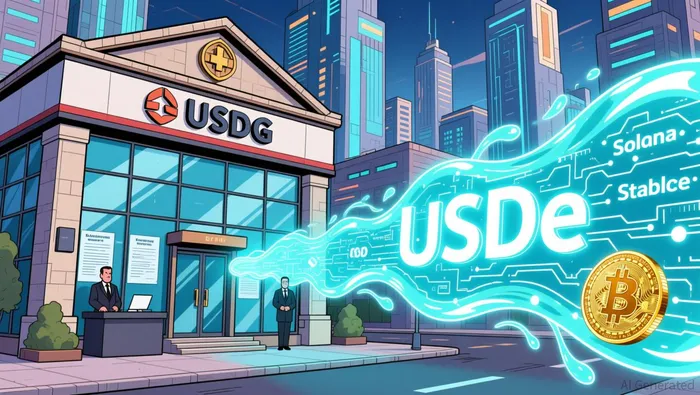
The Battle for Dollar Dominance: Who's Winning the Narrative War?
The stablecoin market just hit $321 billion in late April 2026-growing 50%+ while crypto bled. But here's what's really happening: the market's splitting into two tribes. On one side, you've got the "safe" narrative-regulated dollars like USDG with institutional backing and regulatory moats. On the other, you've got the "freedom" narrative-crypto-native synthetics like USDe that offer censorship resistance and DeFi composability. The question isn't just which will survive. It's which narrative is actually capturing the inflows.
Velocity is telling. Stablecoin velocity-the ratio of transfer volume to circulating supply-doubled from 2.6x in early 2024 to 6x by early 2026 according to Andreessen Horowitz analysis. That's not just growth. That's utility. That's people actually using these dollars as money, not just parking them. The Fed's own economists flagged this shift, citing the GENIUS Act as a material catalyst for institutional confidence. But here's the tension: velocity measures movement, not conviction. A dollar can move fast and still be paper hands.
Enter USDe. The synthetic dollar exploded from $140 million to $7.2 billion in under a year an increase of over 50 times, then got dumped to $6.4B during the March crash before recovering to $0.9987. That's the stress test that matters. The protocol held. The delta-hedge held. The community held. Now it's on Solana's Jupiter Lend with $30 million per hour transfer limits-capital's already moving, with over $70 million bridged in a single week.
Solana's the battleground. SOL just hit a new ATH at $65.