

Three crypto AI projects announced a partnership last week that was described as a step toward "verifiable AI" for Web3. DGrid AI, a decentralized AI inference network, is joining forces with AIVM and its parent project ChainGPT - ChainGPT's purpose-built Layer-1 blockchain still working toward its mainnet launch. The stated goal: stronger infrastructure for on-chain small language models, autonomous agents, and AI systems whose outputs can be audited rather than trusted on faith.
Read that description carefully. Every word of it is still a plan.
I don't write about partnership announcements for the announcements themselves. I write about them when they reveal something about how a sector is trying to establish credibility before it has shipped the thing that would earn credibility on its own merits. What this collaboration shows - and what the wider crypto-AI space is showing right now - is a pattern that should be familiar to anyone who followed the DePIN cycle or the early tokenization wave. The partnerships come first. The infrastructure arrives later, if at all.
What "verifiable AI" actually means - and doesn't
The phrase has been around long enough that it no longer needs a glossary, but it's worth being precise. Verifiable AI refers to systems where the correctness, provenance, or reasoning path of an AI output can be independently checked - ideally with cryptographic proofs anchored to a blockchain. Chainlink has published extensively on the concept, the IETF has drafted a Cognitive Trust Stack framework, and a dozen smaller projects are positioning themselves as the plumbing layer.
The idea is sound. AI models are black boxes, and as they get delegated more decisions - trading, lending, content moderation - the absence of an audit trail is a structural problem. Blockchain's value proposition of tamper-proof recordkeeping is supposed to plug that gap.
The unstated part, which almost nobody addresses in the press releases, is this: you can only verify something whose inputs and execution environment you already trust. If the model running on your infrastructure is itself unverified, or if the data feeding it is unverified, the cryptographic proof on the other end is just a receipt for an unknown quantity. Verification requires a chain of trust, not a single checkpoint.
The partnership machine
Here's the thing about DGrid AI that's more revealing than any one announcement: the velocity at which it's making them. In the past four months, DGrid has announced partnerships with AltLLM, Pieverse, Stable, and now AIVM and ChainGPT. They secured seed funding in October 2025 to build out a node network. Their stated ambition is to provide decentralized, low-cost AI inference for Web3 applications as an alternative to OpenAI and similar centralized providers.
That's a credible ambition. Decentralized inference is a real need. But DGrid's partnership cadence reads like an acquisition-of-credibility strategy, not an integration roadmap. Each announcement pairs the project with a different adjacent ecosystem - an LLM provider, a stablecoin network, an agent framework, a blockchain. The cumulative effect is the impression of being everywhere. The question, which the reader should hold onto, is whether any of these integrations have moved past the press release.
What's actually shipped
AIVM, the blockchain at the center of this announcement, was introduced in May 2025 as ChainGPT's purpose-built Layer-1 for AI - a network combining decentralized compute, tokenized data, and verifiable agents. It had an internal prototype release by early 2025, and a testnet was expected in late 2025. The mainnet launch is slated for 2026.
It is now June 2026. As of my research, I could not find confirmation that AIVM's mainnet is live or even in a public testnet. The ChainGPT documentation describes plans to evolve from "standalone products into a connected ecosystem" during the first half of 2026 - which suggests the integration work is still in progress.
This matters because the entire "verifiable AI" thesis depends on the underlying rails being operational. You can't build verifiable agents on a blockchain that doesn't yet exist. The DGrid-AIVM collaboration describes advancing components like Policy Oracle, TEE, and KYA. All of these are architectural designs, not running products.
I'm not saying this to dismiss the projects. Building decentralized AI infrastructure is genuinely hard. What I'm saying is that the sector has learned to announce before it ships, and the market has learned to treat announcements as evidence of progress rather than intentions.
The broader signal
This pattern isn't unique to these three projects. The crypto AI category as a whole is in the same phase. The Binance Square research piece covering DGrid's AltLLM partnership (published May 14) noted that the goal is to "advance the development of robust crypto-native AI infrastructure" - which is to say, the category is still trying to prove that the infrastructure can work at all before it can argue about who builds it better.
Compare this to what's happening on the centralized side. OpenAI, Google, and Anthropic are iterating on verifiable output systems - watermarking, provenance tagging, model cards - within their own closed ecosystems. They don't need blockchain or consensus mechanisms because they already control the execution environment. The verification challenge for them is different, but their products exist and ship.
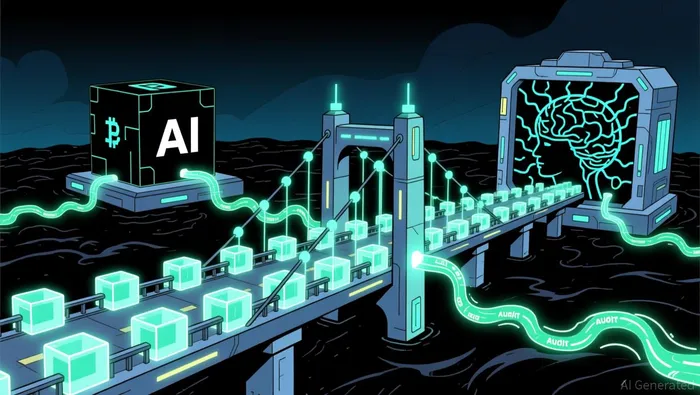
That's the tension the crypto side hasn't resolved. The argument for decentralized verifiable AI is strongest when you're worried about centralized control - and that argument makes the most sense to people who would never use OpenAI in the first place. Meanwhile, the institutions that actually need audit trails for AI decisions are the same ones that would rather have a Chainlink oracle than a decentralized inference network whose availability and performance are unproven.
What would change my mind
Two things. First, I'd want to see AIVM's mainnet go live with real transactions - not a demo, not a testnet with incentivized validators, but a network where third-party applications are running AI workloads because they chose it over centralized alternatives. Second, I'd want to see at least one of DGrid's partnerships produce a measurable integration: a live inference endpoint, a published benchmark, a case study with actual compute demand.
Until then, this is the announcement phase. It's necessary - every sector has one - but it's not the part of the story where the structural shift happens. The structural shift happens when someone ships something that works well enough that other people start building on it without being paid to do so.
The verifiable AI problem is real. The question is whether the crypto answer to it arrives as infrastructure or as a branding exercise. Right now, the press-release cadence suggests the latter. I'll be watching the commit logs and the mainnet status page more carefully than I'll be watching the announcements.