

Viasat confirmed the April 27, 2026 launch of the ViaSat-3 F3 satellite aboard a SpaceX Falcon Heavy rocket, completing its global constellation and expanding broadband coverage to the Asia-Pacific region. - The mission marks SpaceX's return to flight for the Falcon Heavy after an 18-month gap, demonstrating the vehicle's continued relevance in the heavy-lift launch market for commercial and government payloads. - The newly launched satellite aims to deliver over 1 Tbps of throughput, establishing a cornerstone for Viasat's unified, high-capacity network focused on sovereign communications and commercial mobility. - SpaceX executed synchronized Return to Launch Site (RTLS) landings for the side boosters while expending the center core, reflecting the demanding trajectory required for deploying large payloads to geostationary orbit.
SpaceX is preparing to launch the ViaSat-3 F3 communications satellite aboard a Falcon Heavy rocket from NASA's Kennedy Space Center in Florida on April 27. The launch aims to complete the ViaSat-3 mini-constellation, which provides high-throughput broadband service to the Asia-Pacific region. The 6.6-ton satellite will be deployed into geostationary orbit, allowing it to continuously serve customers over a specific geographic area. This mission follows the successful deployment of ViaSat-3 F1 in April 2023 and ViaSat-3 F2 in November 2025. Dave Abrahamian, Viasat's vice president of space systems, highlighted the launch as a pivotal moment for delivering fast, secure, and reliable broadband to commercial, defense, and consumer customers. The Falcon Heavy, one of the most powerful operational rockets, will use its two side boosters for landing at Cape Canaveral, while the central booster will be expended. The upper stage will deploy the satellite into geosynchronous transfer orbit approximately five hours after liftoff according to launch details.
SpaceX has successfully launched the Falcon Heavy rocket for the first time in 18 months, lifting off from NASA’s Kennedy Space Center in Florida. The mission, designated as the @viasat-3 F3, utilizes one of the most capable rockets in operation, combining three Falcon 9 boosters to generate over 5 million pounds of thrust. This immense power is critical for transporting large payloads to geostationary orbit and beyond, serving both commercial and government needs.
The launch window opened at 10:21 a.m. ET, with a backup opportunity available on April 28. The mission's primary payload, Viasat-3 F3, is a Ka-band communications satellite based on Boeing's 702 satellite bus. Weighing 6,400 kg, it is designed to expand high-speed internet coverage across the Americas, Europe, and Africa, addressing growing demand in underserved regions. The satellite was successfully placed into orbit, meeting the mission's objectives.
In line with SpaceX’s reusability strategy, the rocket’s two side boosters executed synchronized Return to Launch Site (RTLS) landings at Landing Zones 2 and 40 at Cape Canaveral Space Force Station. These boosters had previously supported multiple missions, including SDA-0A, SARah-2, and several Starlink launches. The center core, identified as B1098-1, was expended due to the demanding trajectory required for the satellite deployment. This launch marks a significant return to service for the Falcon Heavy, which had not flown since October 2024, demonstrating the vehicle's continued relevance in the heavy-lift launch market as reported.
Why Is The ViaSat-3 F3 Launch Critical For Viasat's Global Strategy?
Viasat, Inc. confirmed that the ViaSat-3 F3 satellite is scheduled for launch on April 27, 2026, aboard a SpaceX Falcon Heavy rocket from Kennedy Space Center. The launch window opens at 10:21 a.m. EDT. The Falcon Heavy delivery places the satellite in a favorable transfer orbit, allowing its electric propulsion to reach geostationary orbit. Following a months-long transit, the satellite will undergo in-orbit testing before entering service by late summer 2026.
ViaSat-3 F3 is designed to cover the Asia-Pacific (APAC) region, substantially increasing secure, reliable, and flexible capacity for customers in that area. It aims to deliver greater bandwidth economics compared to previous generations. Once in service, the completed ViaSat-3 constellation will serve as a cornerstone of Viasat’s unified, global, high-capacity network.
CEO Mark Dankberg highlighted the strategic focus on sustained reductions in capital intensity and the development of a common lower mass multi-orbit, multi-band satellite architecture. This architecture is adaptable for broadband or mobile satellite services with strong sovereign communications capabilities. The satellites utilize state-of-the-art technology to maximize efficient bandwidth deployment, supporting commercial mobility, fixed services, and defense customers.
ViaSat-3 F3 introduces new functional capabilities, including enhanced resilience for US and international government customers. ViaSat-3 F1 entered service in 2024. Meanwhile, ViaSat-3 F2 is currently undergoing in-orbit testing; its reflector has successfully completed bloom deployment, a process previously delayed by operational constraints during the spring eclipse season. Final deployments for F2 are expected over the next several weeks as Viasat confirmed.
How Does The Falcon Heavy Return Strengthen SpaceX's Heavy-Lift Market Position?
The Falcon Heavy's return to flight after an 18-month hiatus underscores its unique value proposition in the commercial launch sector. While SpaceX has successfully commercialized the Falcon 9 for medium-lift missions, the Falcon Heavy remains the only operational heavy-lift vehicle capable of deploying massive payloads directly to geostationary orbit. The Viasat-3 F3 mission, weighing 6,400 kg, required the immense thrust of over 5 million pounds generated by combining three Falcon 9 cores.
The mission's execution highlights SpaceX's refined reusability protocols for heavy-lift operations. The synchronized Return to Launch Site (RTLS) landings of the two side boosters at Landing Zones 2 and 40 at Cape Canaveral Space Force Station demonstrate the vehicle's reliability. These boosters, having supported previous missions such as SDA-0A, SARah-2, and multiple Starlink launches, will be refurbished and reused, aligning with SpaceX's goal of minimizing launch costs. However, the central core, B1098-1, was expended to ensure the precise trajectory needed for the satellite's geostationary transfer orbit. This trade-off between reusability and payload capacity is a common strategic decision in heavy-lift missions, prioritizing mission success for high-value commercial and government payloads.
The successful deployment of the Viasat-3 F3 satellite reinforces SpaceX's dominance in the geostationary communications satellite market. Competitors in the heavy-lift sector face significant barriers to entry, with few vehicles capable of matching the Falcon Heavy's performance-to-cost ratio. This mission also serves as a critical validation of the vehicle's readiness for future defense and national security missions, further solidifying SpaceX's role as a primary launch provider for U.S. government agencies. The return of the Falcon Heavy to active service after a prolonged gap signals operational stability and robust manufacturing pipelines, key indicators for investors monitoring SpaceX's broader ecosystem.
What Are The Implications For Viasat's Sovereign Communications Capabilities?
The completion of the ViaSat-3 constellation marks a strategic milestone for Viasat in the realm of sovereign communications and global broadband infrastructure. The newly launched ViaSat-3 F3 satellite is engineered to provide enhanced resilience for U.S. and international government customers, addressing the growing demand for secure, high-capacity satellite communications. This capability is increasingly critical as geopolitical tensions drive nations to invest in independent, secure communication networks that are not reliant on terrestrial infrastructure.
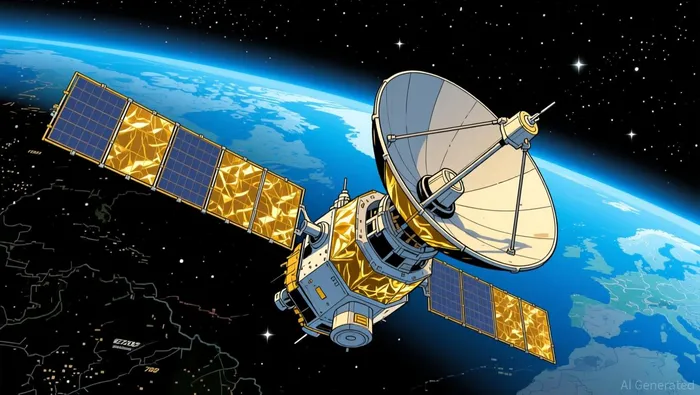
Viasat's strategic focus on a common lower mass multi-orbit, multi-band satellite architecture allows for greater flexibility and efficiency in bandwidth deployment. This approach supports a wide range of applications, from commercial mobility and fixed broadband services to critical defense communications. By reducing capital intensity and leveraging advanced technology, Viasat aims to offer competitive pricing while maintaining high service quality. The expanded coverage in the Asia-Pacific region, combined with existing coverage in the Americas, Europe, and Africa, creates a truly global network capable of serving underserved markets and high-demand commercial sectors.
The integration of the ViaSat-3 F3 satellite into the broader constellation will enhance Viasat's ability to provide seamless connectivity across borders. This is particularly relevant for industries such as aviation, maritime, and remote energy operations, which require reliable, high-speed internet access in remote locations. The mission also aligns with Viasat's broader vision of a unified, global network that can adapt to evolving customer needs. As the satellite undergoes in-orbit testing and prepares for service by late summer 2026, investors will be watching for early performance metrics and customer adoption rates that could drive revenue growth in the competitive satellite communications sector according to company updates.