

The market's 20% surge in Virgin Galactic shares following the announcement tells you everything about what traders are pricing. The company reported weaker-than-expected quarterly results and continued cash burn on its Delta spaceplane development, yet the stock still rallied sharply. That's the market betting on the operational catalyst-the Q4 2026 first flight and the $750K tranche-not the current financials.
Here's the tactical setup: the market is front-running a catalyst that won't materialize for months. The next SpaceShip doesn't enter service until late 2026 or early 2027, when flight cadence is set to increase. The cash inflows from the tranche and any subsequent financing won't hit the balance sheet until Q3 at earliest. That's a three-to-four-month gap between the price move and fundamental validation.
For momentum traders, this creates a clear risk/reward setup. The upside is straightforward-if execution holds and the Q4 flight materializes, the stock has room to run. But the downside is equally clear: any delay to the flight timeline or financing shortfalls could unwind the rally fast. The market is pricing hope, not earnings. That's a valid tactical play, but it's also a wide margin for error.
The Catalyst Timeline: From Ground Testing to Flight Cadence
The market's 20% rally is a bet on a very specific sequence of events-and the timeline is tighter than most people realize.
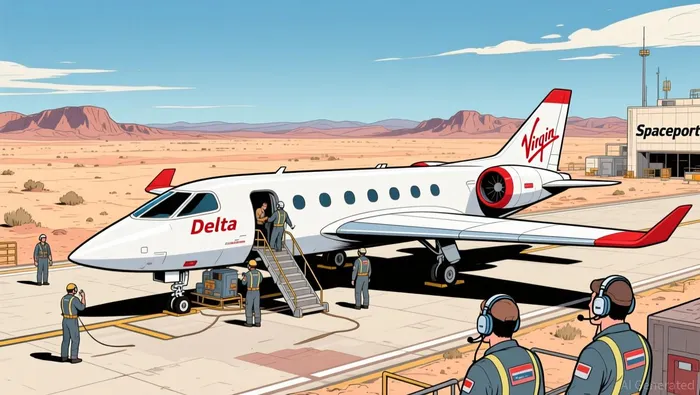
Ground testing kicks off in April 2026 over the next week or two, running through July when structural assembly wraps up. That's followed by a formal rollout and transport to Spaceport America in New Mexico. Meanwhile, pilot training is already underway using the older Unity vehicle-new hires are getting proficiency time in parallel while ground tests are in progress.
The flight test program starts later in Q3 with glide tests, then moves to powered flights: first a partial-duration burn at Mach 1 to 1.5, then two full-duration suborbital flights. The first powered test carries two pilots plus NASA research payloads; the second carries two pilots and six company employees to validate the cabin experience. Three tests total-the company says that's sufficient given Unity experience-and then commercial service begins in Q4 2026 as outlined in the March 30 earnings call.
Flight cadence ramps from there: four flights per month to start, scaling to eight by Q2 2027, then 10 or more in the second quarter of 2027.
The $750K tranche closes in Q3 2026, generating roughly $37.5M in near-term cash 50 seats at $750,000 each. That's a 25% price jump from the prior $600K level a sharp increase from the company's earlier pricing. With 675 customers on the waiting list more than 675 customers are currently waiting, demand appears sufficient to absorb the initial tranche without execution pressure.
Here's the tension: the timeline is aggressive but not impossible. The ground test window is narrow-April through July-and any snag pushes the Q4 flight target. The flight test program has three milestones, and each one is a potential delay point. Yet the waiting list provides a buffer: even if the first tranche sells out quickly, the pipeline is there to sustain near-term revenue once flights begin.
The market is pricing execution on this exact schedule. Miss the Q4 target, and the thesis cracks. Hit it, and the cadence ramp provides a clear path to scaling revenue through 2027.
The Critical Risk: Cash Runway and Going Concern
The market's 20% rally is a bet on execution-but the financial buffer is thinner than the price action suggests.
Virgin Galactic closed 2025 with $338 million in cash. At current burn rates, that's roughly 9-10 months of runway-even before accounting for the Delta spaceplane development costs that continue mounting through 2026. The $750K tranche closes in Q3, adding $37.5M to that pot. But operational burn doesn't pause while they wait for flight cadence to ramp.
Here's the tactical gap: the company continues burning cash on Delta development while generating zero revenue from operations. The $37.5M from the $750K tranche 50 seats at $750,000 each is a near-term lifeline, but it's a rounding error against the burn rate. Management acknowledged "significant cash inflows" tied to the tranche but emphasized maintaining "appropriate strength in our balance sheet" on the earnings call. That's not confident CEO-speak. That's a company that knows its runway is finite and is signaling to investors that the balance sheet is a priority-because it's a vulnerability.
The math is straightforward: the tranche alone cannot sustain operations through the ramp period. The company needs sustained flight cadence-at least 8 flights per month, ideally hitting 10+ by Q2 2027 ramp up flight rate to eight or ten-plus flights per month-to generate enough revenue to offset the burn. Anything less and the cash position deteriorates faster than the market is pricing.
This is the primary tactical risk: the market is betting on execution hitting an aggressive timeline, but the financial buffer is thinner than it appears. Miss the Q4 flight target, or fail to sustain cadence once flights begin, and the runway shrinks to a critical level within 12-18 months. The $750K tranche is a lifeline, not a solution.
What to Watch: Catalysts and Scenarios
The 20% rally is a bet on execution hitting a tight timeline. Here are the specific events that will validate or invalidate that bet-and when you need to make a decision.
Q3 2026 Tranche Close: The Cash Lifeline
The $37.5M from the $750K tranche 50 seats at $750,000 each is the near-term financial oxygen. If this closes on schedule in Q3, it extends runway and validates the pricing strategy. If it's delayed or fails to close, that's a fundamental red flag-the market will interpret it as either demand weakness or execution problems. Either way, the thesis cracks. Watch for the confirmation announcement; absence of news by late Q3 should trigger a reassessment.
Q4 2026 First Flight: The Make-or-Break Milestone
Ground testing runs April through July over the next week or two, followed by rollout and transport to Spaceport America. The first powered flight target is Q4 2026. This is the critical operational pivot. The test program has three milestones-glide tests, partial-duration burn, full-duration burns-and each is a potential delay point. Miss Q4, and the entire cadence shifts. The market has priced a clean execution path; any slip pushes the flight cadence ramp into 2027, which pressures the cash position before revenue scales.
Competitive Landscape: The Monopoly Window
Blue Origin's New Shepard is paused. SpaceX is focused on orbital and lunar programs. Virgin Galactic remains the only active commercial suborbital operator-but this monopoly status is fragile. It's contingent entirely on execution. If the Q4 flight materializes and cadence ramps as planned, Virgin Galactic owns the niche. If delays mount, competitors will see an opening. The 675+ customers on the waiting list more than 675 customers are currently waiting provide demand-side insulation, but only if the company can actually deliver flights on schedule.
Pricing Trajectory: The Long-Term Upside
Management has indicated prices will "rise in steps." The current $750K tranche will be retired after completion these space flights will be slotted in our manifest immediately after we fly the current members. That's a signal: the $750K level is not the ceiling. With demand appearing sufficient to absorb the initial tranche, future pricing power is the real long-term option. But this is a 2027+ story. It doesn't help the cash position in the critical 12-18 month window.
Scenario Summary:
Validation: Tranche closes Q3 → $37.5M inflow extends runway. Ground tests complete July → Q4 first flight hits. Cadence ramps to 4 flights/month by year-end, 8 by Q2 2027. Stock holds gains and climbs on execution confirmation.
Invalidation: Tranche delayed or cancelled → market interprets as demand or execution failure. Ground test snag pushes first flight to 2027 → runway pressure intensifies. Cadence stalls below 4 flights/month → cash burn outpaces revenue. Stock unwinds the 20% rally within weeks of the miss.
The setup is clear. The risk is concentrated in the next six months. Watch the tranche close and the Q4 flight date-those are the decision points that will determine whether this rally holds or collapses.