

TL;DR: Walmart just slashed ~1,000 corporate jobs in a single day - not because of AI, but to crush duplication and force teams onto a single platform. The real story? A brutal corporate-vs-frontline split that's reshaping retail's biggest employer.
The Breakdown:
Scale of the purge: Roughly 1,000 corporate employees were told their jobs were eliminated or relocated on May 12, 2026. That brings the 2026 total to about 1,100 corporate roles cut or moved - from a workforce of 2.1 million people. Mathematically, that's just 0.1% of total headcount. But for the people affected? It's a life-altering hammer drop.
The ultimatum: Affected staff weren't just let go - they were given a choice: apply for internal openings or relocate. Many were asked to move to Bentonville, Arkansas, or Northern California. The practical option? Relocate or leave. This isn't a layoff - it's a geographic purge of corporate talent.
Not AI, not even close: The memo explicitly stated this wasn't driven by AI automation. Instead, CTO Suresh Kumar and AI acceleration head Daniel Danker framed it as "simplify how the work is organized, make ownership clearer, and better align roles to the work and skills we need going forward." The goal: bind tech and AI product teams tighter together on a single shared platform. "Create once and scale globally" - that's the pitch.
The corporate vs. frontline divide: Here's where it gets stark. While corporate offices bleed talent, the retail floors and distribution centers are hiring like crazy. Cashiers, stockers, cart pushers, warehouse workers - Walmart is aggressively adding frontline headcount. The company's 2.1 million workers are overwhelmingly frontline, and executives want to keep it that way. Automation handles the warehouses; humans still handle the stores. The message is clear: corporate overhead gets trimmed, field operations get protected.
The signal for retail tech: This is a consolidation play, not an automation play. Walmart is folding together what were previously separate teams for Walmart U.S., Sam's Club, and international markets into one unified tech stack. The aim? Remove layers, kill duplicate efforts, and move faster against Amazon, Costco, and Aldi. It's a structural bet that centralized tech platforms beat fragmented regional teams.
Bottom line: Walmart's cutting corporate fat to build a leaner, faster tech engine - while simultaneously expanding its frontline army. The divide between office and floor is widening, not narrowing. For retail tech workers? The message is brutal: adapt to the new platform or get relocated. For the industry? This is a blueprint for how big retail is restructuring for the Amazon era.
Dimon's UK Ultimatum: $10B in Taxes Paid, HQ on the Line
TL;DR: Jamie Dimon just drew a line in the sand for the UK government - keep banks friendly or lose a $13.4 billion London headquarters investment. This isn't a threat. It's a business calculation with a countdown clock.
The Breakdown:
The ultimatum: JPMorgan's new Canary Wharf tower - 3 million square feet, up to 12,000 employees - now hangs in the balance if the UK turns hostile toward banks again. Dimon put it bluntly: "If that happens too much, we will reconsider."
The $10B bill: Dimon's frustration is personal. "We paid probably $10 billion in extra taxes by now," he said. "I've always objected to the fact, we didn't damage the UK in any way. I don't think that's right or fair." That's not a startup cutting losses - that's a titan calling in a massive favor.
The stakes: This isn't just about one building. The six-year project contributes £9.9 billion ($13.4 billion) to the local economy and creates 7,800 jobs. For London's financial sector, this is a referendum on whether the UK remains bank-friendly or pushes global players toward Frankfurt, Paris, or Dublin.
Political timing matters: Starmer's government just took a beating in local elections. Some Labour lawmakers are calling for his resignation. Bond markets are already spooked by the prospect of a leftward lurch and higher taxes. Dimon knows this - and he's using it. He called Starmer a "smart guy." The implication? Don't throw away the relationship.
The signal to City of London: This is what happens when fiscal policy gets messy. A rival financial center doesn't need to poach your talent - it just needs to wait for you to walk away. JPMorgan's message is clear: loyalty gets rewarded, but exploitation gets an exit strategy.
Bottom line: Dimon isn't threatening political instability - he's threatening capital flight. The UK gets a $13.4 billion vote of confidence, or it gets nothing. The choice is London's.
The Fed Pivot: Rate Hike Odds Surge on Oil-Fueled Inflation Fears
TL;DR: The market's Fed bet just flipped - from cuts to a hike. Oil prices exploding past $100 on Iran war fears are overpowering all the labor market optimism. The Dow just hit its lowest 2026 close, the Nasdaq its lowest year - and everyone's suddenly worried about inflation again.
The Breakdown:
The great flip: Earlier this year, markets were pricing in multiple Fed cuts. Now? The odds of a rate hike in the next 12 months have shot to 10% shortly after Fed Chair Powell's press conference, up from 0% a day earlier. That's the market's collective gut check - inflation risks are now outweighing job market concerns for the first time since 2022.
The numbers that matter: - Dow Jones: 46,677 - lowest close of 2026, first time below 47,000 - Nasdaq Composite: 22,311 - lowest close this year - S&P 500: 6,672 - lowest close in 2026 - WTI crude: pushing past $100 on the news - Brent crude: surged 7.5% to $102.50
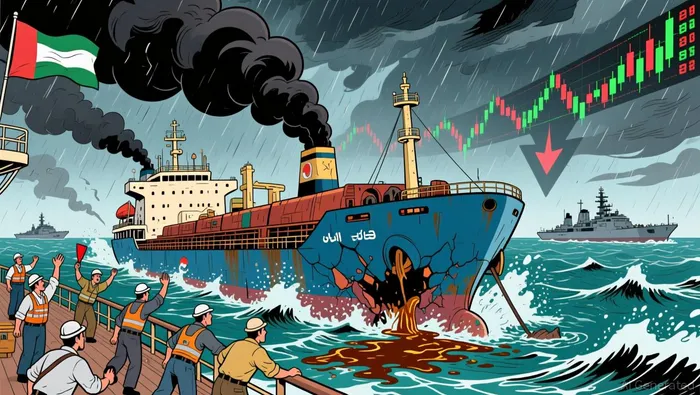
The trigger: The Iran war escalation. After failed peace talks in Islamabad, Trump announced a blockade of the Strait of Hormuz - the world's most critical oil shipping lane. Iran's new Supreme Leader vowed to keep it closed as a "tool to pressure the enemy." The U.S. Navy admitted it's "not ready" to escort tankers yet. Supply chain fear is real.
Powell's warning that prices could "go much higher" the longer the war lasts is now looking prescient. The 5-year breakeven inflation rate - a key market gauge of long-term inflation expectations - has turned positive for the first time since 2022. JPMorgan strategists are saying risks are now "skewed towards higher yields."
The old narrative is dead: For most of 2026, markets bet the Fed would cut because the job market was softening. That story just got overwritten by oil. Every time crude spikes, inflation fears spike with it - and the Fed's hands get tied.
Bottom line: The Fed pivot no one saw coming is happening in reverse. Instead of cutting, markets are now pricing in the possibility of tightening. Oil is the weapon, inflation is the ammo, and the stock market just took a direct hit. Until the Strait of Hormuz clears up, this is the new baseline.