

Multicoin Capital co-founder Kyle Samani said it plainly on May 31, in a tweet thread responding to Starknet co-founder Eli Ben-Sasson: "Web3 is dead; we now only have DeFi and DePIN."
It reads like a funeral notice. But if you look at what actually happened to the categories in between, it reads more like a cleanup bill.
The category that was too broad to survive
"Web3" was never a product. It was a container - a label for everything from social networks and gaming to NFT collectibles, decentralized governance experiments, and digital identity projects. The promise was that blockchain could power all of it. The reality turned out to be much narrower.
Gaming is the clearest autopsy. The sector raised roughly $15 billion, took 63% of all Web3 venture funding in 2022, and then - by every metric that matters - collapsed. More than 90% of GameFi projects have failed. Daily active wallets slid from 7 million in January 2025 to 4.66 million by the third quarter, a 33% drop. In Q2 2025 alone, more than 300 projects shut down. Token prices across the sector average around 95% below their peaks.
The problem wasn't technical. It was that you can't incentive a game into being fun. Token rewards create participants, not players. Once the money dried up, the users left - and the projects that depended on them went with them.
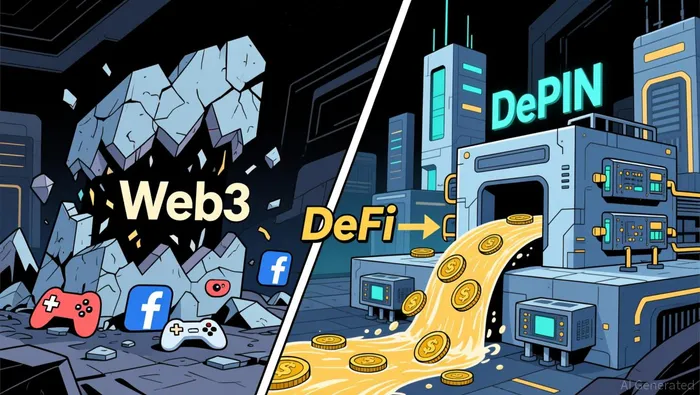
Social tokens and DAO governance fared no better. The original promise was decentralized community control and creator-owned platforms. What happened instead is that decision-making power in DAOs concentrated among early adopters and capital-rich actors, while user participation atrophied. Governance tokens stopped being a functional voting mechanism and became another speculative asset with no cash flow. Projects that raised hundreds of millions to build "decentralized Twitter" or "Web3 Uber" quietly pivoted or disappeared.
This is what happens when a narrative outpaces its own mechanics. The container broke because most of what was inside it had no reason to exist on-chain.
The irony in what Samani keeps
Here's where the headline gets interesting. Samani says DeFi survives - but DeFi is the one category currently bleeding the most.
Total value locked - the measure of how much capital sits in DeFi protocols - fell 49% since October 2025, dropping from a $170 billion peak to roughly $85 billion. Then, over the last few weeks, another $20 billion vanished from high-profile exploits. That's a sector that has given back more than half its peak capital.
None of this means DeFi is dead. It means DeFi is volatile and expensive to run, which is exactly what you'd expect from a financial system still writing its own rulebook. But the contrast is worth sitting with: the category Samani declares surviving is the one that just lost nearly half its capital. And the one he doesn't mention with as much certainty - DePIN - is the one actually generating revenue.
The category no one understood
DePIN - decentralized physical infrastructure networks - is blockchain's most misunderstood category. The idea is simple in theory: use token incentives to crowdsource real-world hardware. People buy a device, the protocol verifies the work it does, and both sides get paid in crypto.
What separates DePIN from everything that failed in Web3 is that it doesn't try to build demand from scratch. It builds infrastructure that already has a market. Helium, which started as a wireless network and pivoted to mobile, now has 2.5 million daily active users - a tenfold increase from a year ago, driven largely by consumer mobile plans. The project reported $24 million in revenue in January 2026, with 35% of that revenue coming from non-token sources like real mobile carriers paying for coverage. Solana-based DePIN projects collectively generated $2.9 million in revenue in April 2026 alone.
This matters because revenue from real customers, not just token emissions, is the difference between a protocol that creates value and one that redistributes it. The gaming sector had the second model. DePIN has the first.
What this is actually about
The structural shift here isn't that Web3 died. It's that blockchain is returning to the two things it's actually good at: programmable money and verifiable coordination of physical resources. DeFi is the first. DePIN is the second. Everything between them was an overlay that looked convincing until the capital ran out.
I think what's harder to accept than Samani's headline is its implication for how we should think about the space. If you've been investing in Web3 because you believed in the broad thesis - that blockchain would remake social, gaming, governance, and commerce - the evidence has been piling up for months that the broad thesis was wrong. The narrow one has been working all along.
The question now is whether the two survivors can justify the valuations their surrounding ecosystems still demand. DeFi needs to prove it can grow without relying on perpetual yield inflation and survive rounds of exploits that chip away at trust. DePIN needs to prove its hardware networks can scale beyond early adopters and that non-token revenue can become the majority of the model, not a nice-to-have footnote.
What I'm watching is whether the capital that flows out of dead gaming and social projects rotates into these two categories or leaves crypto entirely. If it rotates, we get a consolidation play: smaller total addressable market, but higher quality and clearer unit economics. If it leaves, the sector shrinks and the argument about what blockchain is actually for stays unresolved for longer.
Either way, "Web3" as a category is gone. What's left is narrower, less glamorous, and - I think - much more interesting.