

Albuquerque is not an anomaly. It is a microcosm of a much larger, deliberate contraction. Wendy's is executing one of the most significant domestic footprint reductions in its history, closing a mid-single-digit percentage of its U.S. stores-a necessary but painful amputation to stop a brand that has been bleeding sales and shareholder value.
The numbers tell a clear story of acceleration. Following an initial announcement in November 2025, the chain closed 28 restaurants in the fourth quarter as part of a planned 5% to 6% reduction. That follows a 2024 where 240 locations were shuttered on top of the closure of 240 US Wendy's locations. Now, the pace is ramping: the company expects to close between 298 and 358 locations in the first half of 2026. That's roughly 300 to 360 stores, or about 5-6% of its nearly 6,000-location U.S. network, in a single half-year. A review of the chain's store locator shows the U.S. footprint already shrank by roughly 200 locations between September 2025 and early 2026.
This isn't random pruning; it's a systematic retreat from underperforming real estate. The driver is undeniable pressure on the core domestic business. In the U.S., same-store sales fell 11.3% last quarter compared to just 2% at international locations. For the full year, that decline averaged 5.6%. The broader sales engine is stalling: global systemwide sales dropped 8.3% in the fourth quarter alone from the previous quarter.
The thesis is simple: the company is trading short-term pain for long-term stability. By closing consistently underperforming restaurants, management aims to eliminate what CEO Ken Cook calls a drag on franchisee profitability and enable focus on locations with the greatest potential. But the scale of the cut is historic. For a chain that once boasted near 6,000 domestic stores, shedding over 500 locations in under a year is a radical restructuring. The Albuquerque closures are just the first visible symptom of a brand fundamentally rewriting its map.
Project Fresh: The Turnaround Playbook
The closures are not a retreat-they are part of a broader strategic reset. Project Fresh, announced in October 2025, is Wendy's official turnaround playbook, a four-pillar framework designed to reverse years of strategic drift. The stock's loss of roughly half its value over the past year during which time the company has cut guidance twice is the market's verdict on that drift. Project Fresh is an honest admission of error-particularly around value positioning and brand relevance-but execution risk remains formidable.
The plan's four pillars provide the structure: brand revitalization, system optimization, operational excellence, and capital reallocation. On brand, Wendy's has taken a decisive step by retaining Creed UnCo, the consultancy led by former Yum! Brands CEO Greg Creed, to overhaul its advertising with data-driven creative to develop new, data-driven advertising. This is a direct response to the brand's fading connection with younger consumers-a core weakness that competitive value menus have exploited. The company is also investing $20 million toward boosting average unit volumes as part of the broader reset strategy, a clear signal that it recognizes underperforming locations as a drain on the entire system.
That capital shift is critical. The company is reallocating resources away from new construction and toward proven locations. This is evident in the aggressive closure schedule-298 to 358 locations in the first half of 2026 alone as part of the broader reset strategy-and in the focus on optimizing labor and operating hours to prioritize average-unit-volume growth. The goal is to concentrate investment where returns are clearest, a necessary discipline for a chain whose domestic same-store sales fell 11.3% last quarter compared to just 2% at international locations.
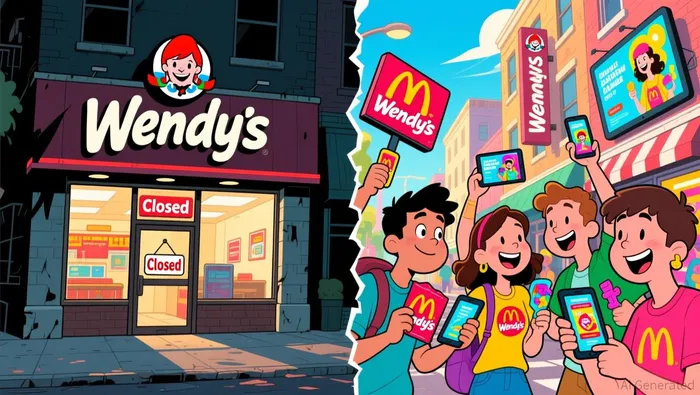
Yet the execution challenge is immense. The same operational frictions that caused the decline-slow service, inconsistent quality, a value proposition muddled by promotional fatigue-have not been magically solved by a strategic plan. Project Fresh calls for "One Wendy's" collaboration between corporate and franchisees to maximize profitability within each market, but aligning a fragmented franchise system around a new brand direction is a slow, contentious process. The plan was announced in October, and while a new value menu has launched, the market has not yet seen the sales inflection that would validate the approach.
The thesis here is straightforward: Project Fresh correctly identifies the problems but faces a high bar on delivery. The stock's 50% decline is a warning shot, not a verdict. If the four pillars can be executed in tandem-if brand messaging finally resonates, if closed stores translate to higher sales at remaining locations, if franchisee profitability improves-then the turnaround has a foundation. If not, the closure wave will continue, and the brand's already-eroded momentum will keep fading. The next few quarters will test whether this is a genuine reset or simply a more organized version of the strategies that got Wendy's into this position.
What This Means for Investors and What to Watch
The closures are a necessary corrective, but Wendy's faces a narrow path to recovery. Success depends on executing Project Fresh while avoiding further brand erosion during the transition. For investors, the thesis now hinges on three watchpoints: Q2 2026 same-store sales trajectory, franchisee retention rates, and marketing ROI metrics.
The Bull Case: A Clean Reset If Project Fresh executes as intended, the closure of 300-plus underperforming locations in the first half of 2026 should lift traffic and profitability at remaining stores. The brand revitalization effort-spearheaded by Creed UnCo-could finally reconnect Wendy's with younger consumers, reversing the 11.3% same-store sales decline that has plagued the domestic business. Franchisee profitability improves, systemwide sales stabilize, and the stock re-rates.
The Bear Case: Brand Erosion Accelerates The risk is that closures themselves damage brand perception-empty storefronts signal distress to consumers. If the new value menu fails to move the needle and marketing spend doesn't translate to traffic gains, the decline accelerates. Franchisees grow restless as systemwide sales keep falling 8.3% in Q4, prompting exits that further destabilize the network. The stock, already down roughly half its value over the past year, has nowhere to go but lower.
The Historical Parallel: McDonald's in the 2000s McDonald's provides a template-and a warning. In the mid-2000s, the Golden Arches closed hundreds of underperforming locations while overhauling its menu and marketing. The difference: McDonald's had stronger brand equity to draw on and executed the transition faster. Wendy's must avoid the same missteps that cost McDonald's market share during its own restructuring.
Key Metrics to Track Q2 2026 same-store sales will be the first real test of whether Project Fresh is working. Franchisee retention rates will signal whether the closure program is destabilizing the system. Marketing ROI metrics will show whether the Creed UnCo partnership is delivering measurable traffic gains.
The Investment Verdict The stock's 50% decline over the past year prices in significant distress. If Q2 same-store sales show any meaningful improvement-say, a single-digit decline rather than double-digit-investors should view this as evidence the turnaround has traction. The risk/reward now favors patient capital willing to bet on execution.