

The price action tells the story of a broken promise. The WLFI token has collapsed more than 76% from peak levels, now trading around $0.08. This isn't just a correction; it's a violent flow signal that the market's trust in the project's decentralization has evaporated.
The immediate liquidity crisis is stark. Despite a 24-hour trading volume of $88.64 million, the token's market capitalization remains at $2.57 billion. This disconnect reveals extreme illiquidity, where a tiny fraction of the market's total value is changing hands daily. It signals a market where few are willing to buy, and those who do are likely doing so at fire-sale prices.
The situation is compounded by a critical withdrawal risk. The platform's self-issued USD1 stablecoin pool is being utilized at a rate approaching 93%. This high utilization, coupled with the allegations of a hidden "backdoor blacklisting function," creates a dangerous feedback loop. If more users attempt to withdraw their funds simultaneously, the pool's ability to meet demand could be severely strained, accelerating the outflow of capital and deepening the collapse.
The Flow of Funds and 'LUNA 2.0' Allegations
The money flows that preceded the collapse reveal a pattern of circular financing and governance failure. World Liberty Financial raised over $460 million during the first half of 2025, a massive influx that fueled its initial growth. This capital was then deployed in a high-risk, self-referential deal: the company secured a $75 million stablecoin loan by pledging 5 billion WLFI tokens as collateral. This structure is a classic red flag, where the project uses its own token to borrow liquidity, creating artificial demand and obscuring true market health.
The situation was compounded by a major governance dispute. The project's largest investor, Tron founder Justin Sun, publicly accused WLFI of embedding a secret "backdoor blacklisting function" in its smart contracts. Sun claimed this gave the company the power to freeze any user's tokens without warning, a direct violation of decentralization principles. The dispute turned personal when Sun's own wallet was reportedly blacklisted in September, framing the conflict as one between a major investor and the project's leadership.
This sequence mirrors the problematic financing seen with LUNA. Just as LUNA's ecosystem relied on internal token sales and collateralized loans to inflate value, WLFI's $75M loan used its own token as collateral. The parallel is stark: both cases involve a project using its own asset to borrow against, creating a fragile, self-reinforcing loop that collapses when trust erodes. The public dispute over the backdoor function further accelerated that erosion, turning a financial flaw into a narrative crisis.
Catalysts and What to Watch
The immediate catalyst is the escalating legal battle. WLFI has fired back, threatening to take Justin Sun to court. This shift from public accusation to formal legal action raises the stakes and introduces a prolonged period of uncertainty. The outcome of this suit will be a major determinant of the project's viability and the fate of its token.
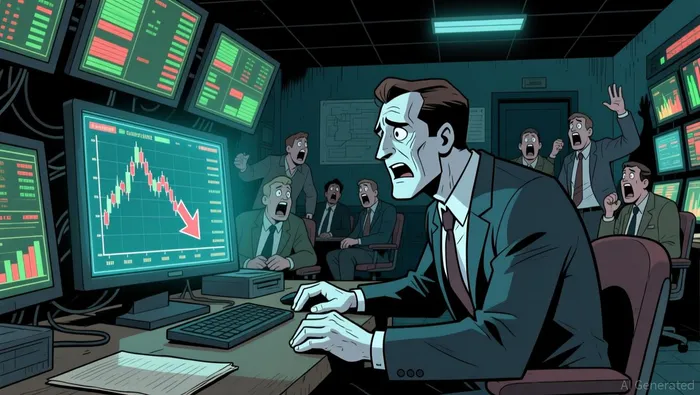
Adding to the selling pressure is a massive on-chain movement. In April's first week, the team moved 3 billion WLFI tokens. This is not routine governance activity; it's a significant flow that likely represents a coordinated sell-off or collateral liquidation. Such a move, especially in a market with already strained liquidity, directly feeds the downward price pressure.
The critical flow metric to watch is the 24-hour trading volume relative to market capitalization. With a current volume of $88.64 million against a $2.57 billion market cap, the ratio is already thin. A sustained drop in volume below the $10 million threshold would signal a market in terminal decline. It would confirm that liquidity has dried up entirely, leaving the token effectively dead with no buyers and no meaningful price discovery.