Billions Are Pouring Into World Cup Markets. Can They Be Trusted?
As the 2026 FIFA World Cup attracts fans, prediction markets are preparing for what some industry participants view as their largest real-world stress test yet.
“The World Cup is such a litmus test for prediction markets,” Asaf Meir, co-founder and chief executive of Solidus Labs, told AInvest's Capital & Power. “This is a large-scale event that's really putting to test prediction markets in a few ways, one of which is basically market integrity.”
The results could determine whether the rapidly growing sector earns broader acceptance among institutional investors and regulators.
👇 Click the Image for Prediction Market Trends in Sports, Crypto, Politics, and more
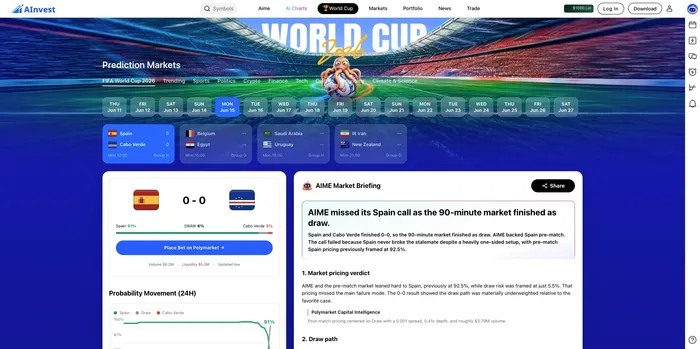
Prediction markets allow participants to trade contracts tied to the outcome of future events, ranging from elections and economic data releases to sporting events. Platforms such as Kalshi have seen rapid growth as traders increasingly use event-based contracts to express views on real-world outcomes.
That growth has also attracted greater regulatory and compliance attention. Kalshi recently expanded its surveillance and enforcement framework, including partnerships with Solidus Labs and academic market-forensics experts, as part of a broader effort to strengthen protections against insider trading and market manipulation.
Meir said Solidus’ role is to monitor trading activity across platforms and connect market behavior with external data sources to identify potentially suspicious conduct.
“What we do is market integrity,” he said. “We make sure that markets are healthy, that there's no adverse selection, that there's no information leakage.”
According to Meir, the firm's surveillance systems analyze trading data alongside information from online communities, public sources, and other datasets to detect patterns that may indicate manipulation. When suspicious activity is identified, the company alerts the relevant platform, which then determines whether further action is warranted under its own compliance procedures.
The issue has become increasingly important as prediction markets seek to attract larger institutional participants. Reuters reported in May that platforms including Kalshi are actively courting hedge funds and asset managers as the industry enters its next phase of growth. Kalshi said institutional trading volume increased sharply over the previous six months as firms explored using event contracts for risk management and forecasting.
Meir argued that confidence in market integrity will be essential if that institutional adoption is to continue.
“Ultimately investors want to make sure the data they watch is accurate and representing reality,” he told Capital & Power. “A lot of market integrity ultimately is what allows to usher in mainstream adoption, both from retail but also from institutions.”
The stakes could be substantial. Meir estimated that approximately $2 billion in trading volume was already expected around World Cup related markets before the tournament has began. “It's significant and it (hadn't) even started yet,” he said.
For prediction markets, the World Cup may ultimately serve as more than a sporting event. It could become a defining test of whether the industry can demonstrate the transparency, surveillance, and trust mechanisms necessary to support its ambitions of becoming a mainstream financial market.