

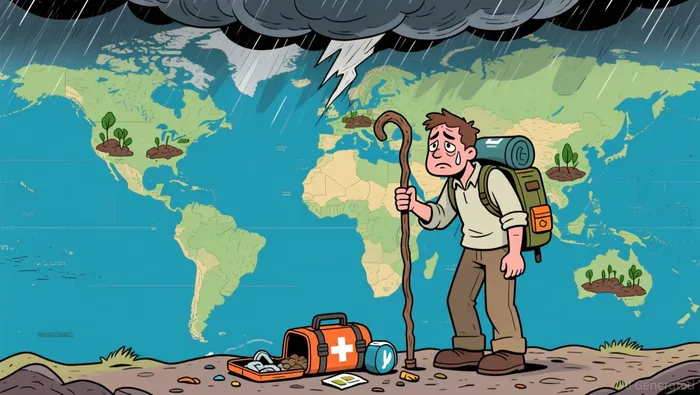
The IMF chief says the world isn't ready for shocks. The headline makes it sound like someone forgot to pack a survival kit. That's the wrong story.
The world has a survival kit. It just used all of it.
Here's what the IMF actually said at its April 2026 Spring Meetings. It cut the 2026 global growth forecast to 3.1 percent - a 0.2 percentage point downgrade driven by the war in the Middle East, which triggered an energy supply shock that hit energy-importing countries the hardest. The "adverse scenario" sits at 2.5 percent, which is near-recession territory for an economy whose baseline was already unimpressive. The IMF would have revised growth up if not for the conflict.
But the part that investors tend to skip - because it doesn't fit neatly into a headline - is the one that actually explains the mechanics. The IMF's own Fiscal Monitor, released at the same meetings, found global public debt at just under 94 percent of GDP in 2025. That figure is projected to reach 100 percent of GDP by 2029, a year earlier than the IMF previously expected. Nearly $29 trillion was added to global debt stockpiles in 2025 alone.
That is the plumbing. When government debt is at 94 percent of global output and rising, the standard response to a negative shock - fiscal stimulus, central bank rate cuts, coordinated lending - has been used up. Not debated. Not poorly designed. Used up. The world isn't "unready" for shocks. It has run through the playbook and the page is blank.
To understand why this matters, think of a household that's already maxed out three credit cards. The next bill doesn't land any harder than usual. The problem is there's nothing left to charge it to. That's the global economy right now.
During the pandemic, governments spent like there was no tomorrow. Central banks cut rates to zero or below, then printed money in amounts that made the 2008 response look like a down payment. Sovereign debt across major economies tripled in a few years. Then inflation arrived, forcing central banks to reverse course and hike rates back up - which locked that debt in at higher interest costs just when governments needed flexibility the most.
The IMF's IMFC (International Monetary and Financial Committee) chair's summary from the Spring Meetings put it plainly: policy space has eroded and international cooperation is weaker. Countries' resilience has eroded as they struggle to respond again.
The odd thing is not that Georgieva warned about shocks. The odd thing is that she also admitted global economic resilience had exceeded expectations. That sounds contradictory until you separate two things: the economy absorbed the last round of shocks better than anyone predicted, and precisely because it did, everyone spent their buffer doing it. You don't get resilience and fiscal space at the same time. You trade one for the other.
The current shock - the war in the Middle East - matters because it's an energy supply disruption. Energy flows have been disrupted asymmetrically: oil exporters get a windfall, importers face higher costs, and countries with limited fiscal space can't cushion the difference with subsidies or stimulus. The IMF noted the impact will persist well into the future regardless of the ceasefire.
The UK, for example, had its 2026 growth forecast cut from 1.3 percent to 0.8 percent, with inflation expected to peak around 4 percent. The UK has no emergency fiscal room at that level of public debt. Neither do most of its peers.
What the IMF calls "growth-at-risk" - its framework for measuring the downside tail of the growth distribution, not just the central forecast - has been tilted toward negative outcomes. The IMF literally oversamples years with negative growth shocks when building this distribution, and the result is a downside that's gotten worse, not better. The central case is 3.1 percent. The bad case is 2.5 percent. The gap between them is the gap between slow-growth stagnation and recession. And neither scenario includes policy tools to make the numbers better.
So what does this look like for someone who actually holds assets, not just reads warnings?
The implication is that the tail risk is no longer symmetrical. In a normal cycle, you get shocks and you get policy responses that soften them. If the response mechanism is broken, shocks don't get absorbed - they get transmitted directly into earnings, credit spreads, and sovereign debt markets.
That means two things for portfolio construction:
First, countries and companies with low debt loads and strong balance sheets are no longer just "defensive." They are the only ones with optionality. When policy space is gone, private-sector balance sheets become the shock absorber. Companies that can self-fund, raise capex, and weather higher input costs will capture market share from indebted competitors that can't.
Second, the sovereign debt market is pricing in a future where central banks are expected to save the day even though their tools have shrunk. If the next shock hits and there's no aggressive fiscal or monetary response - not because policymakers are ideologically opposed to it, but because they literally can't do it without breaking something worse - then the repricing in sovereign spreads and equity valuations could happen quickly. It's not a recession call. It's a "no circuit breaker" call.
The simplest model is this: when global debt is 94 percent of GDP and climbing, the standard toolkit is exhausted. The IMF chief's warning isn't really about whether we'll face shocks - that's obvious. It's about the fact that the mechanisms designed to handle them have been depleted by the last round. The world didn't fail to prepare. It prepared, succeeded, and in doing so used up the preparation.
That's a different problem to trade around.