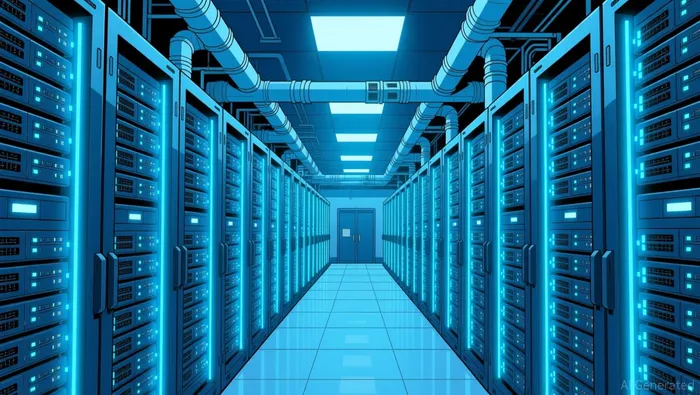
The headline version of the AI story has hardened into a familiar warning: companies are spending too much on artificial intelligence, and the bill is coming due. If the investments don't pay off, budgets get slashed and the hangover sets in. A recent survey found nearly 70% of companies would cut AI budgets this year if projects fail to deliver measurable ROI.
If you live for dividends, though, the "bill coming due" framing has the whole chain of cash flow backward.
Let's trace who actually writes the checks, who collects them, and what happens to the income stream if things go sideways. Because the people spending the most on AI infrastructure aren't the same companies threatening to pull the plug.
The anxiety is about enterprise IT managers - mid-market companies trying to justify AI pilots to a board that wants a quarterly return. That's a real debate. But the cash-flow engine funding infrastructure dividends runs on a different layer entirely.
Amazon plans to spend roughly $200 billion on capex in 2026. Microsoft is at $190 billion. Alphabet guided to $180–$190 billion. Meta forecasts $125–$145 billion. The Big Five hyperscalers combined are on track to spend well over $700 billion this year, and Goldman Sachs puts the broader annual AI capex baseline at $765 billion for 2026 - up from their earlier $500 billion estimate late last year. These projections have been revised upward, not downward, as the year has progressed.
Enterprise budget anxiety and hyperscaler infrastructure commitment are two different worlds. When 70% of general companies say they'll trim AI spend, they're talking about software subscriptions, cloud API costs, and pilot programs - not the physical data centers, power grids, and cooling systems that the hyperscalers are signing 10-year leases for right now.
This is where the income investor actually sits. If you own data center REITs, you're on the receiving end of the $765 billion, not the paying end of the enterprise pilot budget.
Equinix (EQIX) collects long-term anchor leases from hyperscalers and enterprise tenants who need physical space for their compute. The stock yields around 2.0% on a trailing basis, with an EPS payout ratio near 49%. That's a conservative coverage level for a property business - half the earnings go to shareholders, half stays in the building for the next phase of growth. The dividend grows gradually, the way a landlord raises rents on rolling renewals rather than a growth stock announcing a surprise.
Digital Realty (DLR) runs a similar model. The stock yields roughly 2.6%, and management is guiding core FFO - the cash-flow measure REIT investors use to gauge whether the dividend has room to breathe - to $7.90–$8.00 per share for 2026, roughly 8% growth from 2025. At $4.88 in annual dividends, that's comfortable coverage with a margin for the unexpected.
Yes, these yields are modest. They won't fund a lifestyle on their own. But they serve a specific job in an income portfolio: they're the cash-flow proxy on the AI buildout, without the valuation stretch of a chipmaker or the speculative risk of an application-layer company. If the hyperscalers keep spending, the leases keep collecting.
Now, the risk. Here's where the "bill coming due" story would have to actually hurt the income stream, and how it would look if it did.
The bear case isn't about enterprise AI budgets shrinking. It's about one of three things breaking the hyperscaler spending assumption: a recession severe enough to make $765 billion in capex unaffordable, interest rates staying elevated long enough to make debt-financed data center builds unprofitable, or - the one analysts watch most closely - hyperscaler capex decelerating by more than 20% year-over-year, which would be the first structural signal that the spending wave is cresting rather than rising.
None of those three has happened. Capex forecasts have been revised up through mid-2026. The spending acceleration is still intact. Data center REIT debt maturities are manageable relative to the lease cash flows sitting underneath them. And the hyperscalers generating that demand have balance sheets that dwarf their REIT landlords.
But we need to be honest about the leverage question. Data center REITs are heavily capitalized businesses. They use debt to acquire and build properties, and rising rates make that debt more expensive. Both EQIX and DLR carry significant debt loads. If financing costs stay above the low-rate environment of the past decade, it compresses the cash flow available for dividends even if rents are growing. That's a real pressure, not a hypothetical. The difference is it's a funding cost issue, not an AI-ROI issue. The checks are still being written; the question is whether the cost of borrowing to own the buildings keeps the economics positive.
Here's the practical implication. If you're building an income portfolio and you want exposure to the AI infrastructure wave, the data center REIT layer is where the cash flow is most visible and most contractually protected. Hyperscalers don't cancel 10-year leases because an AI chatbot disappointed their CFO. They sign them, build them, and pay rent on them - and the dividend is the fraction of that rent that makes it to your account.
The enterprise AI ROI story is real, and it matters. Just not for the income stream you're holding. Don't let a worry about middle-market IT budgets make you sell a position where the actual payer is Alphabet with a $190 billion capex plan. Different budgets. Different risk. Different dividend.
So what should the income investor do? If your portfolio already holds data center REITs, the current picture supports holding for income - the payout is covered, the tenants are the biggest spenders in the economy, and the spending wave hasn't cracked. If you're looking to add, wait for price weakness that pushes the yield a point or two higher without changing the underlying lease quality. The AI capex spend isn't slowing; if anything, it's accelerating. Lower prices on intact cash flow are a reinvestment opportunity, not a selling signal. The only scenario that changes this call is that 20%+ hyperscaler capex deceleration - watch the guidance, not the headlines.