

XCMG just wrapped its 8th International Customer Festival in Xuzhou, China. The theme: "Green Intelligence for A Better World." Over four days, customers from dozens of countries walked factory floors, examined autonomous road construction products across nine categories, and watched battery-swap electric excavators demonstrate their 6-minute charge cycles.
It looked impressive. It was designed to.
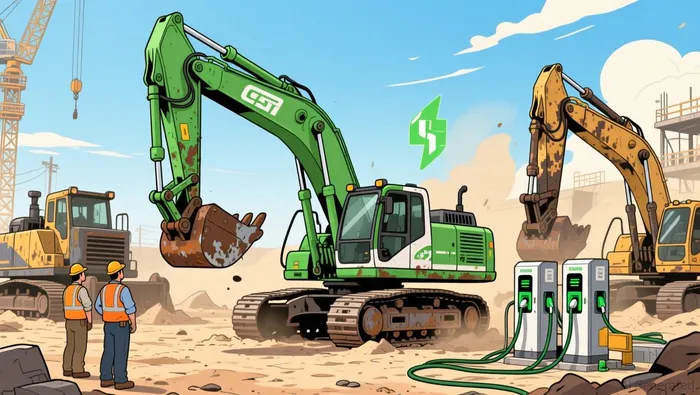
This is a marketing event, not evidence of a completed transition. XCMG's stock is up 34% over the past year on the assumption that its "green intelligence" pivot is already underway at scale. The festival was built to reinforce that assumption. The problem is the assumption hasn't been stress-tested against the economics of how construction equipment actually gets bought, deployed, and operated.
The Electric Claim, Decomposed
XCMG's star exhibit was the XE215EV battery-swap electric excavator - a 21.5-ton machine with a 400 kWh lithium iron phosphate battery, capable of 8 hours of continuous operation before needing a swap. The compact XE27CR EV, shown more recently, packs a 23.5 kWh battery for 3+ hours of work.
Compare that to the XE215 diesel counterpart: unlimited runtime (refuel in 10 minutes), no battery degradation, no charging infrastructure required. The diesel machine costs less to buy, operates anywhere without grid access, and has a service ecosystem that spans every continent.
The electric version only wins if the customer has already built the swap infrastructure. That infrastructure - swap stations, spare battery inventory, grid connections - is a multi-million-dollar site investment. XCMG doesn't make the stations. It sells the machines that depend on them.
This is the same chicken-and-egg problem that has kept battery-electric construction equipment at the margins of the industry. A March 2026 Construction Briefing analysis confirmed what any fleet manager knows: "the purchase price of battery powered construction machines is still significantly more expensive than their diesel counterparts. Few companies" make the switch because the math only works in narrow use cases.
XCMG's battery-swap approach is genuinely interesting engineering. The ICCT published a case study in August 2025 documenting battery-swap electric excavators operating in northern China's largest coal mine, cutting emissions and operating costs. That's a real data point. But it's from a single mine, in a single country, in an industry - mining - where the host company can absorb infrastructure costs as part of environmental compliance budgets.
That does not translate to the general construction market, where contractors operate on thin margins and refuse to tie capital to site-specific infrastructure.
The Revenue Silence
Here's the number XCMG doesn't give you: what percentage of its revenue actually comes from electric machinery.
XCMG reported full-year 2024 revenue of roughly RMB 92.5 billion (about $12.7 billion). In 2025, overseas revenue grew 16.6% year-over-year to RMB 48.6 billion, accounting for nearly half of total revenue. The company ranks in the global top three by the KHL Yellow Table with approximately 6.4% market share.
None of these figures break out electric sales as a separate line item. The 2024 ESG report notes that clean energy accounted for 13.63% of XCMG's energy consumption - not its product mix. That's the energy the factory uses, not the energy the machines use. It's a classic corporate sustainability report sleight of hand: report something real that looks like what the audience wants to hear.
If electric machinery were a material revenue stream, XCMG would lead with it. It doesn't.
The Scale Problem
Caterpillar reported $67.6 billion in full-year 2025 revenue - more than five times XCMG's top line. CAT doesn't talk about "green intelligence." It talks about customer demand, and the demand is still overwhelmingly diesel. CAT has shown electric prototypes, but hasn't committed to the same electric-first narrative because its customer base hasn't asked for it at scale.
XCMG's electric lineup exists in a market that the Global Market Insights report values at $15.8 billion for 2025, projected to grow at 20.8% CAGR through 2035. That sounds fast until you compare it to the broader construction equipment market, which was $167 billion in 2025. Electric equipment is roughly 9.5% of the total.
XCMG is positioning itself as a leader in a segment that remains a small fraction of the industry, and that segment's growth is still measured against a tiny base.
What the Festival Was Actually For
The 8th International Customer Festival had a real purpose: customer acquisition for XCMG's overseas push. Overseas revenue is the growth engine - up 16.58% in 2025, approaching half of total revenue. The electric narrative is the premium positioning tool that makes XCMG look like a technology company rather than a heavy-equipment manufacturer, which helps close deals with buyers who want to signal ESG compliance on their own balance sheets.
The autonomous products, the multi-category displays, the factory tours - these are designed to show international buyers that XCMG is not just the cheap alternative to CAT and Komatsu. It's the forward-looking alternative. The narrative does real work.
That doesn't make the engineering claims true. It makes the marketing effective.
The Cross-Currents
- XCMG's electric engineering is real, not vaporware. The XE215EV battery-swap system works in controlled environments. Chinese mining operations have validated the concept. This isn't a scam - it's a narrow use case dressed as a broad strategy.
- The TCO math still favors diesel for most operators. Higher purchase price, limited runtime, battery degradation over the machine's lifecycle, and the infrastructure dependency all push electric equipment toward specialty applications.
- XCMG's overseas growth is genuine but diesel-driven. International buyers are purchasing XCMG for value pricing and expanding product breadth, not because they're converting to electric fleets. The 48% overseas revenue share reflects emerging-market penetration where diesel dominance is strongest.
- The stock has already priced in the green transition thesis. A 34% gain over 12 months means the market has rewarded the narrative before the revenue can confirm it. At a market cap of approximately ¥110 billion, further appreciation requires electric revenue to scale faster than current evidence supports.
Directionally, the gap between the narrative and the numbers will narrow - eventually. Battery costs come down. Swap infrastructure standardizes. Regulations push emissions harder. But that is a 5-to-7 year timeline, not a "festival to festival" inflection.
You decide which was marketing fluff and which was analysis. XCMG's electric products are genuinely engineered machines that work in specific applications. The "Green Intelligence for a Better World" framing treats those specific applications as an industry-wide inflection point. They're not the same thing. For an investor who bought the stock over the past year, the thesis is no longer whether XCMG can build electric machines. The thesis is whether the market for those machines grows fast enough to justify the premium the stock already carries. The evidence says that hasn't happened yet.