

The market is still pricing the regulatory drama. But the case is over. That's the first reason the old framework no longer works - and also the reason it hasn't worked to buy and hold since August 2025.
The SEC lawsuit that hung over XRP for years ended in 2025. Ripple paid $50 million - a fraction of the $125 million originally demanded - withdrew its cross-appeal, and both sides formally closed the door. No pending appeals. No remaining claims. The overhang that suppressed XRP for seven years is gone.
So why does XRP trade near $1.40, roughly 63 percent below its July 2025 cycle high of $3.65 and down about 26 percent this year? The bounce is real. The inability to hold is equally real. The headlines keep arriving. The math keeps pulling it back.
The news cycle is the bounce. The supply cycle is the gravity.
Here's what has happened since the case closed, in rapid succession:
Ripple spent roughly $3 billion on acquisitions throughout 2025 - most notably the Convera deal, which gives Ripple access to a network processing $190 billion in cross-border payments. Big bank integrations with Deutsche Bank and Société Générale followed. Ripple's RLUSD stablecoin (a dollar-pegged token issued under New York regulatory oversight) crossed $1.6 billion in market cap by April 2026 and expanded to Ethereum Layer 2 networks. In March 2026, the SEC approved multiple spot XRP ETFs; seven are now live. Cumulative net inflows across all XRP ETFs have exceeded $1.44 billion. May 2026 brought $84 million in inflows - the strongest month of the year.
Every single one of those is a reason to expect the price to go up. Every single one has failed to make it stick.
The reason is simpler than any of those headlines: Ripple sold more than $8 billion worth of XRP in 2025. That's from scheduled monthly releases of roughly 300 million tokens per month. The company raises cash by selling its own asset. That is not a criticism of the strategy - a private company needs capital to execute - but it is the supply-side force that neutralizes the demand-side headlines.
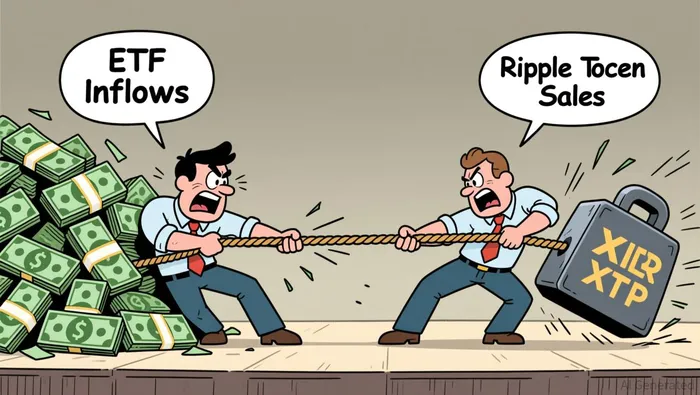
The bounces happen on news. The fades happen because the news doesn't change the daily supply/demand balance.
The thing the market keeps confusing
There is a persistent conflation between Ripple the company and XRP the token. They move together in sentiment but not in fundamentals.
Ripple is thriving as a private business. It hit a $40 billion to $50 billion private valuation in November 2025. It's ranked as the 9th-largest potential IPO candidate. It's spending billions to build infrastructure. A Coinbase and EY-Parthenon survey of 351 institutional investors found that 18 percent already hold XRP and another 25 percent plan to add it in 2026. On-chain ODL (On-Demand Liquidity, Ripple's payment settlement product) volume is projected to grow 30 to 50 percent as more payment providers adopt it.
But Ripple buying, selling, and partnering doesn't automatically bid up XRP. Ripple's $8 billion in annual token sales does. That supply is the hidden denominator in every ETF inflow chart and every adoption headline.
The ETF numbers look solid until you put them next to the supply. Seven funds, $1.44 billion in cumulative inflows since launch. Strong for XRP's history. But against $8 billion in annual token sales volume from a single entity, the inflows are a current - not a flood.
What has to change for the bounce to become structural
This isn't a case of buying early and waiting for the market to catch up. The market has already caught up to the news. It's a case of identifying which number has to flip before the price holds.
The inflection point isn't the next bank partnership. It isn't the next ETF inflow month. It's the moment when sustained monthly buying - from ETFs, institutions, ODL usage, and retail - structurally exceeds the monthly supply coming from Ripple's sales and the circulating unlock schedule.
That hasn't happened yet. But it's closer than it was two years ago. The case is done. The ETFs are live. The infrastructure is scaling. The supply overhang from Ripple's sales is the last standing reason the price can't hold. When the demand side grows large enough to clear it on an ongoing basis - not a headline basis - the bounces stop fading.
The tripwire and the proof
I can be wrong again. The setup is that Ripple's business growth eventually outpaces its token sell rate. Either the company raises enough capital to reduce the monthly supply, or demand compounds to the point where the supply is absorbed. Both are plausible. Neither has happened.
What would prove the thesis wrong: if XRP drops below $1.00 and stays there through another round of positive adoption headlines, it signals that the supply/demand imbalance is deeper than the headlines suggest and that institutional demand is structural window-dressing, not real conviction. That's the level where the bounce mechanism itself breaks down.
What would prove it right: a month where ETF inflows exceed $100 million while XRP holds above $1.80 without a headline catalyst. That would be the first sign that the demand side is large enough to move independently of the news cycle.
Until then, XRP keeps doing exactly what it should: bouncing on news, fading on math. The old story is dead. The new one hasn't hit the numbers yet.
Discipline over ego. The setup improves only when one number flips - sustained demand exceeding sustained supply. Watch that, not the headlines.