

XRP has fallen roughly 8% over the past week, sliding below $1.25 as the broader crypto market sells off. The headline framing, repeated across a dozen outlets in the last 48 hours, is that traders are bracing for deeper losses. That's not wrong. But it misses the actual story.
The more revealing development isn't what XRP did. It's that the CLARITY Act - the bipartisan crypto regulatory bill - advanced through the Senate Banking Committee in May and was placed on the full Senate calendar on June 1. On the same day XRP started slipping, the very legislation that was supposed to be its tailwind moved closer to passage.
The market didn't care.
That disconnect is worth sitting with for a moment. If XRP's price were really about regulatory clarity - and many of its holders have staked the entire narrative on that - then legislative progress should have been a floor, not a backdrop for a selloff. The fact that it wasn't tells you something about what's actually moving markets right now.
The plumbing broke before the politics arrived
The primary driver of this sell-off has nothing to do with XRP-specific news. It's a liquidity chain reaction that started at the top of the stack and worked its way down.
Rising U.S. Treasury yields pulled money out of spot Bitcoin ETFs at the worst weekly pace of 2026 - more than $1.4 billion in Bitcoin ETF withdrawals alone. That matters because ETF inflows have been the institutional on-ramp that kept price bids intact since January. When that money reverses direction, it doesn't just reduce demand; it signals that the risk-free rate is competing more aggressively with crypto's speculative premium.
Then Strategy - the firm formerly known as MicroStrategy, run by Michael Saylor - sold 32 BTC between May 26 and 31 to fund shareholder dividends. It was the company's first Bitcoin sale in more than three years. The market read it as a crack in the armor of the largest institutional Bitcoin holder, and sentiment followed. Bitcoin fell below $70,000 for the first time since April.
Once Bitcoin broke that level, the leverage unwind began. Nearly $1.5 billion in crypto positions were liquidated in a single 24-hour period, with 97% of them forced exits from leveraged long positions. That's not organic selling. That's the plumbing: when price crosses a threshold, exchange margin calls trigger automated liquidations, which push price lower, which trigger more liquidations.
XRP, like most altcoins, gets caught in the crossfire. When Bitcoin bleeds and leverage flushes, everything correlates downward. The secondary amplifier here is that altcoins tend to fall faster than Bitcoin during risk-off moves, because their bid structure is thinner and more dependent on risk appetite in the first place.
What this reveals about the regulatory narrative
Here's the part that interests me more than the price action: the market's indifference to the CLARITY Act's progress suggests that regulatory clarity, at least in its current form, doesn't provide immediate price support when macro conditions turn hostile.
The SEC and CFTC already jointly classified XRP as a digital commodity back in March 2026. The CLARITY Act, if it passes the full Senate and reaches the House floor, would codify clearer jurisdictional boundaries between the agencies and prohibit the Federal Reserve from unilaterally issuing a retail CBDC. These are structural wins. But structural wins don't stop $1.5 billion in liquidations on a Tuesday.
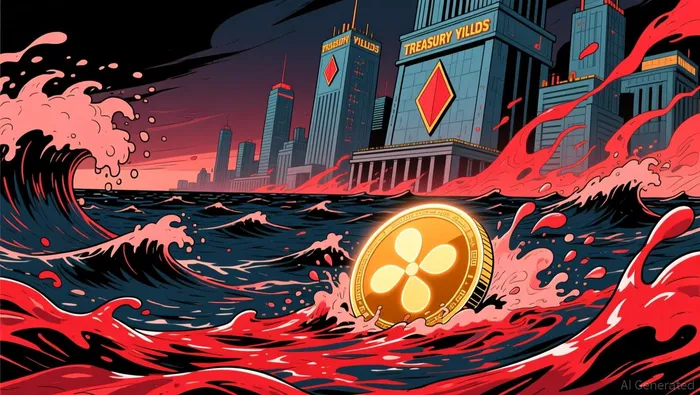
What this episode shows is that crypto price action is now governed by the same liquidity channels that govern other risk assets. Treasury yields, ETF flows, leverage cycles - these are the real levers. Regulatory clarity is a slower-moving theme that sets the ceiling over months and years. It doesn't put a floor under intraday liquidation cascades.
I think that distinction matters more than most coverage admits. The XRP community has spent years arguing that regulatory resolution would unlock institutional demand and reprice the token. That may still be true over a longer horizon. But this week proved that when the macro plumbing turns, narrative tailwinds don't provide liquidity.
What to watch next
The question now is whether this is a clean deleveraging event or the start of something deeper. I'm watching three things:
First, whether Bitcoin ETF outflows persist or reverse. If the outflow trend continues through the week, it suggests institutional risk appetite is genuinely cooling, not just rotating. If they stabilize, this was likely a leverage flush that will recover.
Second, whether the CLARITY Act moves through the full Senate. The legislative calendar is packed, and there's no guarantee of a vote. If it stalls, the regulatory clarity thesis loses its near-term catalyst. If it passes, the structural tailwind remains - just not priced in yet.
Third, whether XRP holds the $1.20 area. That level has acted as support through multiple tests this year. A break below it would suggest the broader altcoin bid is weakening in a way that could take longer to repair.
The structural shift here isn't about XRP being weak. It's about crypto behaving like the institutional asset class it's become - and that means it's now vulnerable to the same forces that move everything else. Good regulatory news doesn't immunize you against rising yields and fleeing capital. That's not a bug in the system. It's what the system is becoming.