

The headlines read the way you'd expect after months of anticipation. Spot XRP ETFs launched last November, and they've pulled in well over $1 billion in cumulative inflows. Institutions finally have a regulated on-ramp to XRP. The category has arrived.
Except the price doesn't reflect any of that. XRP is down roughly 43% in 2026, and for the better part of 75 days this year it's been stuck between $1.30 and $1.50, as if the ETF inflows never happened. The token sits around $1.44, its market cap hovering near $86 billion on a circulating supply of about 61 billion tokens.
That disconnect is the actual story. The XRP ETF phenomenon isn't a straightforward case of institutional validation translating into price appreciation. It's something closer to a fee war among asset managers competing for a newly available category, layered on top of supply dynamics that are absorbing every dollar of demand.
The fee war is the engine
Here's the detail the market commentary usually skips. Franklin Templeton - which manages $1.6 trillion across its funds - waived its entire management fee on the first $5 billion of its XRP ETF assets through May 2026. Grayscale did something similar with its XRP Trust ETF. These aren't cosmetic discounts. When you're competing for flows into a brand-new asset class with limited existing infrastructure, free access is the only differentiation that matters.
I think the fee promotions are doing more analytical work than most people realize. They explain why the early inflows were so large and so concentrated. Money didn't flood into XRP ETFs because of a sudden conviction shift about XRP itself. It flooded in because six major asset managers were simultaneously telling every institutional desk: you can now buy XRP through a standard wrapper, and it costs nothing for a while.
That's an access story, not a conviction story. And it matters because the inflow pattern suggests it. By April 2026, weekly XRP ETF inflows had collapsed to under $2 million, while broader XRP-linked global products reported $130 million in net outflows. The promotional gravity faded, and the flows followed.
The supply side doesn't care about ETFs
Meanwhile, on the supply side, Ripple's escrow schedule continues on autopilot. Every month, 1 billion XRP is unlocked from escrow - worth roughly $1.4 billion at current prices. Most of it gets re-locked, but the mechanism itself is a structural overhang. Even if Ripple only sells or distributes a fraction of each monthly release, that's a persistent supply tap running against whatever demand the ETFs generate.
Think about the arithmetic. The ETFs pulled in $1.5 billion cumulatively over several months. That's impressive as a category headline. But the escrow unlocks $1.4 billion worth of XRP every single month, and that's before you account for derivatives market selling that has been absorbing spot demand since launch.
An analysis from late last year put it plainly: ETF inflows are material, but they aren't overpowering selling pressure in spot and derivatives. That's not a bearish take on XRP - it's a mechanical observation about what happens when you layer new demand rails on top of existing supply dynamics without changing the underlying tokenomics.
What this is really about
I'm less interested in where XRP goes next than in what the ETF structure reveals about how these categories develop. The XRP ETF rollout followed the same playbook as the early Bitcoin and Ethereum spot ETF launches: regulatory clarity first, asset-manager filings second, fee promotions third, concentrated early inflows fourth. The pattern is now almost mechanical.
But the XRP case adds a wrinkle that the earlier ones didn't have - or at least didn't have in this form. XRP is the only major crypto ETF where the underlying company maintains a monthly supply release schedule that directly competes with the institutional demand the ETFs are supposed to create. Bitcoin doesn't have this. Ethereum doesn't. The issuers of those tokens don't sit on the other side of the market.
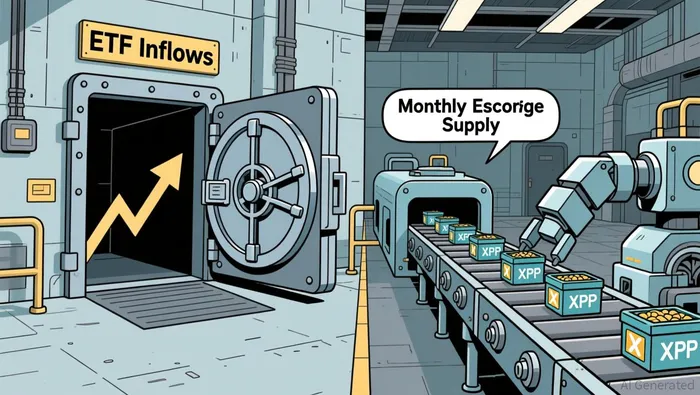
That creates an odd structural dynamic. The ETF issuers are fighting to attract institutional money into an asset where the company behind the asset is also a regular seller of it. It's not a conflict in any legal sense - the SEC settled its case with Ripple in May 2025, which cleared the pathway to ETF approval - but it is a market-structure oddity that doesn't show up in the promotional language.
What would change the read
The fee waivers expire in May - Franklin Templeton's promotional period ends this month. That's a clean test. If inflows sustain without the fee subsidy, the conviction argument gains ground. If they don't, the fee-war explanation holds.
On the supply side, the question is whether Ripple ever adjusts its escrow distribution schedule in response to ETF demand. That seems unlikely given the company's stated business model, but the market has been wrong about company incentives before.
What I'm watching, honestly, is whether this becomes a case study in how crypto ETF categories mature. The XRP ETFs will probably survive at smaller scale. They've established the plumbing. But the early inflow numbers - the $1.5 billion headline - tell a story about promotional competition and newly available access, not about structural demand that overpowers supply. The price action has known the difference all along.
The broader lesson, if there is one, is that ETF approval is no longer the event for any crypto asset. It's the opening of a plumbing debate. The real question is always what sits on the other side of the pipe.