

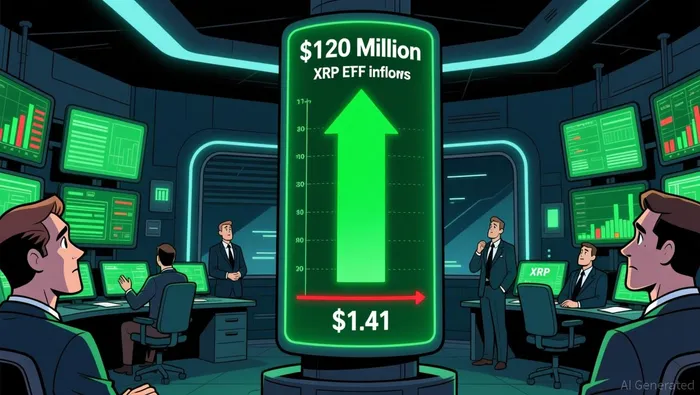
Institutional demand for XRP is surging, with a $120 million weekly inflow marking the strongest weekly figure since December 2025. This capital signal reflects rising conviction, with the total assets under management in spot XRP ETFs now approaching $1 billion. The inflow stands out sharply against a backdrop of broader crypto ETF outflows, indicating a specific rotation into XRP as other assets see selling pressure.
Yet this surge in demand is not translating to price strength. The XRP price remains stuck in a narrow range, hovering around $1.41 and down roughly 43% year-to-date. This disconnect highlights a key dynamic: the inflows represent passive institutional exposure through regulated funds, not direct capital flowing into the XRP network itself. The capital is validating the asset's market presence without necessarily supporting its underlying utility.
The setup creates a fragile tension. For now, the weekly inflow is a powerful bullish signal in isolation, but the asset's technical chart remains weak, failing to print higher highs. The real question is whether this capital will eventually move from passive ETF holdings into the broader market, providing the liquidity and conviction needed to break the price out of its prolonged downtrend.
The Passive Nature of Demand and Its Limits
The $120 million weekly inflow is a signal of passive institutional exposure, not active capital deployment. The data reflects buying into regulated ETFs, which hold XRP as a security without using it for on-chain settlement, lending, or liquidity provision. This creates a disconnect where capital validates the asset's market presence without contributing to its underlying utility or network activity.
A critical metric reveals the inflow's composition: Bloomberg Intelligence estimates 84% of total XRP ETF assets are retail. This suggests the surge is driven by retail capital, not a deep institutional shift toward treasury management. The demand appears magnified by XRP's smaller ETF base, making daily flows look larger relative to Bitcoin and Ethereum. As one report notes, XRP's smaller product structure can magnify daily changes, skewing rankings even when the absolute capital is modest.
This passive demand has limits. It provides liquidity to the ETF market but does not guarantee a rally in the underlying asset. For the price to break out, this capital must eventually move from passive holdings into the broader market. Until then, the inflow is a validation of the product's existence, not a direct catalyst for the network's growth or price discovery.
Catalysts and Risks: Bridging the Gap
The critical catalyst for converting passive inflows into price momentum is regulatory clarity. A survey of 351 institutional investors found that 65% said regulatory clarity is the top factor behind increasing crypto exposure, pointing directly to the CLARITY Act as the key trigger for converting intent into actual XRP buying. This vote is the single most important near-term event that could unlock the 25% of institutions planning to add XRP this year.
The primary risk is that inflows remain concentrated in spot ETFs, which hold XRP passively. As an Evernorth executive noted, ETFs are a passive wrapper that simply buy and hold XRP. This creates a disconnect where institutional capital validates the asset's market presence without driving active treasury management or on-chain utility. The thesis depends on this capital eventually flowing into more active structures like the public XRP treasury company Evernorth is building.
A key watchpoint is a divergence between steady ETF inflows and expanding derivatives leverage. While spot ETFs provide a floor, a surge in XRP futures Open Interest would signal deeper institutional conviction and active hedging, potentially bridging the gap between passive demand and price discovery. For now, the inflows are a powerful signal, but the price remains tethered to the lack of a regulatory catalyst and the passive nature of the capital.