

The XRP Ledger's core flow metric has exploded. The network now averages nearly 3 million daily transactions, a massive 200%+ increase from the ~1 million per day in mid-2025. This acceleration is not a one-off spike; it represents a sustained climb in network activity, with the ledger processing 2.7 million transactions in a single day recently. This volume surge is the engine driving institutional adoption.
That engine runs on stablecoin transfers and real-world asset tokenization. RLUSD dominates the stablecoin market on XRPL, holding about 84% of the share. The network recorded $1.77 billion in stablecoin transfer volume over the past 30 days, a 91.9% increase. More broadly, the total value of tokenized assets on the ledger has surged to $2.3 billion. This is the real utility: institutional settlement flows and automated payments, not retail speculation.
Yet the market valuation remains stubbornly disconnected. Despite this massive on-chain activity, XRP price remains pinned in a tight range, repeatedly rejected near $1.50. The volume is there, but the price action shows a stark lack of conviction from the broader market. This divergence between surging flow and stagnant price is the central puzzle for the XRP ecosystem.
Institutional Capital Flows: ETF Inflows and Regulatory Clarity
The institutional capital story is now a persistent, on-chain reality. After years of quiet OTC interest, regulatory clarity from the 2025 court victory enabled a wave of spot XRP ETFs. This new channel has attracted a significant floor of capital, with cumulative inflows crossing $1.50 billion by early March 2026. Names like Goldman Sachs have backed these products, cementing XRP's place in the institutional allocation conversation.
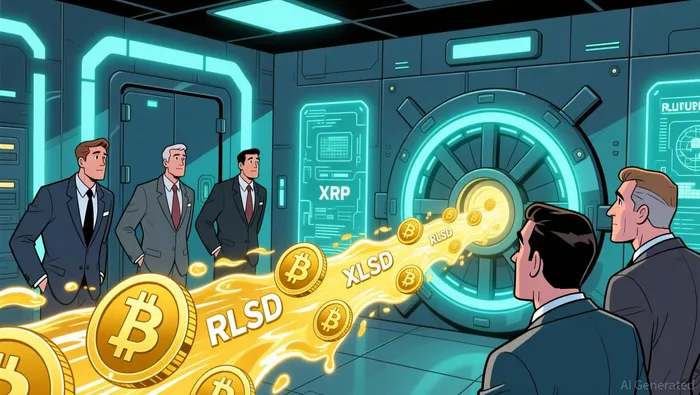
This flow is structural. The ETFs have shown remarkable resilience, with no net outflow days in their first month. That persistence, even amid price volatility, signals considered allocation decisions rather than speculative chasing. It's a new, reliable source of demand that was absent for years, providing a fundamental support layer for the asset.
The key signal for price catalysts is the convergence of this institutional capital with sustained on-chain activity. The network's daily transaction volume now averages 2.7 million, a level that must be maintained. Combined with the growth of RLUSD's market cap toward $2 billion, this flow creates a setup where price may finally align with the underlying utility.
Competitive Positioning: Speed, Cost, and Market Share Gains
XRPL has captured a clear leadership position in the nascent real-world asset (RWA) market. The ledger now hosts $2.3 billion in tokenized value, a figure that has allowed it to overtake Solana and Polygon in total on-chain RWA. This growth is accelerating, with the network ranking second in 30-day RWA growth behind only Arbitrum. The primary driver is institutional adoption, with commitments like Archax's pledge to bring $1 billion in assets onto the ledger by mid-2026.
Its competitive edge is built on three institutional-grade advantages. First, the network offers speed and low costs that are critical for settlement and treasury operations. Second, it provides built-in compliance tools and a "Permissioned DEX," creating a secure, gated environment that regulated banks and firms prefer over more open blockchains. This focus on compliance is a direct response to the needs of the traditional finance sector entering tokenization.
The Liquidity Layer Question: XRP as Bridge Asset
The core investment thesis hinges on a single flow: whether XRP becomes the essential bridge for tokenized assets or remains a fee token. The ledger now hosts $2.3 billion in tokenized value, a figure that is growing rapidly. Yet the critical disconnect is that most of this activity settles in stablecoins, not XRP. For the price to reach $10, XRP must transition from a utility token to a liquidity layer that connects these assets.
The primary risk is that this liquidity layer gets captured by competitors. Networks like Ethereum and Arbitrum inherit massive security and have larger DeFi TVL. They already have the established infrastructure for trading and liquidity provision. XRPL's compliance tools and built-in DEX are its edge, but they must be leveraged to create a dedicated, high-volume trading hub for tokenized bonds, funds, and commodities.
The path to $10 requires a shift in on-chain behavior. If institutions start actively trading these assets on the ledger, market makers would need to hold XRP as working capital to quote prices. This would create real, on-chain demand that burns and locks XRP, moving it beyond mere fee payments. The current setup-where billions in assets sit in a few issuer accounts with minimal trading-does not generate that demand. The ledger must evolve from an institutional record-keeping tool into a global trading hub.