

XRP slid below $1.10 on June 5, briefly, then bounced. Headlines called it a new selloff on shaky ground. The language is familiar enough that you could swap in almost any altcoin from any weak month and the sentence would still work.
The more useful question is what the selloff is actually about - because I don't think it's about XRP itself.
Here's the proximate mechanism. Liquidation-driven selling pushed XRP from $1.40 toward $1.09 in a few days. Leverage ratios climbed even as price fell - from 0.13 to 0.18 - meaning traders were adding leveraged shorts into the drop. That triggered more liquidations, which triggered more selling. The classic feedback loop: $227 million in short liquidation leverage was stacked against just $118 million in fresh ETF inflows entering May. The derivatives market got crowded, then unraveled. Nothing structural, just a mechanical squeeze.
That's the spark. The deeper problem is what the market is pricing - and what it's not.
The Ripple-XRP disconnect
Ripple - the company - is having its most serious run at institutional payment infrastructure. The stablecoin it launched in late 2024, called RLUSD, has grown to $1.7 billion in market cap and just expanded into Turkey and Ethereum Layer 2 networks. RippleNet, its cross-border payment network, counts over 300 banks as partners: SBI Holdings in Asia, Santander in Europe, PNC Bank in the US. Early 2026 saw XRP ETF products attract over $1.5 billion in cumulative inflows, and daily transactions on the XRPL blockchain hit 3 million in March.
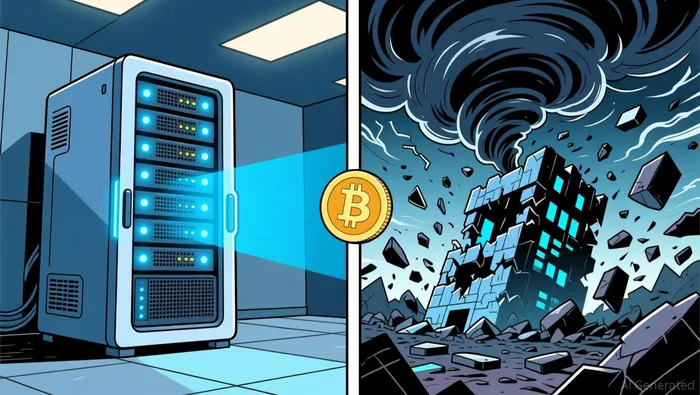
Here's the part that doesn't fit the token's narrative: most of that institutional activity doesn't use XRP. RippleNet banks use the network for messaging and settlement coordination. RLUSD is the stablecoin that's growing. The XRPL sees volume, but a large portion is stablecoin and non-XRP token traffic.
This is the structural tension that keeps reappearing in XRP's price action. Ripple is building payment rails, and that's genuinely interesting. But XRP - the token - is priced by speculators betting on a version of adoption that hasn't materialized the way the community expected. The company's institutional success and the token's market dynamics have become two largely separate stories.
Compare this to the US stablecoin market, where the token and the issuer are more tightly linked to network effects, or to Bitcoin, where the asset itself is the product. XRP occupies an awkward middle: it's supposed to be the bridge currency of enterprise settlement, but the bridges are being built with other coins.
The monthly overhang
Then there's the supply mechanics. On June 1, Ripple completed its routine monthly escrow release, unlocking 1 billion XRP across three transactions - roughly $1.3 billion worth at the time. Every month, a fresh tranche of tokens becomes available. Some are sold, most are moved back to escrow, but the headline number stays the same and it's a constant psychological weight.
I'm not sure this overhang gets enough attention relative to the leverage issue. The liquidation cascade is the spark, but the monthly unlock is part of the fuel. Traders know a predictable volume enters circulation each month, which makes sustained upside harder to build. It's not a death spiral - Ripple's been transparent, and most of each unlock gets re-escrowed - but it's a structural feature that favors volatility. When the broader market turns, the token becomes especially vulnerable.
Context: a market that's turning
It also matters that the wider crypto market is under pressure. Bitcoin, which hit an all-time high near $126,000 earlier this year, has pulled back toward the $63,000-$70,000 range amid Iran-Israel tensions and rising oil prices. Geopolitical stress and central banks holding rates steady are weighing on risk assets broadly.
XRP is down 38 percent this year, which is worse than Bitcoin's pullback. That relative weakness is the more telling data point than any single selloff. It suggests the market is re-evaluating XRP's premium specifically, not just participating in a broad correction.
What would change the story
The obvious counterargument is that this is short-term noise. XRP supporters point to the SEC lawsuit resolution from March 2025, ETF growth, and expanding bank partnerships as evidence of an upward long-term trajectory. These are real developments.
The question is whether any of them change the pricing dynamic. Legal clarity removes an overhang, but doesn't create demand on its own. ETF inflows bring buyers, but the June escrow unlock dwarfed May's total ETF inflows. Bank partnerships are impressive, but if they're using RippleNet's messaging layer rather than XRP as a bridge currency, the transmission mechanism to token demand is indirect at best.
I think the piece I'm more interested in is RLUSD. If Ripple's stablecoin continues to grow - $1.7 billion suggests it's finding product-market fit in enterprise corridors - then the company's real bet might be on regulated stablecoin settlement, not on XRP appreciation. That's not a bad business model. It's just not one that XRP token holders are currently pricing in. It echoes the pattern we've seen elsewhere in crypto: the companies that build the rails sometimes benefit more from the infrastructure than from the speculative token attached to it.
The actual takeaway
The selloff was leverage. The weakness is structural. The question going forward isn't whether XRP is "shaky" - it's whether Ripple's institutional success ever translates into sustained token demand, or whether the company becomes a payment infrastructure story that happens to also have a token.
If XRP can break and hold above $1.40 while the broader market stabilizes, it would suggest the leverage overhang cleared. If it drifts toward $1, especially on monthly escrow release days, the market is voting that Ripple's institutional wins don't move the token needle.
Either way, I think we're seeing the early stages of a more interesting conversation - not about whether XRP will rally, but about what role the token actually plays in a company that's increasingly successful without needing it to.