

Veteran Capital Corp. spent 730 days holding a letter of intent to acquire a Kenyan solar energy company, gave it "repeated extensions," and then dropped it because the target didn't finish its required financing. The termination came June 11. The letter was signed June 12 of 2024. No binding agreement was ever reached. The shares have been on halt the entire time.
That was weird. Or at least it would be, in most market structures.
Here's what makes it less weird and more mechanical: Veteran Capital is a Canadian Capital Pool Company, or CPC. A CPC is roughly Canada's version of a SPAC. Sponsors get a publicly listed shell on the TSX Venture Exchange - the junior market - and then shop around for an operating business to merge with. The investor buys the promise that someday, the shell becomes something.
Two years ago, the TSX Venture Exchange removed the old 24-month deadline for CPCs to close their qualifying transaction. Before the rule change, if you didn't find a deal in two years, you liquidated. After the rule change, you just keep looking. The clock got deleted.
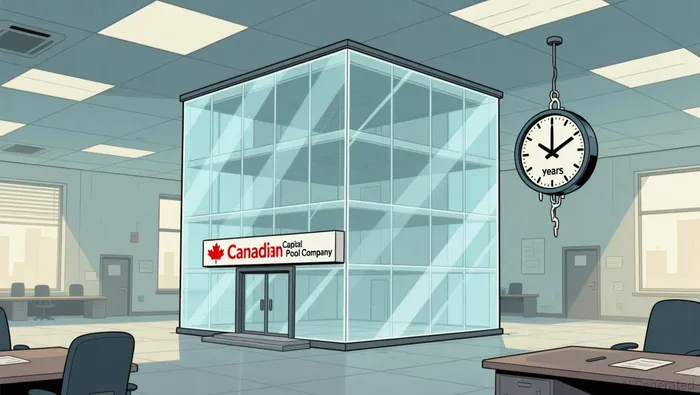
This is basically the plumbing. The old rule created real time pressure on sponsors. Without it, the incentive structure shifts: there's no urgency to close, no forced liquidation, and no reason to walk away from a soft target that hasn't worked out. You just keep extending, keep searching, and keep the shell alive. The shareholders who bought in 2021 are still sitting there. The stock trades around $0.04 CAD.
Powerhive is real enough - Kenya's first privately owned utility, a Berkeley-headquartered company that builds solar mini-grids and does battery swapping and e-mobility across Africa. It raised roughly $75 million over four rounds, with investors including Enel Green Power and Toyota Tsusho. The CEO, Christopher Hornor, posted on LinkedIn in 2024 about Powerhive going public on the Toronto Stock Exchange and cross-listing on the Nairobi Stock Exchange. The Veteran Capital deal was apparently supposed to be one path to that outcome.
But the termination release says Powerhive failed to complete its "required financing" and failed to enter a binding definitive agreement. So the financing was supposed to be part of the deal mechanics, not already done. This looks like the kind of PIPE or sponsor-side commitment that often lives in a SPAC-style LOI - money that's supposed to show up at closing to make the combined company work - and it never materialized.
Veteran Capital says it "intends to continue its search for a qualified transaction with an alternative party." It has also applied to the exchange to lift the trading halt on its shares. So the plan is: un-halt the stock, keep looking, and try again.
The interesting question isn't whether Powerhive was the right target. The interesting question is what structure allows a publicly listed company to spend two years doing nothing, collect no operating revenue, pay no dividends, and remain listed - while the people who bought the shell in 2021 have had no say and no exit.
This is not the SPAC crash story. The US SPAC implosion was dramatic and crowded and involved trust accounts, redemption waves, and warrant arbitrage. This is smaller and quieter. It's the Canadian penny-stock version: a shell that was always unlikely to do anything but couldn't be forced to admit it.
The 2021 rule change was supposed to be a reform. The thinking was probably that CPCs were rushing to close bad deals just to beat the clock, and removing the deadline would give sponsors time to find the right one. The actual result, at least in this case, is something different. Without a deadline, "the right one" becomes a search that never ends. The structure becomes indefinite limbo.
Veteran Capital's shares are cheap. That's not a recommendation. $0.04 on the TSX Venture Exchange means there's a reason they're $0.04. The company is a shell with no business, no revenue, and no current deal. If it finds another target, the stock might move. If it doesn't, the stock stays at four cents. The risk-reward is binary and the binary is tilted toward nothing happening.
The structural point is cleaner. Classification boundaries matter. A CPC is neither a going concern nor a liquidation. It's a holding pattern with a public listing, and the 2021 rule change made that holding pattern permanent unless the exchange or the shareholders decide otherwise. Someone designed this so sponsors wouldn't feel pressured. Someone should check whether it accidentally created a structure with no pressure at all.