

ZTO's valuation still looks low relative to its growth and cash generation
ZTO appears to be priced more like a mature courier than a business growing well above the market's current expectations. In 2025 it grew parcel volume by 13.3%, earned RMB9.5 billion in adjusted net income, and generated RMB11,968.4 million of operating cash flow. Management also authorized a US$1.5 billion share repurchase program, reinforcing the view that this is a cash-generative business rather than a stagnant logistics name.
Why the setup matters now
The early 2026 read-through matters because it suggests 2025 was not a one-off. First-quarter parcel volume grew 13.2%, EPS improved year over year, and adjusted net income reached RMB2.4 billion. If earnings momentum holds, a company growing in the low-teens while producing this much cash could compound at a higher rate than the market currently assumes.
The debate is fairly narrow. Bears focus on whether margins can hold in a competitive market; bulls point to the first-quarter mix shift, with retail volume expanding faster than traditional e-commerce volume and supporting margins. For now, that is where the main disagreement sits.
That is why the valuation gap matters. The stock carries a Hold consensus and a $25.50 price target, yet Morgan Stanley is at $30.10 with an Overweight rating, implying roughly 14 times 2026 estimated price-to-earnings. If the market starts to trust sustained profit growth, the upside could come from both earnings and multiple expansion. The main risk is straightforward: if competition forces price cuts fast enough to break margin durability, the case weakens.
Margin expansion looks plausible, but it still needs to be proven
The margin case does not require a dramatic turnaround. It asks whether a large, growing network can keep converting more parcels, better pricing discipline, and a better mix into a stronger profit curve. After adding 4.5 billion parcels in 2025 on top of an already large base, ZTO is in a position where scale can still help margins.
What first quarter suggests
First-quarter results point to the right mechanism. ZTO handled 9.7 billion parcels in Q1, growing 13.2%, while management said it improved operating cost efficiencies and strengthened network pricing policy fairness and transparency. If margins are improving because more volume spreads fixed costs and pricing is becoming more orderly, that is more durable than a one-time cost cut.
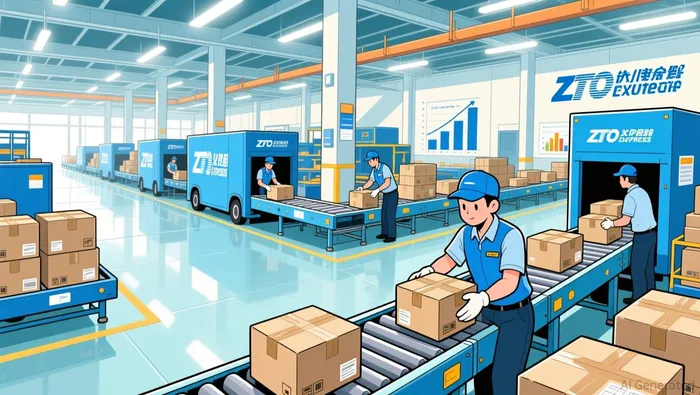
Mix is the second lever. Management said daily average retail volume continued to expand faster than traditional e-commerce volume, which it said improved the revenue structure and supported margins. In simple terms, not all parcels are equal: a better mix means the business is moving more than just a larger volume of packages.
What the next few quarters need to prove
This is where the bull case moves from plausible to credible. Morgan Stanley expects approximately 10% year-over-year volume growth in the second quarter and about 2.9 billion yuan in adjusted net profit for Q2 2026. If volume remains healthy and unit profitability improves even moderately, the market has a better reason to believe margin expansion is building rather than peaking.
Key watchpoints include:
- Management cited more orderly pricing, but that is not the same as a permanent moat.
- If competition shifts back toward price-led growth, current margin assumptions could prove too generous.
- The retail-volume mix benefit needs to continue; otherwise the revenue-quality argument weakens.
- Unit economics still need to improve quarter by quarter, not just in one headline quarter.
The re-rating depends on how the market prices ZTO's earnings durability
The re-rating question is not whether ZTO can keep growing. It is whether the market will stop treating that growth as the output of a price-sensitive transport business.
What the numbers imply
Morgan Stanley's updated model frames the debate cleanly. Its forecasts now imply 21% growth in 2026 adjusted net profit and 16% growth in 2027, yet the $30.10 end-2026 target still asks for only about 14x 2026 estimated P/E. That suggests the near-term upside does not require market euphoria; it only requires investors to assign a more normal mature multiple instead of a discounted logistics multiple.
That discount is visible in the stock's own history. ZTO's PE ratio has ranged from 11.7x to 16.1x, and it was 15.67x on May 27, 2026. That range suggests the market has been willing to pay somewhat more when earnings visibility improves, but also quick to pull back when competition fears returned. The opportunity exists because sentiment still looks more fragile than confident.
What would support a higher multiple
For the re-rating to stick, investors likely need evidence that profits are not just cyclical, but backed by more sustainable pricing and cost discipline. If that proof holds, today's valuation may look inexpensive relative to the growth profile.