Musk's AI Economy Call: 20%-30% More Output, Then the Robot Wave
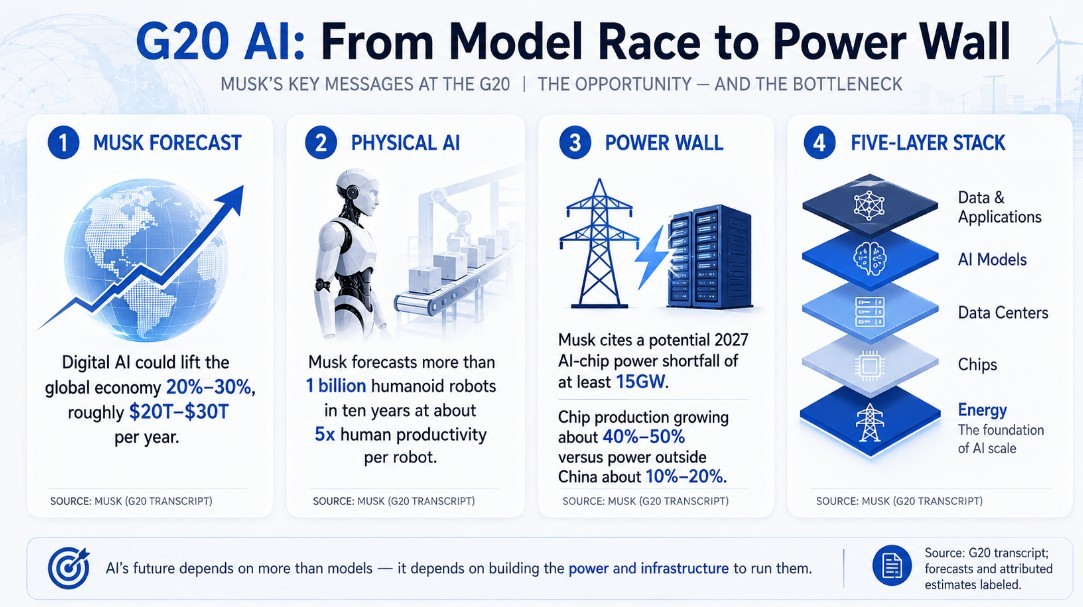
Musk’s most aggressive claim was also his broadest: digital AI could eventually add 20%-30% to global economic output, equivalent to roughly $20 trillion to $30 trillion a year by his estimate. The logic is less about selling more AI software than lowering the cost of intelligence itself. Musk predicts that AI could reach “Stockfish level” in software and become extremely capable across digital engineering within roughly 12-18 months.
Altman says AI could drive the greatest boom in entrepreneurship and small-business creation in history because founders can increasingly access expertise, scientific problem-solving and complex supply-chain support without first assembling the capital and human team that used to be required.
Musk's Digital AI Economy Estimate
That productivity argument becomes even more consequential when Musk moves from digital AI to physical AI. Software can scale almost instantly; robots cannot. They require factories, chips, motors, supply chains and power. That makes adoption slower—but potentially far larger in economic impact. Musk says humanoid-robot usefulness is the product of AI software capability, AI-chip capability and electromechanical dexterity, especially hand control. Musk forecasts more than one billion humanoid robots within a decade, with each producing roughly five times the output of a human.
AI's Power Wall: Chip Supply Is Growing Faster Than Electricity
Musk describes “quite a crisis of power” and cites an industry estimate of at least a 15GW shortfall for AI chips in 2027. He contrasts roughly 40%-50% annual growth in AI-chip production with roughly 10%-20% annual growth in power available outside China.
For investors, the implication is not that the GPU trade is ending. It is that the scarcity premium may be spreading outward—from chips into generation, grid access, data-center capacity, cooling and networking. The next leg of the AI infrastructure trade may be defined less by who can manufacture another GPU and more by who can actually turn that GPU on. Electricity generation, grid access and data-center capacity determine whether chips can be activated, connected and monetized. Musk uses SpaceX as an example, saying Google, Anthropic and others lease compute there because SpaceX could turn on AI capacity faster through self-built power facilities.
The Cited 2027 AI Power Shortfall
| Input | Why It Matters |
|---|---|
| Power generation | Supplies electricity for AI chips and data centers. |
| Grid access | Determines whether available power can reach a site. |
| Data centers | Converts physical infrastructure into deployable compute. |
| Cooling | Enables sustained high-density operation. |
| Networking | Connects accelerators, clusters and users. |
Tom Brown, an Anthropic co-founder, says ministers should build more data centers and more compute because infrastructure is already the bottleneck. Altman adds that without enough data centers, AI intelligence could become a “highly-priced commodity”; with enough infrastructure, it can diffuse more broadly.
Huang's Five-Layer AI Stack: Why Energy Sits Beneath the GPU Trade
Jensen Huang says every country should recognize AI as infrastructure, like water, roads, electricity and the internet, and build enough of it to support its local economy. His “five-layer cake” runs from Energy at the base to Chips, Data Centers, AI Models, and Data & Applications at the top.
Jensen Huang's Five-Layer AI Economy
For most of the AI rally, Wall Street has concentrated on the second layer: chips. The G20 discussion suggests the scarcity premium may be migrating downward toward energy and outward toward the infrastructure needed to convert silicon into usable compute.
| Speaker | Emphasis |
|---|---|
| Elon Musk | AI productivity upside, power constraint and “default legal”. |
| Sam Altman | Entrepreneurship, compute scarcity and cybersecurity. |
| Anthropic | More data centers and compute because infrastructure is the bottleneck. |
| Jensen Huang | AI as national infrastructure and regulation of practical, actual harm. |
The speakers differ on how that expansion should be governed. Musk argues new technologies should be “default legal”; Huang says regulation should target “practical and actual harm,” while Altman puts more emphasis on cybersecurity. But those differences obscure a much larger area of agreement: infrastructure and deployment, rather than model capability alone, are becoming increasingly decisive.
The more important consensus was economic. Musk sees intelligence becoming dramatically cheaper, Altman sees that intelligence creating new businesses, Brown sees compute as the immediate bottleneck, and Huang sees the infrastructure beneath it becoming strategic at the national level. For markets, that shifts the question from whether AI demand will grow to which physical constraints will capture the value as it does.
The next AI winners may not simply be the companies building the smartest models or fastest chips, but the ones controlling the increasingly scarce infrastructure required to run them.
Risk Disclosure
For information only — not investment advice. Stock investments carry risk, including loss of principal. Data current through September 3, 2026; re-verify before acting.