

The U.S. labor market continued to show resilience in April, with job growth coming in well above expectations despite mounting concerns about an economic slowdown and elevated rates.
According to the Bureau of Labor Statistics, nonfarm payrolls increased by 115,000 in April, exceeding the Dow Jones consensus estimate of 55,000, though slowing from March's unusually strong gain of 185,000.
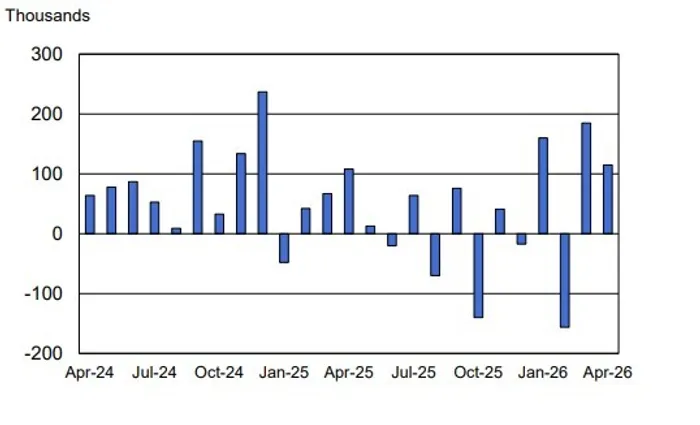
The unemployment rate held steady at 4.3%, suggesting the labor market remains stable even as hiring moderates. Economists say only modest payroll growth is now needed to maintain unemployment at current levels due to slower labor force growth.
Wage growth, however, showed signs of cooling. Average hourly earnings rose 0.2% for the month and 3.6% from a year earlier, both below expectations of 0.3% monthly growth and 3.8% annually. The softer wage data may ease some concerns at the Federal Reserve over persistent inflation pressures.
Job gains were concentrated in several key sectors. Health care added 37,000 positions, continuing its steady expansion led by nursing facilities and home health care services. Transportation and warehousing employment rose by 30,000, driven primarily by hiring in couriers and messengers, while retail trade added 22,000 jobs.
Social assistance employment also continued to trend higher, gaining 17,000 jobs during the month.
Meanwhile, federal government employment continued to contract, falling by 9,000 jobs in April. Since peaking in October 2024, federal payrolls have declined by 348,000 positions, or roughly 11.5%.
The information sector remained under pressure, losing 13,000 jobs, with declines across telecommunications, media production, and data-processing-related services. Employment in the sector has now fallen by 342,000 since late 2022.
Broader labor market indicators were largely stable. The labor force participation rate held at 61.8%, while the employment-population ratio remained at 59.1%.
However, some underlying signs of softness emerged. The number of workers employed part time for economic reasons rose by 445,000 to 4.9 million, indicating more workers are accepting reduced hours or struggling to find full-time positions.
The number of people unemployed for less than five weeks also climbed by 358,000 to 2.5 million, while long-term unemployment remained little changed at 1.8 million.
Across demographic groups, unemployment rates showed little movement. Adult men posted a 4.0% unemployment rate, adult women stood at 3.9%, while unemployment among Black workers remained elevated at 7.3%. The jobless rates for White, Asian, and Hispanic workers were 3.7%, 3.3%, and 5.0%, respectively.
Overall, the report reinforced the view that the U.S. labor market is cooling gradually rather than collapsing outright. While hiring momentum has slowed from earlier peaks, steady payroll gains and stable unemployment continue to support the broader economy, even as investors closely watch for signs of weakening demand and a potential shift in Federal Reserve policy.